 HYGO News
 Canada's Carney Flip-Flops: 'U.S. Absolutely Our Most Important Ally' After Saying Relationship 'Over'; Windsor Plant Closes
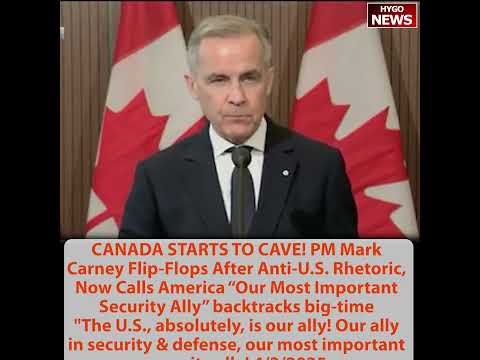
Canada’s Carney Flip-Flops: “U.S. Absolutely Our Most Important Ally” After Saying Relationship “Over”; Windsor Plant Closes
Canadian Prime Minister Mark Carney executed a dramatic reversal in April 2025, just days after declaring the U.S.-Canada relationship “over.” When confronted by a reporter asking whether the United States was still an ally, Carney’s tone shifted: “The U.S. is absolutely our ally. It’s our ally in security and defense partnerships. It’s our most important security ally.” Meanwhile, 3,600 auto workers at a Windsor, Ontario plant learned their facility was shutting down for at least two weeks due to the tariffs. Agriculture Secretary Brooke Rollins acknowledged “a short time of uncertainty” for farmers but defended Trump’s vision: “The new golden age of prosperity will move in.”
The Flip-Flop
The exchange that captured Canada’s reversal came from a single reporter’s question.
“You said previously that the relationship that Canada had with the United States is now over,” the reporter said. “Is the U.S. still our ally?”
Carney’s answer was immediate and emphatic: “The U.S. is absolutely our ally. It’s our ally in security and defense partnerships. It’s our most important security ally. For example, it’s still, even with these tariffs, the largest trading partner.”
The contrast with his earlier statement was stark. Just days before, Carney had declared from Ottawa that the “old relationship” with the United States was “over” — rhetoric that had played well domestically as a show of defiance against Trump’s tariffs. But the bravado had a shelf life. When asked directly whether the United States was still an ally, the reality of Canada’s strategic position forced a correction.
Canada’s dependence on the United States was not a matter of preference; it was a matter of geography, economics, and security. The U.S. was Canada’s largest trading partner by an enormous margin, its primary security guarantor through NORAD and NATO, and the only country that shared a land border spanning thousands of miles. Declaring the relationship “over” was a political gesture; maintaining the alliance was a strategic necessity.
”The Ambition Is Enormous”
Carney provided what amounted to a backhanded acknowledgment of Trump’s tariff strategy.
“Yesterday marked the latest in President Trump’s unprecedented series of U.S. tariffs that are designed to reshape the international trading system,” Carney said. “The ambition of these measures is enormous. The effects on the global economy will be monumental.”
The description — “unprecedented,” “enormous ambition,” “monumental effects” — was technically critical in tone but substantively accurate in content. Carney was acknowledging that Trump was doing something no previous president had attempted: fundamentally restructuring the global trading system. Whether one supported or opposed the tariffs, their scale and ambition were undeniable.
Carney noted a partial reprieve: “We received confirmation that the latest reciprocal tariffs will not be imposed on Canada.” The exemption from the April 2 reciprocal tariffs — while the auto tariffs remained in effect — suggested that the Trump administration was treating Canada differently from other countries, possibly in recognition of the ongoing bilateral negotiations.
“At the same time,” Carney continued, “President Trump confirmed that the tariffs announced last week against our auto industry will come in and indeed have come into effect today.”
Windsor: 3,600 Workers
Carney then described the real-world impact that made the tariff debate concrete.
“We are already seeing the consequences,” he said. “Just last evening, workers from Unifor Local 444, with whom I met last week, learned that their auto assembly plant in Windsor will be shutting down for at least the next two weeks.”
He quantified the human cost: “That’s 3,600 workers who are now out of work, not by their choice. Workers who now worry how they’re going to put food on the table and pay their bills.”
He pledged solidarity: “I and my government stand in solidarity with those workers in Windsor.”
The Windsor plant closure was exactly the kind of short-term disruption that the Trump administration had predicted and accepted as the cost of restructuring. The plant was closing because the 25% auto tariff made it economically irrational to continue manufacturing cars in Canada for export to the United States. The solution — from the administration’s perspective — was for the auto company to move production to the United States, where no tariffs applied.
The 3,600 Canadian workers losing their jobs were, in the administration’s framework, the inverse of the American auto workers who had lost their jobs over decades as production moved to Canada and Mexico. The tariffs were reversing the flow — and the jobs would follow.
Rollins: “A Short Time of Uncertainty”
Agriculture Secretary Brooke Rollins provided the American response to the global reaction.
She displayed a chart showing tariff rates by country: “This is the average — 14 percent. Well, down here you’ve got little bitty United States of America. This is what he’s trying to fix.”
Rollins acknowledged the disruption: “For our farmers and our ranchers, they understand that there may be a short time of uncertainty.”
But she defended the long-term vision: “For the long haul, as we restructure the American economy and the government, American economy and our private sector, with the government playing a role in that — President Trump’s vision of using tariffs.”
She addressed the market selloff directly when asked about financial markets “tanking”: “Well, listen, y’all. We are a couple hours in. The president announced this yesterday afternoon. We knew that there would be some of that as people are adjusting.”
Rollins predicted the trajectory: “But at the end of the day, yesterday marked step one. This will be a short time of uncertainty, and then we’ll move back to the prosperity that this president has envisioned, that he is so bold and so willing to fight for.”
She concluded with the administration’s signature optimism: “The new golden age of prosperity will move in. Again, for me, I’m really focused on our farmers and our ranchers, and that’s what we’ll continue to focus on. But it will reach every corner of America as we are restructuring.”
The chart showing the United States as the lowest-tariff major economy was the visual that made the reciprocal argument self-evident. When every other country charged higher tariffs than the United States, asking for equal treatment was not protectionism — it was fairness.
The Broader Pattern
Carney’s flip-flop was not an isolated event. It was part of a pattern that the Trump administration had predicted: initial defiance followed by accommodation. Countries that depended on access to the American market — which was virtually every country — would eventually calculate that negotiation was preferable to confrontation.
The sequence was: tariff announcement, outrage, threats, market disruption, and then quiet negotiation. Carney had compressed the first three stages into a single week, going from “the relationship is over” to “absolutely our most important security ally” in a matter of days. The Windsor plant closure and the exemption from additional reciprocal tariffs had apparently accelerated the Canadian timeline from defiance to deal-seeking.
Key Takeaways
- PM Carney reversed his “relationship is over” rhetoric: “The U.S. is absolutely our ally. Our most important security ally.”
- He acknowledged Trump’s tariffs as “unprecedented” with “enormous ambition” and “monumental effects on the global economy.”
- A Windsor, Ontario auto plant shut down for two weeks, putting 3,600 workers out of work — the tariffs’ immediate Canadian impact.
- Agriculture Secretary Rollins showed a chart of global tariff rates with the U.S. at the bottom: “This is what he’s trying to fix.”
- Rollins on the market drop: “We are a couple hours in. This will be a short time of uncertainty, then the new golden age of prosperity will move in.”