 HYGO News
 Big deal: zero $ payment but balance not grow for current & future borrowers; cut in half payments
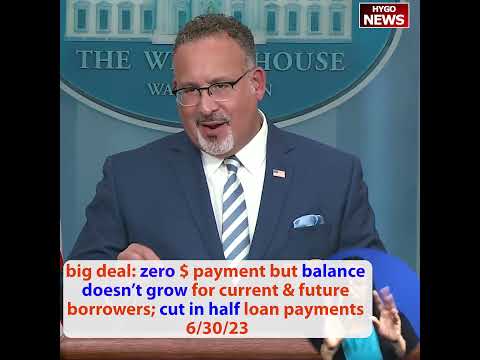
Big Deal: Zero Dollar Payment but Balance Does Not Grow for Current and Future Borrowers; Payments Cut in Half
On June 30, 2023, the same day the Supreme Court invalidated President Biden’s sweeping student loan forgiveness program in a 6-3 ruling, White House officials announced the administration’s Plan B: a new income-driven repayment plan called SAVE that would freeze balance growth for borrowers making reduced payments and slash undergraduate loan payments by half. This short clip captures the key moments from the White House press briefing where Deputy NEC Director Bharat Ramamurti and Education Secretary Miguel Cardona outlined the new program.
Balance Freeze: A Major Reform for Income-Based Repayment
One of the most significant features of the SAVE plan addressed a problem that had plagued income-driven repayment programs for years: negative amortization. Under previous plans, borrowers who qualified for lower monthly payments based on their income often saw their loan balances grow because the reduced payments did not cover accruing interest. The result was that borrowers could make payments for years and still owe more than they originally borrowed.
Ramamurti explained the reform directly: “By the way, one concern that people have had about the income-based repayment program in the past is that if you were making these smaller payments, your balance would keep growing over time. One of the reforms we’re putting in place is making sure that that balance doesn’t grow over time, even as you are making potentially a zero-dollar payment each month. It is a big deal for both current borrowers and for all the future borrowers who are out there.”
He added an important caveat: “Now, I want to be clear: That’s not a substitute for debt relief, but it is a huge benefit for borrowers that is going to be available coming this summer. And we encourage people to sign up for it.”
The distinction was significant. The administration was not claiming the SAVE plan replaced the $400 billion in forgiveness the Supreme Court had just struck down. Instead, it was positioning the plan as meaningful but narrower relief that could be implemented through regulatory authority without requiring congressional approval or surviving the same legal challenges.
Undergraduate Loan Payments Slashed by Half
Secretary of Education Miguel Cardona focused on the impact for undergraduate borrowers, who make up the largest share of federal student loan holders. He emphasized that the SAVE plan would make college more financially accessible for students deterred by the prospect of high monthly payments after graduation.
Cardona stated: “I want to make it very clear to the folks who are paying attention to this that maybe don’t know the details of it: The income-driven repayment plan that we talked about today, SAVE — we’re calling it ‘SAVE’ — will cut in half loan payments for undergraduate students. So think about the students that said, ‘I can’t go to college because I can’t afford the 600-, 700-dollar…’ — those are going to be cut in half.”
By cutting monthly payments from the range of $600 to $700 down to $300 to $350 for qualifying borrowers, the plan aimed to reduce the financial burden that caused many graduates to delay major life milestones such as buying homes, starting families, or saving for retirement.
Supreme Court Strikes Down Biden’s Loan Forgiveness 6-3
The backdrop for the SAVE plan announcement was the Supreme Court’s decisive rejection of Biden’s student loan forgiveness program. The Court ruled 6-3 in Biden v. Nebraska that the President had overstepped his authority in attempting to cancel student loan debt through executive action.
The timeline of the legal battle unfolded as follows: President Biden announced the forgiveness program in August 2022, offering up to $10,000 in debt cancellation for borrowers earning under $125,000 per year and up to $20,000 for Pell Grant recipients. The program would have affected over $400 billion in student loan debt. Six Republican state attorneys general challenged the program, arguing it violated the separation of powers. Separately, two borrowers who did not qualify for forgiveness filed suit in Department of Education v. Brown. The 8th U.S. Circuit Court of Appeals blocked the program in November 2022, and the Department of Justice’s request to lift that block was denied by the Supreme Court before the case was heard on its merits.
The 6-3 ruling, with Chief Justice John Roberts writing for the majority, found that the administration’s use of the HEROES Act of 2003 to justify mass debt cancellation exceeded the statute’s intended scope. The major questions doctrine, which requires clear congressional authorization for actions of vast economic and political significance, was central to the Court’s reasoning.
The SAVE Plan as Regulatory Alternative
The SAVE plan represented a fundamentally different legal strategy from the forgiveness program the Court struck down. Rather than attempting mass debt cancellation through emergency powers, the administration used its regulatory authority over the federal student loan program to restructure how income-driven repayment worked. This approach operated within the Department of Education’s existing authority to set the terms of federal loan repayment programs.
The shift from sweeping forgiveness to targeted repayment reform reflected the legal and political reality after the Supreme Court ruling. The administration could no longer promise outright cancellation, but it could make the existing repayment system significantly more affordable for millions of borrowers through administrative changes that did not require the same level of congressional authorization.
Key Takeaways
- The Supreme Court ruled 6-3 in Biden v. Nebraska on June 30, 2023, striking down the administration’s $400 billion student loan forgiveness program as an overreach of executive authority.
- On the same day, the White House announced the SAVE income-driven repayment plan as an alternative, featuring a balance freeze that prevents loan amounts from growing during periods of reduced or zero-dollar payments.
- Education Secretary Cardona said the SAVE plan would cut undergraduate loan payments in half, reducing monthly burdens from the $600-$700 range to roughly half that amount.
- The SAVE plan relied on the Department of Education’s regulatory authority rather than the emergency powers the Court had rejected, representing a fundamentally different legal strategy.
- The administration acknowledged the SAVE plan was not a substitute for broad debt relief but called it a major benefit for both current and future borrowers.