 HYGO News
 Biden Trip Failed? Spox Kirby Won't Say If U.S. Had 'Deal' With Saudi For More Oil Production
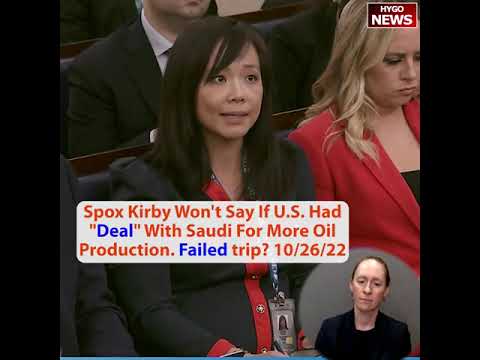
Reporter Asks Kirby Directly: “Did Saudi Arabia Ever Agree to Boost Oil Production?” — Kirby Won’t Answer, Says “I’m Just Going to Leave It There”
On 10/26/2022, a reporter asked NSC Coordinator John Kirby the central question about Biden’s July trip to Saudi Arabia: “Did Saudi Arabia ever agree that they would boost oil production?” Kirby’s response was a tortured non-answer that acknowledged “conversations” and “an architecture that could better balance supply and demand” but refused to confirm or deny whether an actual deal existed. When pressed, Kirby said “I think I’m just going to leave it there” — a refusal that spoke louder than any admission. The exchange came weeks after OPEC+‘s 2-million-barrel-per-day production cut had made the answer obvious: whatever Biden thought he had secured in Jeddah, the Saudis delivered the opposite.
”Did the U.S. Strike a Deal?”
The reporter cut through months of diplomatic ambiguity. “Over the summer, did the U.S. strike a deal with Saudi Arabia to boost oil production?” the reporter asked.
Kirby began with safe ground. “Look, we talked about it before the trip, that energy security was going to be something the president talked about when we went, that we were having conversations with Saudi Arabia before the trip about better balancing supply and demand,” Kirby said.
The use of “conversations,” “talked about,” and “better balancing supply and demand” was diplomatic language designed to sound substantive while committing to nothing. Conversations are not agreements. “Better balancing supply and demand” could mean anything from a binding production commitment to a polite exchange of views.
“What I would tell you is — I’ve seen the press reporting on this — there were discussions before the trip, obviously, about a better balance of supply and demand to stabilize the energy market. Of course there was, and we talked about that openly,” Kirby continued.
The phrase “of course there was” confirmed that oil production was the explicit agenda — which made the failure to secure a concrete commitment all the more damaging. Biden didn’t travel to Saudi Arabia for a cultural exchange. He went for oil.
”Did Those Conversations Culminate in a Concrete Deal?”
The reporter pressed for specificity. “Did those conversations ever culminate in a concrete deal with Saudi Arabia? Did Saudi Arabia ever agree that they would boost oil production?” the reporter asked.
This was the binary question the White House could not answer honestly. If Saudi Arabia had agreed and then reneged, Biden was diplomatically humiliated. If they never agreed, Biden’s trip was a failure from the start — he sacrificed his “pariah” principles for nothing. Either answer was devastating.
”I’m Just Going to Leave It There”
Kirby’s response was maximally evasive. “Again, I’m going to go back to what I said before. There were conversations before the trip, as you might imagine there would be, about an architecture that could better balance supply and demand, to include what was — what ended up as an increase in production at the end of the trip,” Kirby said.
“I think I’m just going to leave it there,” Kirby concluded.
The word “architecture” was doing extraordinary work. Architecture is a structure, a framework — not a commitment. It’s the kind of word diplomats use when they want to describe the existence of a conversation without confirming anything was agreed.
Kirby’s reference to “what ended up as an increase in production at the end of the trip” was a half-truth. OPEC+ modestly increased production quotas in August 2022, but the increase was already expected before Biden’s visit and fell far short of what the administration sought. More importantly, the modest August increase was completely reversed by the October 2-million-barrel-per-day cut.
”Not in Keeping With the Mathematical Analysis”
Kirby referenced KJP’s earlier talking point. “This recent decision by OPEC Plus to cut these two million barrels certainly is not — and Karine said this a gazillion times — it’s not in keeping with what we believe was the actual mathematical analysis of what needed to be done,” Kirby said.
The “mathematical analysis” argument claimed OPEC+‘s market data didn’t support a production cut, so the cut was politically motivated. But the argument undermined the administration’s own position: if the U.S. and OPEC+ disagreed on basic market analysis, the July trip hadn’t even produced agreement on fundamentals — let alone a deal on production levels.
The July Trip in Retrospect
Biden’s July 2022 visit to Jeddah was the most controversial foreign trip of his presidency. The president who had promised to make Saudi Arabia a “pariah” over the Khashoggi murder traveled to the kingdom and was photographed fist-bumping Crown Prince MBS — an image that became defining.
Biden justified the trip on energy security grounds. Gas prices had reached $5 per gallon, inflation was at 9.1%, and the administration needed Saudi cooperation. The political calculation was that lower gas prices outweighed the criticism of legitimizing MBS.
But the trip produced no binding commitments. Within months, OPEC+ — led by Saudi Arabia — implemented the production cut that reversed whatever marginal gains the trip had produced. Kirby’s exchange three months later confirmed the emptiness. When asked point-blank whether Saudi Arabia agreed to boost production, the answer was: “I’m just going to leave it there.”
The Diplomatic Leverage Problem
The exchange illustrated a fundamental problem with Biden’s energy diplomacy. By discouraging domestic oil production — lease moratoriums, pipeline cancellations, regulatory uncertainty, and rhetoric about ending fossil fuels — the administration increased American dependence on foreign supply decisions.
A United States maximizing domestic production would have approached OPEC+ from strength: “We can produce our own oil; your cooperation is helpful but not essential.” Instead, Biden approached Saudi Arabia from weakness: “We need your oil because we’ve discouraged our own industry from producing more.”
The Saudis understood this dynamic perfectly. A president who needs Saudi oil more than the Saudis need American goodwill has no leverage. The fist bump, the abandoned “pariah” rhetoric, and the fruitless trip were the predictable consequences of self-imposed energy dependence.
The Pattern of Non-Answers
Kirby’s “I’m just going to leave it there” joined a growing collection of White House non-answers on Saudi energy policy. KJP had said “I don’t have any calls to read out” when asked if swing-state Democrats wanted Biden to campaign. She had said “I’m not going to get into when” when asked about inflation relief timelines. Now Kirby was saying “I’m just going to leave it there” on whether the centerpiece of Biden’s Saudi trip had produced any result.
The pattern was consistent: when the truthful answer would confirm a failure, the White House preferred to say nothing. Silence was treated as a more manageable outcome than admission.
Key Takeaways
- A reporter asked directly whether Saudi Arabia “ever agreed to boost oil production” after Biden’s July trip; Kirby refused to answer.
- He described “conversations” about “an architecture” — diplomatic language confirming no concrete deal existed.
- OPEC+‘s 2-million-barrel-per-day cut in October reversed any modest production gains from the summer.
- Biden sacrificed his “pariah” stance and fist-bumped MBS without securing the energy cooperation that justified the trip.
- Kirby’s “I’m just going to leave it there” confirmed the diplomatic failure the White House couldn’t admit.
Transcript Highlights
The following is transcribed from the video audio (unverified — AI-generated from audio).
- Over the summer, did the U.S. strike a deal with Saudi Arabia to boost oil production?
- There were discussions before the trip about a better balance of supply and demand to stabilize the energy market.
- This decision by OPEC Plus to cut two million barrels is not in keeping with what we believe was the actual mathematical analysis.
- Did those conversations culminate in a concrete deal? Did Saudi Arabia ever agree to boost production?
- There were conversations about an architecture that could better balance supply and demand.
- I think I’m just going to leave it there.
Full transcript: 240 words transcribed via Whisper AI.