 HYGO News
 Biden Takes No Questions, Greets Disgraced Ambassador Garcetti in India, Applauds Tarmac Dancers
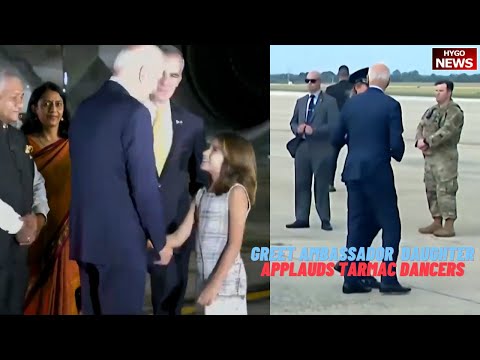
Biden Takes No Questions, Greets Disgraced Ambassador Garcetti in India, Applauds Tarmac Dancers
On September 8, 2023, President Joe Biden arrived in New Delhi, India for the G20 summit after departing Washington without taking any questions from reporters. The compilation of moments from that day captured a series of images that had become characteristic of the Biden presidency: the 80-year-old president using the short stairs to board Air Force One rather than the traditional tall staircase, greeting disgraced former Los Angeles Mayor and current Ambassador to India Eric Garcetti on the tarmac, applauding traditional dancers upon landing, and — as always — refusing to engage with the press. Meanwhile, back home, Education Secretary Miguel Cardona was admitting that taxpayers would foot the bill for the administration’s latest student loan relief effort, and Vice President Kamala Harris was dismissing relentless criticism of her competence as “not new.”
Biden Uses Short Stairs, Takes No Questions
One of the most enduring visual markers of the Biden presidency was the president’s shift from using the traditional tall staircase leading to Air Force One’s upper door to the shorter, sturdier stairs that fold out from the belly of the aircraft. Biden, who had stumbled multiple times on the tall stairs in high-profile incidents captured on camera, increasingly used the shorter set to minimize the risk of another public fall.
The short stairs served a dual purpose. They provided a safer ascent for the 80-year-old president, and they moved most of Biden’s climb into the aircraft out of public view. However, the very fact that the president of the United States needed to use an alternative staircase to avoid falling drew attention to the age and fitness concerns that were his greatest political liability heading into the 2024 campaign.
Before departing, Biden also performed a salute to Secret Service agents, a gesture that had drawn mixed commentary throughout his presidency. The salute was not standard for civilian presidents and appeared to some as an awkward imitation of the military greeting rather than the natural gesture it was when performed by commanders in chief with military backgrounds.
Greeting Eric Garcetti in India
Upon landing in New Delhi, Biden was greeted on the tarmac by Ambassador to India Eric Garcetti and his 12-year-old daughter. The warm greeting belied the controversy surrounding Garcetti’s appointment.
Garcetti, who served as mayor of Los Angeles from 2013 to 2022, had been dogged by allegations that he was aware of and tolerated sexual harassment by his longtime adviser Rick Jacobs. Multiple current and former staffers alleged that Jacobs engaged in a pattern of inappropriate behavior including unwanted touching and crude remarks, and that Garcetti witnessed some of these incidents firsthand. Garcetti denied knowledge of the harassment.
Biden nominated Garcetti as ambassador to India in July 2021, but the nomination was delayed for over a year and a half due to the harassment allegations. The Senate did not confirm Garcetti until March 2023, on a 52-42 vote, making his appointment one of the most contentious ambassadorial confirmations in recent memory. Several Democrats joined Republicans in opposing the nomination.
The spectacle of Biden warmly greeting an ambassador whose appointment had been clouded by sexual harassment allegations was noted by critics who argued the administration applied its professed standards of workplace conduct selectively. Biden had pledged on his first day in office to fire any staffer who treated a colleague with disrespect, yet he pushed through Garcetti’s nomination despite the serious allegations surrounding his office.
Applauding the Tarmac Dancers
After stepping off Air Force One, Biden watched and applauded a performance by traditional Indian dancers on the tarmac, a standard welcoming ceremony for visiting heads of state. The moment was brief and largely ceremonial, but it was folded into a compilation of the day’s events that collectively painted a picture of a president who had time for diplomatic pageantry in India but had still not visited East Palestine, Ohio, more than seven months after the catastrophic train derailment there.
The contrast was a recurring theme in criticism of Biden’s travel priorities. The president maintained an extensive international travel schedule that included trips to Europe, Asia, and the Middle East, while conspicuously avoiding domestic disaster sites and politically inconvenient locations. East Palestine, a working-class community in a deep-red state, continued to wait for a presidential visit that would not come until February 2025.
Reporters Blocked From Biden-Modi Meeting
National Security Adviser Jake Sullivan revealed aboard Air Force One that reporters would be blocked from attending Biden’s bilateral meeting with Indian Prime Minister Narendra Modi. Sullivan explained that the meeting would take place at the prime minister’s residence rather than his office, calling it “unusual in that respect.”
The decision to exclude the press from the bilateral meeting fit the administration’s broader pattern of limiting media access to Biden’s interactions with world leaders. While bilateral meetings sometimes had restricted press pools for security or diplomatic reasons, the frequency with which the Biden White House limited access raised questions about whether the restrictions were motivated by concerns about the president’s performance in unscripted settings.
Harris: Republican Attacks Are “Not New”
While Biden was traveling, Vice President Kamala Harris was fielding questions about the relentless criticism she faced from Republican presidential candidates who questioned her competence and used her as a foil to argue against Biden’s re-election.
The Republican attacks were pointed and personal. Nikki Haley declared that “a vote for Joe Biden is a vote for President Harris.” Chris Christie said, “I want to be clear that I pray every night for Joe Biden’s good health, not only because he’s our president, but because of who our vice president is.” Ron DeSantis called Harris “Biden’s impeachment insurance,” adding, “People know if she were president — as bad as Biden did, it would get worse.”
When asked how she responded to these attacks, Harris offered a dismissive answer: “Listen, this is not new. There’s nothing new about that.”
The vice president’s response reflected a strategy of declining to engage substantively with criticism of her performance. However, the attacks resonated because polls consistently showed Harris with historically low favorability ratings for a vice president. Her office had experienced significant staff turnover, and her public appearances frequently produced awkward moments that reinforced the narrative of a vice president who was out of her depth.
Education Secretary Admits Taxpayers Foot the Bill
In a separate but related clip from the same compilation, Education Secretary Miguel Cardona was pressed on who would pay for the administration’s latest student loan relief efforts. Cardona attempted to frame the cost within the context of deficit reduction: “As I said before, the deficit reduction is creating space for policies that open the door to access.”
When a reporter pressed directly — “That cost is federal government pays for, taxpayers?” — Cardona responded: “You can’t discuss what the costs are without talking about how the deficit has been reduced.”
The exchange was significant because it represented a rare admission from an administration official that taxpayers were ultimately bearing the cost of student loan forgiveness. The administration had generally avoided this framing, preferring to describe the relief as a benefit for borrowers without emphasizing that the forgiven debt represented revenue the government would never collect, a cost that would be borne by all taxpayers.
The reporter also noted that the federal budget deficit was “expected to balloon to $2 trillion for the fiscal year of 2023,” undermining Cardona’s argument that deficit reduction was creating space for new spending. The deficit was growing, not shrinking, making the claim that student loan relief was being funded by fiscal savings factually unsupportable.
Key Takeaways
- Biden departed for India without taking questions from reporters, used the short Air Force One stairs to avoid stumble risk, and performed his customary Secret Service salute before boarding.
- Biden warmly greeted Ambassador to India Eric Garcetti, the former LA mayor whose confirmation had been delayed over a year by sexual harassment allegations involving his adviser Rick Jacobs.
- Reporters were blocked from Biden’s bilateral meeting with Indian Prime Minister Modi, continuing a pattern of limiting press access to the president’s interactions with world leaders.
- Republican presidential candidates targeted Kamala Harris as a liability, with Haley calling a Biden vote “a vote for President Harris,” Christie invoking prayers for Biden’s health, and DeSantis calling Harris “Biden’s impeachment insurance.”
- Education Secretary Cardona admitted taxpayers would pay for student loan relief while claiming deficit reduction created “space” for the policy, a claim undermined by the deficit ballooning toward $2 trillion in FY2023.