 HYGO News
 Biden Spox John Kirby: There Are 'Areas Where We Believe There's Room For Cooperation With China'
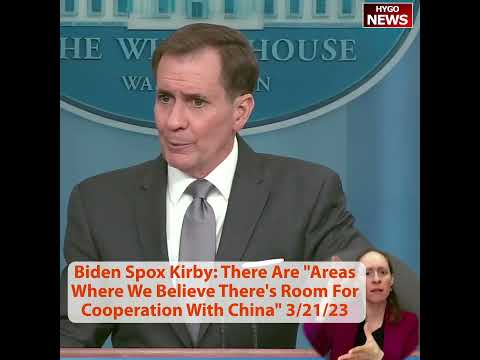
Biden Spox John Kirby: There Are “Areas Where We Believe There’s Room For Cooperation With China”
National Security Council spokesman John Kirby acknowledged during a March 2023 White House briefing that while the administration has “significant concerns” about China’s “coercive and aggressive behavior” — particularly in the South China Sea — there remain “areas where we believe there’s room for cooperation with China” that the Biden administration wants to pursue. The exchange came as the administration sought to balance escalating strategic competition with the need to maintain functional diplomatic channels with Beijing.
The Biden-Xi November Meeting
- Bali summit: Biden and Xi met face-to-face at the G20 summit in Bali, Indonesia in November 2022.
- Three-hour meeting: The bilateral discussion extended over three hours with senior advisors present.
- Rules-based order: Biden emphasized the importance of every country abiding by “international rules of the road.”
- Tension reduction: Both leaders expressed desire to stabilize the bilateral relationship.
- Working groups: The meeting established senior-level working groups for continued engagement.
The “Rules of the Road” Framework
- International institutions: The framework referenced United Nations, WTO, and other international institutions.
- Maritime law: UNCLOS (UN Convention on the Law of the Sea) forms key basis for maritime rules.
- Trade rules: World Trade Organization rules govern international commerce.
- Human rights: Universal Declaration of Human Rights framework covers rights norms.
- Sovereignty principles: Post-1945 international order emphasizes state sovereignty and territorial integrity.
South China Sea Concerns
- Nine-dash line: China claims roughly 90% of South China Sea under disputed historical claim.
- Island building: China has constructed artificial islands with military facilities in disputed waters.
- Freedom of navigation: U.S. conducts regular freedom of navigation operations to challenge excessive claims.
- Regional disputes: Vietnam, Philippines, Malaysia, Brunei, Taiwan all have competing territorial claims.
- 2016 tribunal: Permanent Court of Arbitration rejected most Chinese historical claims in Philippines case.
The Coercive Behavior Characterization
- Economic coercion: China has used trade measures against Australia, Lithuania, and other countries.
- Gray zone operations: Chinese activities below threshold of direct military confrontation.
- Maritime militia: Chinese fishing fleet sometimes operates as informal maritime force.
- Cyber activities: Chinese state-sponsored cyber operations target U.S. and allied systems.
- Technology restrictions: U.S. has imposed substantial technology export controls against China.
The Cooperation Areas
- Climate change: Global climate coordination requires U.S.-China cooperation.
- Global health: Pandemic prevention needs international coordination.
- Nuclear nonproliferation: North Korea, Iran nuclear programs require great-power coordination.
- Macroeconomic policy: G20 coordination requires U.S.-China dialogue.
- Space cooperation: Some areas of space activity benefit from coordinated approaches.
Communication Channel Importance
- Crisis management: Open channels prevent miscalculation during tensions.
- Balloon incident: February 2023 Chinese balloon incident disrupted planned Blinken visit.
- Defense communications: Military-to-military channels had been suspended by China over Taiwan tensions.
- Economic dialogue: Treasury and PBOC maintained limited ongoing contact.
- Ambassador levels: U.S. and Chinese ambassadors maintained regular embassy interactions.
The Blinken Visit Postponement
- Balloon disruption: Secretary of State Blinken’s planned February 2023 Beijing visit was postponed.
- Rescheduling challenges: The visit remained unscheduled at the time of this briefing.
- Diplomatic freeze: Higher-level engagement had frozen after the balloon incident.
- Working-level continued: Lower-level working groups continued functioning.
- Rebuilding process: Administration sought to rebuild higher-level engagement incrementally.
The Taiwan Dimension
- One China policy: U.S. maintains “one China” policy with Taiwan Relations Act commitments.
- McCarthy visit: House Speaker Kevin McCarthy’s anticipated Taiwan meeting would create diplomatic friction.
- Pelosi precedent: Previous Speaker Pelosi’s 2022 Taiwan visit triggered Chinese military exercises.
- Strategic ambiguity: U.S. maintains strategic ambiguity about defense of Taiwan.
- Arms sales: Continued arms sales to Taiwan form key component of U.S. support.
The Great Power Competition Framework
- National Security Strategy: Biden’s 2022 NSS identified China as the “pacing challenge” and only competitor with intent and capability to reshape international order.
- Democratic alliances: Administration emphasized strengthening democratic alliances as counter to Chinese influence.
- Technology competition: Semiconductor and AI competition formed central competitive dimensions.
- Economic decoupling: Selective decoupling on national security-relevant technologies.
- Indo-Pacific strategy: Sustained investment in Indo-Pacific alliances and partnerships.
Kirby’s Balanced Framing
- Two-track approach: The spokesman articulated parallel competition and cooperation tracks.
- Tensions acknowledgment: Kirby acknowledged current tensions while emphasizing cooperation possibilities.
- Administration strategy: The “managed competition” framework attempted to limit escalation risks.
- Presidential intent: Kirby noted Biden’s personal commitment to maintaining communication channels.
- Historical continuity: Approach built on prior administration efforts to manage rather than resolve U.S.-China tensions.
Key Takeaways
- Kirby acknowledged significant concerns about Chinese coercive behavior in areas like the South China Sea.
- The NSC spokesman emphasized that cooperation remained possible and desirable in specific areas.
- He stressed the importance of maintaining open communication channels particularly during periods of tension.
- The framing reflected Biden administration’s “managed competition” strategy toward China.
- The November 2022 Biden-Xi Bali meeting established the “rules of the road” framework being referenced.
- Administration continued seeking to balance competitive pressure with cooperation on global challenges.
Transcript Highlights
The following quotations are drawn from an AI-generated Whisper transcript of the briefing and should be considered unverified pending official transcript release.
- “There are other areas where we believe there’s room for cooperation with China, and we want to be able to pursue that, too.” — John Kirby
- “In some cases, we have significant concerns about China’s behavior, particularly their coercive and aggressive behavior, for instance, in the South China Sea.” — John Kirby
- “In order to do that, Peter, you’ve got to keep those lines of communication open.” — John Kirby
- “You’ve got to have that ability to talk, particularly when things are tense, like they are right now.” — John Kirby
- “In November, when President Biden met with Xi, he said, I want to make sure that every country abides by the international rules of the road.” — Reporter framing
- “Does he think China is abiding by the international rules of the road?” — Reporter question
Full transcript: 129 words transcribed via Whisper AI.