 HYGO News
 Biden Spox John Kirby: 'Not Gonna Get All Hot And Bothered' About Xi Calling Putin A 'Dear Friend'
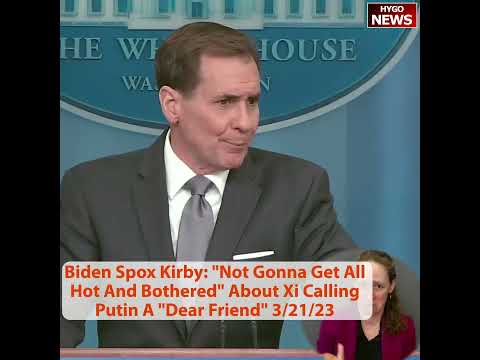
Biden Spox John Kirby: “Not Gonna Get All Hot And Bothered” About Xi Calling Putin A “Dear Friend”
National Security Council spokesman John Kirby brushed off questions during a March 2023 White House briefing about Russian President Vladimir Putin calling Chinese President Xi Jinping a “dear friend” during their Moscow summit, telling reporters the administration was “not overly exercised” about the language and would not “get all hot and bothered about the use of friends.” Kirby pointed to the two countries’ prior declaration of a “partnership without limits” as already having established their closeness — framing the “dear friend” moment as rhetorical continuity rather than new escalation.
The Moscow Summit Context
- State visit: Xi Jinping made a state visit to Moscow in March 2023, meeting directly with Putin.
- Timing significance: The visit came during the second year of Russia’s war in Ukraine.
- Peace plan framing: Xi brought a Chinese-proposed peace plan for discussion with Putin.
- Strategic messaging: The summit was designed to showcase Sino-Russian strategic partnership.
- Western concern: Western capitals watched the summit for signs of deepening strategic alignment.
The “Dear Friend” Language
- Putin’s characterization: Russian President Putin publicly referred to Xi as a “dear friend.”
- Chinese response: Xi reciprocated with similar warm language during the meetings.
- Diplomatic protocol: Such warm language exceeded typical diplomatic formality.
- Propaganda value: Russian state media heavily publicized the friendship framing.
- Symbolic weight: Diplomatic language often signals broader strategic posture.
Kirby’s “Not Exercised” Response
- Dismissive framing: Kirby characterized the language as unremarkable given prior declarations.
- “Partnership without limits”: He referenced the February 2022 joint declaration signed before Russia’s invasion.
- Rhetorical vs. material: The spokesman distinguished between rhetoric and material partnership.
- Low-key response: Administration avoided amplifying the friendship framing.
- Context framing: Kirby emphasized the relationship was already known before the summit.
The February 2022 Partnership
- Beijing summit: Xi and Putin met in Beijing during the Winter Olympics on February 4, 2022.
- Joint declaration: The two leaders signed a partnership “without limits” and “no forbidden areas.”
- Ukraine invasion timing: Russia invaded Ukraine weeks after the summit on February 24, 2022.
- Historical document: The declaration marked a notable strategic realignment.
- Western interpretation: Analysts read the declaration as signaling coordinated opposition to U.S. leadership.
The Putin War Criminal Designation
- ICC arrest warrant: The International Criminal Court issued an arrest warrant for Putin before the Moscow summit.
- Ukraine children: The warrant cited alleged unlawful deportation of Ukrainian children.
- U.S. position: Biden personally labeled Putin a “war criminal” after specific incidents.
- Administration stance: The U.S. supported ICC accountability mechanisms despite not being a Court member.
- Summit symbolism: Xi’s Moscow visit after the warrant issuance carried additional symbolic weight.
The “Useful Purposes” Framing
- Kirby’s analysis: The spokesman said the countries see in each other “useful purposes.”
- Strategic transaction: Framing emphasized transactional rather than ideological alignment.
- Common opposition: Both nations share opposition to U.S.-led international order.
- Growing closeness: Kirby acknowledged “two countries that are growing closer together.”
- Pushing agenda: Unfinished sentence captured in the transcript suggested coordinated anti-Western activity.
The China Peace Plan
- Twelve-point document: China released a 12-point peace plan before Xi’s Moscow visit.
- Vague principles: The plan contained general principles without specific implementation details.
- Cease-fire call: The document called for an immediate cease-fire.
- Territorial ambiguity: The plan avoided specific positions on Russian-occupied Ukrainian territory.
- Western reception: U.S. and European officials generally rejected the plan as favorable to Russia.
Western Strategic Concerns
- NATO coordination: NATO increased intelligence sharing regarding Chinese-Russian cooperation.
- Sanctions effectiveness: Deepening Sino-Russian trade threatened Western sanctions effectiveness.
- Military equipment: U.S. officials warned about potential Chinese weapons transfers to Russia.
- Economic support: Chinese purchases of Russian energy provided Moscow with sanctions relief.
- Diplomatic alignment: Coordinated diplomatic positions challenged U.S. global influence.
The Ukraine War Context
- Ground fighting: Intense fighting continued across eastern and southern Ukraine.
- Western aid: Substantial Western military aid continued flowing to Ukrainian forces.
- Russian losses: Russia continued suffering substantial military casualties and equipment losses.
- Economic pressure: Russian economy struggled under sustained Western sanctions.
- Endurance test: The war increasingly became a contest of Western vs. Russian endurance.
Biden Administration Strategy
- Alliance building: Administration focused on strengthening NATO and Asian alliances.
- Sanctions maintenance: Ongoing coordination to maintain sanctions regime against Russia.
- Military aid: Continued military assistance to Ukraine at unprecedented levels.
- Chinese engagement: Parallel effort to maintain dialogue with China despite Russian alignment.
- Rhetorical restraint: Kirby’s response reflected broader administration preference for measured rhetoric.
Key Takeaways
- Kirby dismissed concerns about Putin calling Xi a “dear friend” during their Moscow summit.
- The NSC spokesman said the administration was “not overly exercised” about the diplomatic language.
- He referenced the February 2022 “partnership without limits” declaration as establishing baseline closeness.
- Kirby characterized the relationship as transactional — two countries seeing “useful purposes for pushing” their agendas.
- The administration framed the rhetoric as continuity with established partnership rather than new escalation.
- Biden personally considered Putin a war criminal, creating pointed contrast with Xi’s “dear friend” framing.
Transcript Highlights
The following quotations are drawn from an AI-generated Whisper transcript of the briefing and should be considered unverified pending official transcript release.
- “I don’t think we’re overly exercised about that comment.” — John Kirby
- “It wasn’t that long ago, MJ, where they were talking about a relationship without limits, right, partnership without limits.” — John Kirby
- “So we’re not going to get all hot and bothered about the use of friends.” — John Kirby
- “These are two countries that are growing closer together — that see in each other useful purposes.” — John Kirby
- “The President considers Blackmere Putin to be a war criminal.” — Reporter framing
- “I’m just wondering what it means to President Biden that Putin calls President Tsing a friend.” — Reporter question
Full transcript: 99 words transcribed via Whisper AI.