 HYGO News
 Biden says it's 'a fact' his policies have reduced deficit: 'I spend a lot of money.. I cut deficit
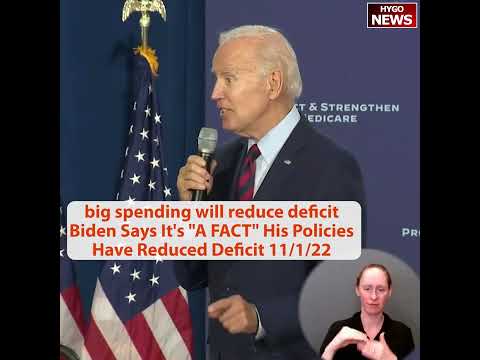
Biden Admits “I Spend a Lot of Money” Then Claims He “Cut the Deficit in Half” — Tells Audience to “Google It” as If the Claim Were Self-Evident
On 11/1/2022, President Biden traveled to Hallandale Beach, Florida — one week before the midterm elections — and delivered one of his most self-contradictory economic statements of the campaign. “They talk about ‘big spending Democrats.’ Yeah, I spent a lot of money to do these things,” Biden acknowledged. “But guess what? I cut the deficit in half. In half — the federal deficit.” He cited “$1 trillion, 400 — $400 billion dollars reducing the debt” and told the audience “that’s a fact — Google it.” The claim that Biden simultaneously spent lavishly and cut the deficit depended on the automatic expiration of pandemic-era emergency spending — not on any fiscal restraint or policy his administration implemented.
”I Spend a Lot of Money… I Cut the Deficit”
Biden opened with a remarkable admission followed by an equally remarkable claim. “Folks, many of us are focused on inflation right now. But let me say something — I want to point something out,” Biden said. “They talk about ‘big spending Democrats.’ Yeah, I spent a lot of money to do these things. But guess what? I cut the deficit in half.”
The two sentences — “I spent a lot of money” and “I cut the deficit in half” — appeared contradictory on their face. Spending a lot of money increases the deficit. Cutting the deficit requires spending less than you take in, or at least spending less than the previous year. Biden was claiming to have done both simultaneously.
The resolution to this apparent paradox was simple: Biden was taking credit for pandemic emergency spending expiring automatically. The federal deficit was approximately $3.1 trillion in FY2020 and $2.8 trillion in FY2021, inflated by trillions in one-time pandemic programs — stimulus checks, enhanced unemployment benefits, PPP loans, and emergency healthcare spending. These programs were designed to be temporary. When they expired — as they were always going to, regardless of who was president — the deficit fell.
Biden’s claim of “cutting” the deficit was like a homeowner claiming to have “reduced” their expenses after a one-time emergency repair bill naturally rolled off. The reduction was automatic, not achieved.
”$1 Trillion, 400 — $400 Billion”
Biden stumbled through the numbers. “This year alone, 1-trillion-400-dollar reduction — $400 billion dollars reducing the debt,” Biden said. “And last year, $350 billion reducing the debt.”
The verbal confusion between “1 trillion, 400” and “$400 billion” was characteristic of Biden’s difficulty with large numbers in extemporaneous speaking. The figure he was attempting to cite was the approximately $1.4 trillion reduction in the annual deficit from FY2021 to FY2022 — from roughly $2.8 trillion to $1.4 trillion.
Biden also appeared to confuse “deficit” with “debt.” The deficit is the annual gap between spending and revenue. The debt is the cumulative total of all deficits over time. Biden’s policies had reduced the annual deficit (primarily through automatic pandemic spending expiration) while the national debt continued to grow — surpassing $31 trillion during his presidency. He was not “reducing the debt” by any measure; the debt increased every year of his presidency.
”Google It”
Biden invoked his granddaughter’s advice to authenticate the claim. “That’s a fact. As my granddaughter used to say, ‘Google it.’ I’m serious. We cut the federal deficit in half while doing all this,” Biden said.
The “Google it” challenge was effective as a rhetorical device — it projected confidence that the claim would hold up under scrutiny. And indeed, Googling “deficit reduction 2022” would confirm that the annual deficit fell from FY2021 to FY2022. What Google wouldn’t immediately reveal was the context: that the decline was automatic, that Biden’s own spending legislation had offset much of the reduction, and that the deficit at its “reduced” level of $1.4 trillion was still historically elevated.
The appeal to “Google it” was a form of argument by citation — pointing to a data point that supported the headline claim while relying on the audience not to examine the underlying methodology. It worked in a rally setting where audiences cheered the claim without parsing the details.
What Biden’s Policies Actually Did to the Deficit
Biden’s major legislative achievements all increased the deficit rather than reducing it:
American Rescue Plan (March 2021): $1.9 trillion in new spending. CBO estimated it added approximately $1.9 trillion to the deficit over 10 years.
Infrastructure Investment and Jobs Act (November 2021): $1.2 trillion over multiple years. Partially offset by spending reallocations but still added to the deficit.
Inflation Reduction Act (August 2022): CBO projected net deficit reduction of approximately $238 billion over 10 years — but this was more than offset by other Biden actions.
Student Loan Forgiveness (August 2022): Estimated cost of $400 billion to $1 trillion depending on the analysis — far exceeding the IRA’s deficit savings.
When you added up Biden’s policy actions, the net impact was deficit-increasing, not deficit-decreasing. The annual deficit fell despite Biden’s policies, not because of them — a distinction the president consistently obscured.
”I’m So Sick of It”
Biden expressed frustration at the “big spending Democrats” label. “Give me a break. I’m so sick and — well, I shouldn’t get going. Come on, man,” Biden said, catching himself before what appeared to be a more heated outburst. “I mean, it’s just amazing.”
The frustration was understandable — Biden genuinely believed the deficit numbers vindicated his economic approach. But the frustration also revealed an inability or unwillingness to engage with the substantive criticism. The question was never whether the deficit fell (it did) but whether Biden deserved credit for the decline (he didn’t, since it was driven by automatic spending expiration) and whether his policies improved or worsened the fiscal outlook (they worsened it, by adding trillions in new spending and obligations).
“Come on, man” and “give me a break” were Biden’s standard dismissals when he didn’t want to engage with inconvenient facts. They conveyed impatience with the criticism without addressing its substance.
The Florida Midterm Context
Biden delivered the remarks in Hallandale Beach, Florida — a heavily Democratic area in Broward County — as part of his closing midterm argument. The Florida visit was designed to support Democratic candidates in competitive races and to energize the base around Social Security and Medicare, which Biden accused Republicans of wanting to cut.
The deficit reduction claim was central to Biden’s midterm economic pitch: Democrats could be big spenders and fiscal conservatives simultaneously. They had passed major legislation, helped American families, and reduced the deficit — all at once. The argument required audiences to accept the deficit decline as a Biden achievement rather than an automatic consequence of pandemic spending expiration, and most rally audiences were happy to oblige.
Key Takeaways
- Biden admitted “I spent a lot of money” then claimed “I cut the deficit in half” — two statements that appeared contradictory because the deficit decline was automatic, not caused by spending restraint.
- He stumbled between “1 trillion, 400” and “$400 billion,” confusing his own deficit figures, and appeared to confuse deficit reduction with debt reduction.
- The deficit fell because pandemic emergency programs expired automatically — Biden’s own legislation (ARP, infrastructure, student loans) increased the deficit.
- Biden told the audience to “Google it” — the headline number was accurate, but the context showed his policies worsened rather than improved the fiscal outlook.
- The national debt surpassed $31 trillion during Biden’s presidency and continued growing despite the deficit decline he celebrated.
Transcript Highlights
The following is transcribed from the video audio (unverified — AI-generated from audio).
- They talk about big spending Democrats. Yeah, I spent a lot of money to do these things. But guess what? I cut the deficit in half.
- This year alone, 1 trillion, 400-dollar reduction — $400 billion dollars reducing the debt. And last year, $350 billion.
- Give me a break. I’m so sick of it — I shouldn’t get going. Come on, man. It’s just amazing.
- That’s a fact. As my granddaughter used to say, Google it. I’m serious.
- We cut the federal deficit in half while doing all this.
- Many of us are focused on inflation right now. But let me say something.
Full transcript: 117 words transcribed via Whisper AI.