 HYGO News
 Biden Says He Would Welcome An Investigation Into His Questionable Response To Maui Wildfires
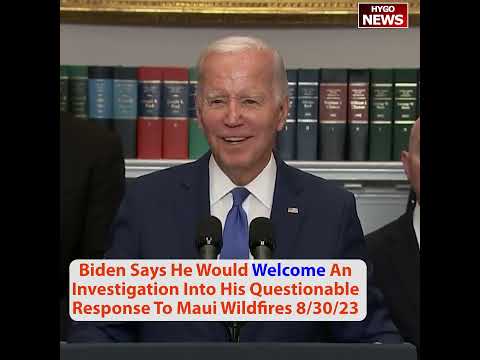
Biden Says He Would Welcome an Investigation Into His Questionable Response to Maui Wildfires
On August 30, 2023, President Joe Biden delivered remarks on his administration’s response to the Maui wildfires and Hurricane Idalia. When a reporter asked about House Republicans planning an investigation into the federal response in Maui, Biden said he would welcome it, though he appeared to misspeak, saying “I welcome a federal response in Maui” rather than “a federal investigation.” Biden then turned the exchange into a challenge aimed at Republicans, suggesting they would provide funding once they saw the devastation firsthand.
Biden arrived an hour late to his own remarks, and the event was widely criticized for the president spending excessive time talking about himself rather than focusing on the victims and the recovery effort. The appearance came after more than a week of Biden facing sharp criticism for his handling of the deadliest wildfire in modern American history while spending time on vacation.
The Exchange on the Investigation
A reporter directly raised the prospect of congressional scrutiny: “What is your reaction to House Republicans who stated they’re researching an investigation into the federal response in Maui?”
Biden’s response was notable both for what he said and what he appeared to mean: “Well, I welcome a federal response in Maui. I think that they should go out and talk to every elected official, from the mayors, to the governors, to the United States senators, to the congresspersons. I welcome them. Once they go out and see it, then I’m sure they’ll provide the money.”
The response contained two revealing elements. First, Biden’s apparent verbal slip, saying he welcomed “a federal response” when he presumably meant to say he welcomed “an investigation into the federal response,” raised further questions about his verbal precision. Second, Biden immediately pivoted the discussion from accountability for his administration’s response to a challenge about Republican spending, attempting to transform a question about his failures into an attack on his political opponents.
This rhetorical maneuver was a familiar Biden technique: when confronted with criticism of his own performance, redirect the conversation to what Republicans should be doing. The approach allowed him to appear confident and welcoming of scrutiny while actually deflecting from the substance of the criticism.
Biden’s Vacation During the Maui Crisis
The investigation question came against the backdrop of Biden’s widely criticized behavior during the Maui wildfire crisis. The timeline of events painted a damning picture of presidential disengagement.
The Maui wildfires broke out on August 8, 2023, ultimately devastating the historic town of Lahaina and killing over 100 people. In the immediate aftermath, Biden was vacationing at his beach house in Rehoboth Beach, Delaware. When reporters shouted questions to Biden about the rising death toll in Maui, the president responded with a now-infamous “no comment” while lounging on the beach, an image that became one of the defining visuals of his presidency’s disconnect from the concerns of ordinary Americans.
Biden continued his Delaware vacation for several more days before departing for another vacation at a luxury villa on the shores of Lake Tahoe, Nevada. The Lake Tahoe trip drew additional criticism as images of Biden relaxing at an opulent lakeside property were juxtaposed with footage of Maui residents sifting through the ashes of their destroyed homes and community.
Biden did not visit Maui until August 21, nearly two weeks after the fires began. His visit lasted only a few hours, during which he made the tone-deaf comparison of the Lahaina disaster to a small kitchen fire at his own Delaware home, a remark that infuriated survivors and their families.
The $700 Payment Backlash
Central to the criticism of Biden’s Maui response was the FEMA Critical Needs Assistance payment of just $700 per household. While FEMA officials explained that additional assistance was available through other programs with a maximum cap of $41,000, the $700 figure became a symbol of the federal government’s inadequate response.
The amount was particularly striking given the cost of living in Hawaii, one of the most expensive states in the country. The median home price in Lahaina before the fires was well over $1 million. Rent for even a modest apartment in Maui regularly exceeded $2,000 per month. The idea that families who had lost everything, their homes, their possessions, and in many cases their loved ones, would receive a one-time payment of $700 struck most Americans as insulting.
The contrast with the administration’s spending priorities amplified the outrage. At the time of the Maui disaster, the Biden administration had sent over $75 billion in aid to Ukraine and was continuing to request additional funding from Congress. The perception that the government was more generous with foreign aid than with assistance to American citizens dealing with a catastrophic disaster became a potent political liability.
House Republicans’ Investigation Plans
House Republicans had signaled their intent to investigate the federal response to the Maui wildfires, joining a growing chorus of voices demanding accountability for the failures at every level of government.
The investigation would potentially examine several areas of concern, including the timeliness of FEMA’s deployment to Maui, the adequacy of the $700 Critical Needs Assistance payment, the coordination between federal, state, and local agencies, and the decision-making process within the Biden administration regarding the president’s engagement with the crisis.
Biden’s dismissive response to the investigation plans, pivoting immediately to a challenge about Republican spending, suggested that the White House was more concerned about political optics than about genuine accountability. His suggestion that Republicans would “provide the money” once they saw the devastation implied that the only barrier to adequate relief was congressional spending, rather than the executive branch failures that had characterized the response from the beginning.
The Broader Pattern of Crisis Response
Biden’s handling of the Maui wildfires fit a broader pattern of crisis response under his administration that critics characterized as slow, inadequate, and tone-deaf.
The president had faced similar criticism for his response to the toxic train derailment in East Palestine, Ohio in February 2023. In that case, Biden did not visit the affected community for over a year, while former President Trump had visited within weeks of the disaster. The pattern of prioritizing vacation time and political events over disaster response fed a narrative that Biden was disengaged from the concerns of everyday Americans.
The August 30 press event, arriving an hour late and spending significant time on personal anecdotes, did little to counter this perception. For many observers, the event reinforced rather than addressed the criticisms of Biden’s Maui response, providing another example of a president who seemed unable to rise to the moment during a national tragedy.
Additional Context
The Maui wildfires would remain a political issue well into 2024, as the recovery process was plagued by bureaucratic delays, insurance disputes, and ongoing questions about accountability. Many Lahaina residents remained displaced months after the fires, and the rebuilding process was hampered by regulatory hurdles and the high cost of construction in Hawaii.
Biden’s “I welcome a federal response in Maui” comment, whether a genuine verbal stumble or a Freudian slip, took on an ironic quality as the federal response continued to be criticized for its inadequacy. The investigation Biden said he welcomed would indeed proceed, adding to the growing list of congressional inquiries that shadowed the final years of his presidency.
Key Takeaways
- Biden said he welcomed an investigation into the Maui wildfire response, though he appeared to misspeak by saying “I welcome a federal response in Maui” and immediately pivoted to challenging Republicans on spending.
- Biden arrived an hour late to his own remarks about the Maui wildfires and Hurricane Idalia, and was criticized for spending too much time talking about himself during the event.
- The president had spent the weeks following the disaster vacationing in Delaware and at a luxury Lake Tahoe villa, responding “no comment” when first asked about the rising death toll while at the beach.
- FEMA’s $700 one-time payment to Maui wildfire victims had become a symbol of the administration’s inadequate response, particularly given Hawaii’s extreme cost of living.
- Biden’s handling of the Maui crisis fit a broader pattern of slow disaster response that became a significant political liability throughout his presidency.