 HYGO News
 Biden: sanctions Russia prices increase $0.03 a gallon, other pardons, meta end fact checking
Biden: sanctions Russia prices increase $0.03 a gallon, other pardons, meta end fact checking
In one of his final press interactions before leaving office in January 2025, President Biden addressed his last-minute sanctions on Russia, acknowledged they could raise gas prices by three to four cents per gallon, gave evasive answers about additional pardons he was considering, and called Meta’s decision to end fact-checking on Facebook “shameful” and “contrary to everything America is about.”
Russia Sanctions and Gas Prices
Reuters correspondent Jeff Mason pressed Biden on the timing and potential economic impact of new sanctions imposed on Russia. Mason asked whether Biden was concerned that the sanctions might lead to higher gas prices, and why they were imposed in the final days of his presidency rather than earlier in his term.
Biden defended the timing by emphasizing the sanctions’ strategic impact. “The sanctions are imposed today because they will have profound effect on the growth of the Russian economy and make it more difficult for Putin to conduct his wars,” Biden said. He acknowledged the potential for a modest increase in energy costs: “It is probable that gas prices could increase as much as $0.03, $0.04 a gallon.”
Biden then attempted to frame the cost as worthwhile. “But what’s going to have a more profound impact on Russia’s ability to continue to act in the way it’s acting in a conduct of war,” he said, leaving the sentence somewhat incomplete but clearly arguing that the strategic benefit outweighed the minor price increase.
The timing question was notable. Critics had long argued that the Biden administration could have imposed tougher sanctions on Russia much earlier in the conflict, potentially limiting Russia’s ability to finance its war in Ukraine. Imposing major new sanctions in the final ten days of his presidency, with an incoming administration that had signaled a different approach to the Russia-Ukraine conflict, raised questions about whether the move was designed more to constrain Trump’s options than to achieve a strategic objective.
The three-to-four-cent estimate for gas price increases was also scrutinized. While the amount seemed modest, it came on top of the significant energy price increases that had occurred throughout Biden’s term, making even small additional increases politically sensitive.
Evasive Answers on Additional Pardons
Mason followed up by asking Biden for details about what additional pardons and commutations he was considering in his final ten days in office. Biden’s response was notably evasive and suggested the pardon decisions were being influenced by Trump’s statements.
“Well, the answer is no, because two things,” Biden began. “One is that — it depends on some of the language and expectations that Trump broadcast in the last couple of days here as to what he’s going to do.” Biden then specifically referenced Trump’s rhetoric about accountability: “The idea that he would punish people for not adhering to what he thinks should be policy as related to his well-being, is outrageous.”
Biden concluded by acknowledging that “there’s still consideration of some folks” but added “nothing — but no decision.” The exchange revealed that Biden’s pardon strategy was at least partially reactive to Trump’s public statements — that is, Biden was considering preemptive pardons for individuals he believed Trump might target for prosecution, a use of the pardon power that critics described as unprecedented in scope and intent.
The admission that pardon decisions were being calibrated to Trump’s rhetoric was significant. It confirmed that the outgoing administration was using its final days to potentially shield political allies from the incoming administration, a practice that, regardless of its legality, represented a major departure from the traditional transition norms between administrations.
Biden Calls Meta’s Fact-Checking Decision “Shameful”
The most passionate exchange came when AFP correspondent Aurelia End asked Biden to comment on Meta’s decision to end its third-party fact-checking operations in the United States. Biden’s response was lengthy, emotional, and at times rambling.
“The whole idea of walking away from fact-checking as well as not reporting anything having to do with discrimination regarding the TPS, I find to be just contrary to American justice — American — the way we talk about one another,” Biden said. “Telling the truth matters.”
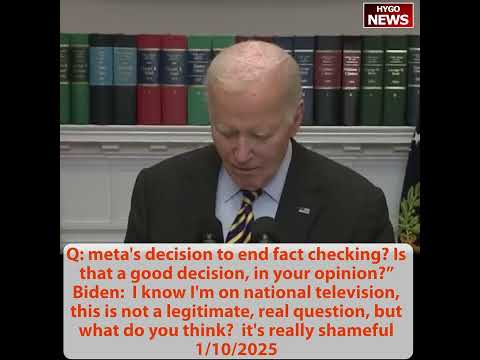
Biden then broke with typical presidential protocol by directly appealing to the reporters in the room. “I know I’m on national television, but you all are local reporters and national reporters,” he said. “This is not a legitimate, real question, but what do you think? Do you think it doesn’t matter that they let it be printed or millions of people read it, things that are simply not true?”
The moment was unusual — a president asking journalists for their personal opinions during a press availability — and reflected Biden’s evident frustration with Meta’s decision. He continued with a broader critique: “It’s just completely contrary to everything America is about. We want to tell the truth. We haven’t always done it as a nation. We want to tell the truth.”
Biden then appeared to reference Mark Zuckerberg directly, though without naming him. “The idea that, you know, a billionaire can buy something and say, by the way, from this point on, we’re not going to fact-check anything,” Biden said. “And, you know, when you have millions of people reading, going online, reading this stuff, it is — anyway, I think it’s really shameful.”
The response was notable for several reasons. Meta’s decision to end fact-checking had been widely interpreted as a pivot toward the incoming Trump administration, with Zuckerberg framing the change as a move toward “free expression” after years of content moderation that had drawn accusations of censorship from conservatives. Biden’s characterization of the decision as “shameful” stood in contrast to his press secretary’s refusal to comment specifically on the move during the previous day’s briefing.
The Broader Context
Biden’s final press interactions painted a picture of a president attempting to shape both policy and perception in his last days in office. The Russia sanctions represented a last-minute foreign policy move that would constrain his successor’s options. The pardon considerations reflected an effort to protect allies from potential prosecution. And the Meta criticism represented a final defense of the content moderation regime that the Biden administration had actively encouraged throughout its tenure.
Each of these positions was defensible on its own terms, but taken together, they suggested an outgoing administration more focused on limiting the incoming administration’s freedom of action than on achieving its own policy goals. The timing of the Russia sanctions, the reactive nature of the pardon strategy, and the public criticism of a social media company that was clearly repositioning itself for the Trump era all pointed to an administration that had not fully come to terms with its loss of power.
Key Takeaways
- Biden acknowledged that new Russia sanctions could raise gas prices by $0.03 to $0.04 per gallon but argued the strategic impact on Russia’s war-making ability justified the cost.
- When asked about additional pardons, Biden admitted the decisions depended on Trump’s rhetoric about what he planned to do, confirming that preemptive pardons were being considered.
- Biden called Meta’s decision to end fact-checking “shameful” and “completely contrary to everything America is about,” breaking with his press secretary’s refusal to comment the previous day.
- Biden asked reporters directly: “Do you think it doesn’t matter that they let millions of people read things that are simply not true?” — an unusual departure from presidential press protocol.