 HYGO News
 Biden: Republican closed one path buying 1st home, Now we're going to pursue another (hope for vote)
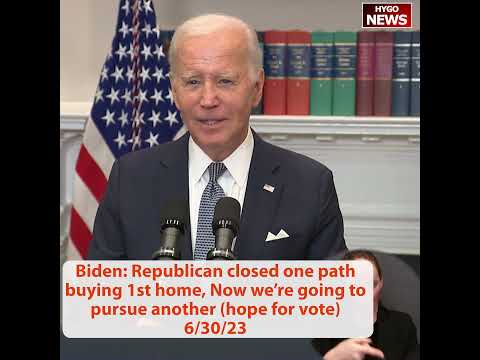
Biden After Court Strikes Down Student Loans: “Today’s Decision Has Closed One Path. Now We’re Going to Pursue Another”
On June 30, 2023, after the Supreme Court struck down his $400 billion student loan forgiveness program, President Biden delivered a defiant closing statement in which he mocked Republicans, cast student loan borrowers as victims of a conservative agenda, and promised to find an alternative path to debt relief. Biden framed the Court’s ruling not as a constitutional correction but as Republicans “closing one path” for young Americans trying to buy their first homes. The speech was widely viewed as laying the groundwork for further attempts to use executive authority to cancel student debt, keeping the promise alive as a political tool heading into the 2024 election cycle.
Biden Mocks Republican “Concern for the Privileged”
Biden opened his closing remarks by taking aim at Republicans who had characterized student loan relief as a handout to the privileged. He said: “Let me close with this. Our Republican officials say, ‘Student loan relief is a giveaway to the privileged.’ You hear that loud now: ‘the privileged.’ I love the concern for the privileged.”
The sarcasm was directed at a common conservative criticism of the forgiveness program: that many student loan borrowers were college-educated professionals with higher earning potential than Americans who had not attended college, and that canceling their debts amounted to a transfer of wealth from taxpayers to a relatively privileged class. Biden dismissed this argument with mockery rather than engaging its substance.
Biden then presented his own characterization of student loan borrowers: “But I know who student loan borrowers are in this country. They’re young, putting off buying their first home until they can get out from under their student loans.”
The framing was deliberate. By linking student debt to homeownership, Biden connected the loan forgiveness program to the broader American Dream narrative. The message to younger voters was clear: the student loan program would have helped them buy homes, and it was Republicans and the Court that had taken that opportunity away.
”Today’s Court Decision Snatches It Away”
Biden then shifted to a more emotional tone, acknowledging the disappointment of borrowers who had been counting on the relief: “Hope on the horizon thanks to the relief that I planned last year — today’s Court decision snatches it away from them. I get it. I get it. I hear this. It’s — it’s — and I’m concerned about it.”
The language was carefully constructed. Biden described the situation as hope being “snatched away,” placing the blame on the Court and, by extension, the Republican attorneys general who had brought the legal challenge. He did not acknowledge that the program had been struck down because it exceeded presidential authority under the Constitution, nor did he address the fact that prominent Democrats, including former House Speaker Nancy Pelosi, had previously warned that the President lacked the power to cancel student debt unilaterally.
The repeated “I get it” was notable for its informality and its suggestion of personal empathy. Biden was positioning himself not as a President whose legal strategy had failed but as a leader who shared the frustration of those affected by a ruling he portrayed as unjust.
”Now We’re Going to Pursue Another”
The most significant line in Biden’s statement was the promise to find an alternative route: “But today’s decision has closed one path. Now we’re going to pursue another.”
This was not merely a consolation message. It was a signal that the administration intended to continue seeking ways to cancel student debt through executive action, despite the Court having just ruled that the previous attempt was unlawful. The vow to “pursue another” path kept alive the political promise that had motivated the original program and signaled to younger voters that Biden would continue fighting for debt relief.
Critics saw the statement as confirmation that the original program had always been more about political strategy than sound governance. By immediately pivoting to a promise of future action, Biden appeared to be following the same playbook: make a promise of debt relief to energize voters, and if it fails legally, promise to try again. The cycle ensured that student loan forgiveness remained a campaign issue regardless of whether it could actually be delivered constitutionally.
The Supreme Court’s Decision
The Supreme Court had ruled 6-3 in Biden v. Nebraska that Biden’s student loan forgiveness program was unlawful. The program, announced in August 2022, would have canceled up to $10,000 in federal student loan debt for borrowers earning $125,000 or less and up to $20,000 for Pell Grant recipients. The total cost was estimated at over $400 billion.
Six Republican state attorneys general had challenged the program on the grounds that it violated the separation of powers. The administration had relied on the HEROES Act of 2003 to justify the blanket cancellation, but the Court found that the statute’s authorization to “waive or modify” student loan provisions during national emergencies did not extend to a program of this magnitude. The 8th U.S. Circuit Court of Appeals had blocked the program in November 2022, and the Supreme Court ultimately affirmed that Biden had overstepped his constitutional authority.
The Political Context
Biden’s closing statement was part of a broader pattern in which the administration treated student loan forgiveness primarily as a political tool. The program had been announced in August 2022, just months before the midterm elections, in a transparent effort to drive turnout among Gen Z and Millennial voters who were burdened by student debt. The timing suggested that the political benefits of the announcement were considered more important than the legal risks of pursuing executive action that might not survive judicial review.
By the time the Supreme Court struck down the program, the midterm elections were long over. But the promise of future action — “we’re going to pursue another” path — served the same political function for the upcoming 2024 presidential campaign. The message was aimed squarely at young voters who Biden needed to retain in his coalition: the fight was not over, and he would keep trying to deliver on the promise of debt relief.
The administration did subsequently pursue alternative approaches, including using the Higher Education Act to propose new income-driven repayment rules and targeted forgiveness for specific categories of borrowers. However, these efforts also faced legal challenges and fell far short of the sweeping $400 billion program that the Court had struck down.
Key Takeaways
- After the Supreme Court struck down his student loan program, Biden mocked Republican criticism that the relief was a “giveaway to the privileged” and framed borrowers as young Americans unable to buy their first homes.
- Biden said the Court’s ruling had “snatched away” hope from borrowers and immediately promised to “pursue another” path to debt relief, signaling continued executive action.
- The statement was viewed as a political maneuver aimed at retaining younger voters by keeping the promise of student debt forgiveness alive heading into the 2024 election cycle.
- The Supreme Court had ruled 6-3 in Biden v. Nebraska that the $400 billion program exceeded presidential authority under the HEROES Act.
- Biden did not address the constitutional basis of the ruling or acknowledge that members of his own party had previously doubted his legal authority to cancel student debt.