 HYGO News
 Biden repeated 'seat' joke, Biden is so slow
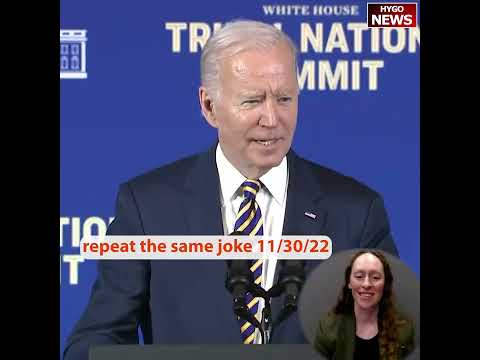
Biden Recycles Same Self-Deprecating Joke Again: “Biden Is So Slow, He Doesn’t Realize There Are No Seats Out Here”
At a late 2022 event, President Biden opened his remarks with a familiar self-deprecating joke about telling audiences to “take a seat” when there were no chairs present. “I don’t know if I have any seats, but if you have a seat, please take them. I once said that when I first became president. They said Biden is so slow, he doesn’t realize there are no seats out here. Anyway, please take a seat if you have one. I say that because one day I said take a seat and everybody said he doesn’t even understand there’s no chairs out here.” The retelling — essentially repeating the same observation twice in different phrasings within a short opening — became notable for its self-referential recognition that his audience might think him confused while simultaneously confirming the very pattern he was trying to defuse through humor.
The Familiar “Seats” Joke
Biden had used the “take a seat” observation as an opening joke on multiple occasions during his presidency. The underlying anecdote was that early in his presidency, he had told an outdoor audience to “take a seat” when there were no chairs available. Observers had joked that this showed his confusion about his surroundings.
Biden had apparently decided to preemptively address this criticism by acknowledging it himself. His defensive joke framework was:
I know you think I’m confused — Acknowledging the observation.
Let me make a joke about it — Trying to defuse through humor.
Here’s the context — Establishing that he’s aware of the pattern.
Continue with substantive content — Moving on after the deflection.
The joke served as a preemptive shield. By raising the criticism himself in joking form, Biden could address it before anyone else pointed to the pattern. This was a common technique for political figures dealing with persistent observations about their behavior.
The Repetition Problem
The striking feature of this specific delivery was the repetition. Biden essentially told the same story twice:
First telling — “I once said that when I first became president. They said Biden is so slow, he doesn’t realize there are no seats out here.”
Second telling — “I say that because one day I said take a seat and everybody said he doesn’t even understand there’s no chairs out here.”
Both tellings conveyed the same story with the same punchline. The second telling added no new information — it just restated what Biden had already said.
This repetition was itself a form of the same phenomenon the joke was trying to address. If the original “take a seat” comment had shown confusion about surroundings, repeating the explanation of that joke twice in short succession showed:
Confusion about what had been said — Not remembering he had just told the story.
Difficulty with narrative management — Losing track of sequence.
Verbal repetition patterns — Characteristic of various age-related issues.
Failure of the joke’s purpose — The joke was supposed to defuse concerns, not demonstrate them.
The Self-Awareness Paradox
Biden’s telling included an unusual element of self-awareness. He was essentially saying “I know people think I’m slow” as part of a joke that simultaneously demonstrated slowness through its repetition.
This created a paradox:
Aware — Biden showed awareness of the criticism.
Addressing it — Making a joke about it.
Confirming it — Through the mechanism of the joke itself.
Not noticing — The immediate confirmation through repetition.
The paradox was that full awareness would have led Biden to realize the repetition was happening and to stop it. But the repetition happened anyway, suggesting that his awareness of the general pattern didn’t translate into awareness of the specific instance.
The Age Question in 2022 Context
By late 2022, Biden’s age had become a significant political issue. He was 80 years old — the oldest sitting president in American history. Questions about his capacity for a second term were increasing. Various gaffes, verbal stumbles, and confused moments were being documented and compared to earlier periods of his public life.
The “take a seat” joke was one of many moments that generated this discussion. Other examples included:
Seeking Rep. Jackie Walorski — Asking if she was present at an event several months after her death in a car accident.
Walking off stages without apparent direction — Various moments where he seemed uncertain where to go.
Shaking hands with empty air — Several incidents where he appeared to greet people who weren’t there.
Confused references to current events — Various moments of apparent factual errors.
Repetition of stories — Similar to the “take a seat” joke repetition.
Each individual incident could be explained as minor mistake. But the pattern, as it accumulated, raised broader questions about cognitive capacity.
The Political Framing
The administration’s response to these moments had been consistent:
Humanizing — Treating moments as normal age-related experiences.
Dismissive — Not treating them as significant.
Counter-narrative — Emphasizing Biden’s sharp moments.
Pushback on coverage — Arguing media focused excessively on stumbles.
Watch me framing — Biden’s own response to concerns.
The administration wanted to prevent the age narrative from taking hold. Each time a moment like the “take a seat” repetition occurred, it complicated this effort. The administration couldn’t directly address the specific moments without drawing more attention to them.
The Joke’s Origin
The original “take a seat” moment had apparently occurred early in Biden’s presidency. The specific incident had involved Biden telling an outdoor audience to sit when no seats were available. This was a minor moment in itself — the kind of verbal stumble any speaker might make in a long career of public appearances.
What made it notable was that it became a recurring reference point for Biden himself. He would return to it in later speeches, apparently finding it useful as a self-deprecating opener. The fact that he returned to it repeatedly suggested:
Comfort with the joke — He felt it worked well.
Familiarity — The story felt safe to tell.
Muscle memory — The telling had become automatic.
Pattern reinforcement — The repeated telling reinforced both the original and current usage.
The Repetition Within the Joke
The most striking feature of this specific delivery was the repetition within the joke itself. Biden told the story, finished it, and then told essentially the same story again. This pattern was:
Unusual for planned remarks — Normal speech writing would have avoided repetition.
Consistent with ad-libbing — Improvised speech can include such patterns.
Age-characteristic — Repetition of recent content is often associated with aging.
Structurally odd — The second telling served no narrative purpose.
Observers noting this pattern could reasonably conclude that Biden had lost track of what he had just said in the moment. This was precisely the kind of observation the joke was intended to preempt.
The Climate Content
After the joke sequence, Biden apparently moved to the substantive content of his remarks. “It’s a peaceful night knowing those dams have been clean energy development and do it quickly. That includes the federal aid by super storms, rising sea levels and wild,” the transcript continued.
The transcription here is somewhat garbled — “peaceful night” may be a mishearing of something else. The topic appears to have been climate and infrastructure issues, involving dams, clean energy, federal aid for storms, sea level rise, and presumably wildfires.
The substantive content of Biden’s remarks had political importance on these issues. The administration had been working on infrastructure, clean energy, and climate adaptation. But the opening “seats” joke had consumed time and attention that could have gone to the substantive content.
The Media Coverage Pattern
Moments like the “take a seat” repetition followed predictable media coverage patterns:
Conservative media — Covered the moment extensively as evidence of decline.
Liberal media — Either ignored the moment or characterized it as a joke.
Mainstream media — Gave it modest coverage, often with balanced framing.
Social media — Generated viral clips both defending and criticizing.
Political opponents — Used clips in political communications.
The polarized coverage meant that different audiences saw different things. For some, the moment was obvious cognitive decline. For others, it was an endearing self-deprecating joke. For still others, it was just a minor moment not worth extended attention.
The Biden Communication Style
Biden’s communication style had long included features that could be mistaken for confusion:
Stories with digressions — Personal anecdotes embedded in speeches.
Self-interruption — Starting one thought and switching to another.
Repetition for emphasis — Using repetition as rhetorical technique.
Folksy personalization — Direct audience engagement that included unrehearsed moments.
Long career references — Pulling from decades of political experience.
These features had always been part of his style. The question was whether current patterns represented consistent style or deteriorating capacity. Observers disagreed on this question, often along partisan lines.
The 2024 Implications
As the 2024 election approached, every Biden moment of apparent confusion carried 2024 implications. The administration needed to manage the accumulated record of such moments. Democratic voters needed to decide if Biden was capable of another term. Republican campaigns would use the clips. Media coverage would shape public perception.
The “take a seat” repetition wasn’t individually decisive. But combined with many similar moments, it contributed to a pattern that would affect 2024 politics. The joke that was supposed to defuse concerns about age instead reinforced them through its own mechanism.
Key Takeaways
- President Biden opened a late 2022 speech with his familiar self-deprecating joke about telling audiences to “take a seat” when no chairs were present.
- Notably, he told the same story twice in short succession with different phrasings.
- The repetition itself demonstrated the pattern the joke was trying to defuse.
- The joke framework included self-aware acknowledgment that people said “Biden is so slow” — language Biden voluntarily attributed to observers.
- The moment became one of many examples in ongoing discussions about Biden’s age and capacity heading into the 2024 election cycle.
Transcript Highlights
The following is transcribed from the video audio (unverified — AI-generated from audio).
- I don’t know if I have any seats, but if you have a seat, please take them.
- I once said that when I first became president. They said Biden is so slow, he doesn’t realize there are no seats out here.
- Anyway, please take a seat if you have one.
- I say that because one day I said take a seat and everybody said he doesn’t even understand there’s no chairs out here.
- It’s a peaceful night knowing those dams have been clean energy development and do it quickly.
- That includes the federal aid by super storms, rising sea levels and wild.
Full transcript: 102 words transcribed via Whisper AI.