 HYGO News
 Biden promised $2T cut in SOTU but Republicans to close off cutting defense spending
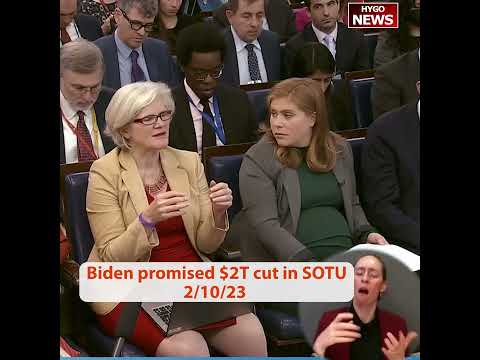
KJP On Biden’s $2T Deficit Cut: “He Takes His Fiscal Responsibility Very Seriously”
In February 2023, a reporter asked White House Press Secretary Karine Jean-Pierre about a specific tension in Biden’s fiscal policy following his State of the Union commitment. “President’s meeting today with the governors, he said during this meeting that Republicans are trying to close off the possibility of cutting defense spending and that that leads only very few options. You know, what is the President’s view on how to get to the $2 trillion in cuts that he has outlined in the State of the Union address?” the reporter asked. KJP’s response avoided specifics: “Want to add, and I’ve said this many times before, you’ve heard the President say this as well. This is a President, the first two years he was able to cut the deficit by $1.7 trillion. He takes his fiscal responsibility very seriously.” The deflection to “$1.7 trillion cut” (pandemic spending ending) and “takes fiscal responsibility seriously” template didn’t answer the specific question about how to achieve the promised $2 trillion in future cuts.
The Biden-Governors Meeting
Meeting:
Governors — Met with.
Defense spending — Discussed.
Policy direction — Signal.
Political framing — Set.
Press attention — Drawn.
The Biden-Governors meeting was venue for signaling on defense spending. Policy direction was hinted. Political framing was established for negotiations. Press attention was drawn to comments about GOP limiting cut options.
”Republicans Trying to Close Off”
The framing:
Republicans blamed — For limits.
Defense spending — Off-limits.
Cut options — Limited.
Democratic position — Shifted.
Political — Maneuvering.
Biden’s framing that Republicans were “trying to close off the possibility of cutting defense spending” positioned GOP as constraining cut options. This shifted Democratic position strategically and set up political maneuvering on budget.
”Only Very Few Options”
Limited options framing:
Constrained — Choices.
Republican fault — Established.
Democrats — Positioned.
Social programs — At risk.
Counter-pressure — Created.
The “only very few options” framing suggested constrained choices due to Republican positions. Democratic positioning was established. Social programs at risk if defense was off-limits. Counter-pressure on Republicans created.
The $2 Trillion SOTU Promise
SOTU promise:
$2 trillion cuts — Outlined.
Budget preview — In SOTU.
March budget — Would detail.
Specifics — Limited then.
Political marker — Set.
Biden’s State of the Union promise of $2 trillion in cuts was political marker set for upcoming budget debate. March budget would detail specifics. SOTU provided preview without full detail. Political positioning was primary purpose.
The Reporter’s Specific Ask
Specific ask:
How — To achieve.
$2 trillion — Goal.
Specific path — Sought.
Details — Required.
Accountability — Press function.
The reporter’s specific ask was “how” to achieve the $2 trillion goal. Specific path was sought. Details required. This was accountability press function — forcing specifics from aspirational rhetoric.
”I’ve Said This Many Times Before”
KJP template:
Repetition acknowledgment — Made.
Template — Deployed.
Standard response — Available.
Substance — Limited.
Pattern — Established.
KJP’s “I’ve said this many times before” acknowledgment preceded template deployment. Standard response was available. Substance was limited. Pattern of repeated templates was established.
The $1.7 Trillion Invocation
$1.7T invocation:
Previous cuts — Cited.
Two-year period — Framed.
Credit — Claimed.
Pandemic end — Reality.
Spin — Used.
The $1.7 trillion deficit reduction from first two years was invoked as credential. Credit was claimed by administration. Pandemic spending ending reality was not acknowledged. Spin was used to bolster current fiscal credentials.
”Takes Fiscal Responsibility Very Seriously”
Template:
“Takes seriously” — Standard.
“Fiscal responsibility” — Concept.
Characterization — Used.
Substance — Limited.
Recurring phrase — In briefings.
KJP’s “takes his fiscal responsibility very seriously” was characteristic template. “Takes seriously” framing was standard. Substance was limited. This exact phrase recurred across briefings on many topics.
The Defense Spending Dynamic
Defense dynamic:
GOP position — Protect.
Progressive pressure — Cut.
Democratic split — Real.
Ukraine context — Relevant.
Budget politics — Complex.
The defense spending dynamic had GOP wanting to protect defense, progressive pressure to cut, real Democratic caucus split, Ukraine context adding complexity. Budget politics around defense were complicated by multiple factors.
The Republican Defense Hawks
Defense hawks:
Strong tradition — GOP.
China hawks — Growing.
Ukraine support — Divided.
Hawks generally — Protect defense.
Freedom Caucus — Some ambivalent.
Republican defense hawks had strong tradition in party. China hawks growing. Ukraine support was divided. Defense hawks generally wanted to protect Pentagon budget. Freedom Caucus was more ambivalent on defense spending levels.
The Progressive Defense Cuts Position
Progressive position:
Cuts supported — Generally.
Pentagon waste — Targeted.
Redirect spending — Domestic.
CPC — Progressive Caucus.
Positions outlined — Annually.
Progressive position generally supported defense cuts, targeting Pentagon waste, redirecting spending to domestic priorities. Congressional Progressive Caucus outlined positions annually. This was established Democratic left position.
The Freedom Caucus Position
FC position:
Mixed — On defense.
Waste concerns — Real.
Spending limits — Demanded.
Defense protection — Not absolute.
Some cuts — Acceptable.
Freedom Caucus position was mixed on defense. Waste concerns were real. Spending limits were demanded broadly. Defense protection wasn’t absolute for them. Some cuts were acceptable to hardliners.
The Mathematical Reality
Math reality:
Budget components — Various.
Defense — Half of discretionary.
Non-defense — Other half.
Entitlements — Off table largely.
Limited targets — For cuts.
The mathematical reality was that budget components were limited for cuts. Defense was about half of discretionary spending. Non-defense was other half. Entitlements were largely off the table. Limited targets available for $2 trillion.
The Entitlement Protection
Entitlement:
Social Security — Protected.
Medicare — Protected.
Medicaid — Mostly.
Other programs — Varied.
Political — Untouchable.
Entitlement protection meant Social Security, Medicare, and Medicaid were mostly protected politically from cuts. Other mandatory programs varied. Entitlements were politically untouchable in current environment.
The Tax Revenue Options
Revenue:
Raise rates — Politically difficult.
Close loopholes — Some agreement.
Corporate — Focus.
Wealthy — Targeted.
Substantial — Revenue available.
Tax revenue options existed for deficit reduction. Raising rates was politically difficult. Closing loopholes had some agreement. Corporate and wealthy targets were politically popular. Substantial revenue was potentially available.
The Biden Tax Proposals
Tax proposals:
Billionaire minimum — Proposed.
Corporate — Higher rates.
Stock buybacks — Taxed.
Revenue focus — Democrat.
Republican opposition — Expected.
Biden’s tax proposals included billionaire minimum tax, higher corporate rates, stock buyback taxation. Revenue focus was Democratic priority. Republican opposition was expected and would block most proposals.
The 10-Year Budget Projection
10-year:
Standard frame — For budgets.
$2 trillion — Over decade.
Annual impact — $200B.
Substantial — But not huge.
Realistic — Potentially.
The 10-year budget projection frame was standard. $2 trillion over decade was $200 billion annually. Substantial but not transformative. Realistic potentially if specific policies were adopted. Standard budget math.
The March Budget Release Coming
March budget:
Release date — Expected.
Full detail — Provided.
Policy specifics — Included.
Political document — Function.
Negotiation framework — Set.
The March budget release would provide full detail with policy specifics. Political document function primary. Negotiation framework would be set. Opportunity for substantive engagement with specifics.
The Political Positioning
Positioning:
Democrats — Fiscal responsibility claim.
Republicans — Cut demands.
Both — Positioning.
Public relations — Primary.
Substance — Limited.
Political positioning by both parties on fiscal policy was primary function of rhetoric. Substantive engagement was limited. Public relations drove messaging. Positioning for negotiations was strategic.
The Reporter’s Follow-Up Possibility
Follow-up:
Specifics needed — Yes.
Path questions — Relevant.
Priorities — Important.
Deflection limits — Reached.
Accountability — Continued.
Follow-up questions about specific paths to $2 trillion were relevant. Priority questions were important. Deflection had limits. Accountability for specific policy questions continued through press corps.
The Administrative Rhetorical Limits
Rhetorical limits:
Templates — Wear thin.
Specifics — Eventually needed.
Credibility — At stake.
March budget — Would require.
Political — Engagement.
The administrative rhetorical limits showed templates wearing thin. Specifics were eventually needed. Credibility was at stake. March budget would require engagement with specifics. Political engagement was ultimate requirement.
The Debt Ceiling Connection
Debt ceiling:
Linked politically — To budget.
Negotiations overlap — Real.
Separation claimed — Administration.
Reality — Integrated.
Political — Entwined.
The debt ceiling was politically linked to budget negotiations. Negotiations overlap was real. Separation claimed by administration but reality was integrated. Political issues were entwined despite rhetorical separation.
The Fiscal Responsibility Brand
Brand:
Claimed — By Biden.
Historical record — Mixed.
Current effort — Substantial.
Marketing — Needed.
Credibility — Building.
The fiscal responsibility brand was claimed by Biden with mixed historical record. Current effort was substantial. Marketing for brand was needed. Credibility was being built through repeated claims and accomplishments.
The McCarthy Counter-Position
McCarthy:
Spending cuts — Required.
Specifics — Harder.
Coalition management — Difficult.
Political posture — Set.
Eventually — Negotiated.
McCarthy’s counter-position required spending cuts but specifics were harder to define. Coalition management was difficult. Political posture was set firmly. Eventually negotiated compromise would come.
The Press Briefing Function
Briefing function:
Message delivery — Primary.
Substance — Secondary.
Templates — Standard.
Accountability — Attempted.
Coverage — Generated.
Press briefing function primarily served message delivery with substance secondary. Templates were standard. Accountability was attempted by reporters. Coverage was generated regardless of substantive engagement depth.
The Long-Term Political Path
Long-term path:
Budget negotiation — Coming.
Debt ceiling — Summer crisis.
Compromise — Necessary.
Fiscal Responsibility Act — June 2023.
Resolution — Eventually.
The long-term political path had budget negotiation coming, debt ceiling summer crisis, necessary compromise, Fiscal Responsibility Act in June 2023 as result, eventual resolution through political process.
The June 2023 Deal Outcomes
Deal outcomes:
Spending caps — Modest.
Defense — Largely protected.
Non-defense — Limited cuts.
Ceiling raised — Two years.
Compromise — Both sides.
June 2023 Fiscal Responsibility Act outcomes included modest spending caps, largely protected defense spending, limited non-defense cuts, ceiling raised for two years. Compromise required concessions from both sides.
The Rhetoric vs. Reality Tension
Tension:
Strong rhetoric — Both sides.
Modest action — Eventually.
Deal — Reasonable.
Positioning — Strategic.
Outcome — Predictable.
The rhetoric vs. reality tension in fiscal debates was real. Strong rhetoric from both sides preceded relatively modest action. Eventually reasonable deals emerged. Positioning was strategic. Outcomes were often predictable despite rhetoric.
Key Takeaways
- A reporter asked KJP about Biden’s statement that Republicans “are trying to close off the possibility of cutting defense spending and that that leads only very few options.”
- The question: How to achieve the $2 trillion in cuts Biden outlined in State of the Union.
- KJP responded with template: “I’ve said this many times before.”
- She cited credentials: “This is a President, the first two years he was able to cut the deficit by $1.7 trillion.”
- She deployed standard phrase: “He takes his fiscal responsibility very seriously.”
- The response didn’t answer the specific question about how to achieve the promised $2 trillion in future cuts.
Transcript Highlights
The following is transcribed from the video audio (unverified — AI-generated from audio).
- President’s meeting today with the governors, he said during this meeting that Republicans are trying to close off the possibility of cutting defense spending.
- That that leads only very few options.
- What is the President’s view on how to get to the $2 trillion in cuts that he has outlined in the State of the Union address?
- Want to add, and I’ve said this many times before, you’ve heard the President say this as well.
- This is a President, the first two years he was able to cut the deficit by $1.7 trillion.
- He takes his fiscal responsibility very seriously.
Full transcript: 103 words transcribed via Whisper AI.