 HYGO News
 Biden plans TSMC in Arizona, but Has No Plans To Visit Southern Border During Trip To border state
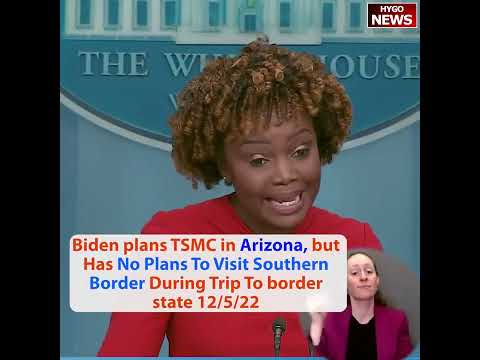
Biden to Visit TSMC Chip Factory in Phoenix But Not the Arizona Border — KJP Dismisses Border Visits as “Political Stunts”
On 12/5/2022, a reporter asked White House Press Secretary Karine Jean-Pierre whether President Biden — during his upcoming visit to Arizona to tour the TSMC chip factory in Phoenix — would also visit the southern border to “see the situation for himself.” KJP confirmed the TSMC visit but dismissed border visits as “political stunts” engaged in by Republicans who weren’t offering “any real ideas.” “We’re asking for Republican officials to come and work with us and let’s have a bipartisan agreement on immigration instead of doing political stunts, instead of doing what they’re doing, going to the border, not actually coming up with any real ideas about that,” KJP said. The exchange illustrated the administration’s pattern of declining to have Biden personally visit the border despite his proximity during multiple Arizona and Texas trips — while characterizing Republican border visits as performative rather than substantive.
The Direct Question
The reporter’s question was geographically specific. “What about in Arizona, I just want to ask you, is one of that CHIPS factory, any plans in Arizona to go to the border and see for the situation for himself there?” the reporter asked.
The question had strong logical force. Biden was planning to visit Arizona — a border state where the southern border was a few hours’ drive from the scheduled TSMC visit in Phoenix. Extending the trip by a few hours to include a border visit would have been logistically straightforward. Other presidents had made similar dual-purpose trips, combining policy announcements with border visits in the same journey.
The reporter’s phrasing was also pointed. “See the situation for himself” implied that Biden wasn’t currently seeing the situation firsthand. The phrase contained a criticism disguised as a question: was Biden willing to observe the border reality, or was he content to govern from a distance?
Biden’s Border Avoidance Pattern
By December 2022, Biden’s refusal to visit the border had become a consistent pattern. He had served nearly two years as president without personally visiting the southern border, despite:
The border being a major policy focus — Immigration was consistently among the top issues in public polling.
Multiple trips to border states — Biden had visited Texas, Arizona, California, and other states that bordered Mexico, often without border stops.
Regular Republican criticism — The absence was a frequent Republican talking point.
Ongoing operational crises at the border — Record encounters, humanitarian issues, and processing backlogs made the situation newsworthy.
This pattern stood in contrast to predecessors who had visited the border frequently. George W. Bush, Barack Obama, and Donald Trump had all made multiple border visits. Biden’s avoidance was historically unusual for a sitting president.
”Visiting at TSMC”
KJP confirmed the TSMC trip. “The President strips tomorrow, so he’ll be visiting at TSMC, a company making a major investment in manufacturing cutting edge chips in Phoenix,” KJP said.
The garbled phrase “the President strips tomorrow” was likely “the President ships tomorrow” or “the President’s trip is tomorrow” — KJP’s standard verbal stumbles. The substance was clear: Biden was heading to Phoenix to visit TSMC.
The TSMC visit was a major event for the administration’s industrial policy agenda. Taiwan Semiconductor Manufacturing Company had announced a $40 billion investment in Arizona chip manufacturing — one of the largest foreign direct investments in U.S. history. The administration wanted to use the visit to claim credit for the CHIPS Act legislation that had helped attract the investment.
The visit showcased Biden’s preferred policy narrative: American manufacturing, advanced technology, economic competitiveness with China, bipartisan legislation, and good-paying jobs. These were positive stories for the administration. The visit was expected to generate favorable coverage.
The Border’s Political Cost
The reporter’s question implicitly asked why Biden was willing to visit TSMC (positive story) but not the border (negative story) on the same trip. The political asymmetry was obvious: Biden wanted to be seen at the location that produced favorable coverage and avoid the location that produced unfavorable coverage.
This pattern was politically rational but contradicted the administration’s stated positions on border policy. The administration claimed that:
- The border was secure
- Immigration policies were working
- Critics were exaggerating the problems
- Biden was engaged with border issues
If these claims were true, a border visit shouldn’t be politically damaging. Biden could visit, point to the administration’s successes, and demonstrate his engagement. The fact that the administration systematically avoided putting Biden at the border suggested that even the administration didn’t fully believe its own talking points about border conditions.
”Political Stunts”
KJP pivoted to attacking Republican border visits. “We’re asking for Republican officials to come and work with us and let’s have a bipartisan agreement on immigration instead of doing political stunts, instead of doing what they’re doing, going to the border, not actually coming up with any real ideas about that,” KJP said.
The “political stunts” characterization was politically charged. Republican officials — governors, senators, House members — had made numerous border visits throughout 2022. Governor Greg Abbott of Texas, Governor Doug Ducey of Arizona, and many others had toured border areas, met with Border Patrol, and highlighted specific incidents. Republican presidential hopefuls including Ron DeSantis, Greg Abbott, and others had made multiple border visits.
KJP was characterizing all of these visits as “political stunts” rather than substantive engagement. This was a significant claim:
It dismissed firsthand observation — Implying that visiting the border was performative rather than informative.
It claimed Republicans lacked ideas — Accusing them of having no real policy proposals.
It shifted blame for policy failures — Making Republican obstruction the reason for border problems.
It exempted Biden from the same critique — Biden’s absence from the border was, by implication, more substantive than Republican presence there.
This asymmetry was logically questionable. If visiting the border was a “political stunt,” then presumably not visiting the border was something meaningful like productive engagement. But the administration couldn’t point to any particular border engagement that Biden’s non-visits had produced. The policy outcomes — record encounters, strained resources, humanitarian issues — continued regardless of whether Biden was absent or present.
”Any Real Ideas”
KJP’s claim that Republicans weren’t “coming up with any real ideas” for immigration was politically contested. Republicans had, in fact, proposed numerous immigration policies:
Finishing the border wall — A signature Republican priority.
Reinstating Remain in Mexico — The Trump-era policy requiring asylum seekers to wait in Mexico for their hearings.
Reforming asylum processing — Proposals to accelerate hearings and deport those with invalid claims.
Increasing Border Patrol resources — Requests for more personnel and technology.
Title 42 retention — Maintaining the COVID-era public health authority to rapidly expel migrants.
Sanctions on cartels — Designating Mexican drug cartels as terrorist organizations.
Whether these ideas were “real” in the sense of being effective policy was debatable. But they were specific proposals with policy content. Characterizing them as non-ideas was rhetorical dismissal rather than factual description.
The administration’s own approach — comprehensive immigration reform through legislation, emphasis on root causes in Central America, protection for DACA recipients — was equally policy-specific. The disagreement between the parties was about which policies to pursue, not about whether Republicans had any policies.
The Bipartisan Framing
KJP positioned the administration as seeking bipartisan cooperation. “We’re asking for Republican officials to come and work with us and let’s have a bipartisan agreement on immigration,” KJP said.
The bipartisan framing was politically useful but not fully accurate. The administration had not made immigration legislation a top legislative priority. Despite claiming interest in a bipartisan deal, the administration had:
- Not pushed immigration legislation during periods of Democratic majorities
- Not engaged in sustained bipartisan outreach on comprehensive reform
- Not made specific concessions that might have enabled a deal
- Not used executive action creatively to reduce border flows
The “bipartisan agreement” framing provided political cover for the administration’s preferred approach — which was to blame Republicans for obstructing legislation while not pursuing the specific policy actions that might have reduced border pressures unilaterally.
”That’s Where I Will Leave It”
KJP ended the exchange decisively. “That’s where I will leave it. That’s what the President is doing. Tomorrow is going to go to Arizona to talk about,” KJP said, trailing off into incompleteness.
The “that’s where I will leave it” indicated KJP was done with the subject and wouldn’t take follow-up questions. This was a standard technique for terminating unfavorable exchanges. The reporter wouldn’t get a more substantive answer, so the exchange was over.
The trailing “to talk about” suggested KJP had intended to finish with a recitation of the TSMC announcement content but either forgot or decided to skip that recitation. The incomplete sentence was typical of her verbal pattern — starting a phrase without clear plan for how to finish it.
The Pattern That Followed
Biden eventually did visit the border — in January 2023, more than a month after this exchange, following sustained political pressure. That visit was carefully choreographed: a short stop in El Paso (a relatively well-resourced border section), meetings with carefully-selected officials, and no encounters with migrants or protest scenes.
The eventual visit confirmed that Biden had been politically forced to the border rather than going voluntarily. The TSMC trip in December 2022, which could have easily included a border stop, had deliberately excluded one. The later El Paso visit was damage control, not engagement.
Key Takeaways
- A reporter asked KJP whether Biden would visit the Arizona border during his trip to tour the TSMC chip factory in Phoenix.
- KJP confirmed the TSMC visit but declined to add a border stop to the itinerary.
- She dismissed Republican border visits as “political stunts” rather than substantive engagement.
- KJP claimed Republicans weren’t “coming up with any real ideas” on immigration, despite numerous specific GOP proposals.
- She called for bipartisan cooperation but didn’t address why Biden personally wouldn’t visit the border during his Arizona trip.
Transcript Highlights
The following is transcribed from the video audio (unverified — AI-generated from audio).
- What about in Arizona, is one of that CHIPS factory, any plans in Arizona to go to the border and see for the situation for himself there?
- The President strips tomorrow, so he’ll be visiting at TSMC, a company making a major investment in manufacturing cutting edge chips in Phoenix.
- We’re asking for Republican officials to come and work with us and let’s have a bipartisan agreement on immigration.
- Instead of doing political stunts, instead of doing what they’re doing, going to the border.
- Not actually coming up with any real ideas about that.
- That’s where I will leave it. That’s what the President is doing.
Full transcript: 131 words transcribed via Whisper AI.