 HYGO News
 Biden on Mask: 'Don't Tell Them I Didn't Have It On'; Not Taking Any Questions; VP Harris Word Salad
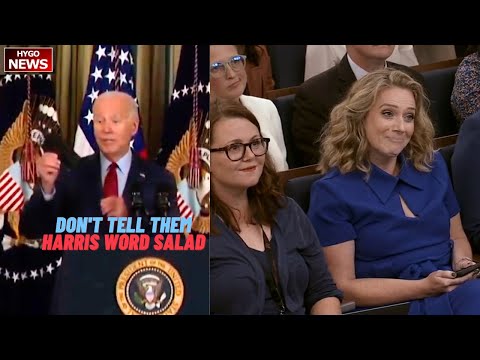
Biden on Mask: “Don’t Tell Them I Didn’t Have It On”; Not Taking Any Questions; VP Harris Word Salad
September 6, 2023 was a day that captured the Biden-Harris administration in miniature: the president joking about violating his own COVID protocol, refusing to take questions, boasting about accomplishments that invited easy rebuttal, and his vice president delivering word-salad remarks at an international summit the president chose to skip. This compilation covers Biden’s ILWU-PMA contract event, Kamala Harris’s ASEAN Summit appearance in Indonesia, and KJP’s contentious briefing on COVID testing transparency.
Biden’s Maskless Entry and the Joke
Biden’s only public event of the day was a ten-minute appearance in the State Dining Room to celebrate the finalization of a new contract between the International Longshore and Warehouse Union (ILWU) and the Pacific Maritime Association (PMA), covering workers at America’s West Coast ports.
Biden entered without his mask despite being on COVID close-contact protocol after First Lady Jill Biden tested positive. Rather than simply proceeding to his remarks, he went off-script: “Hello everybody, let me explain to the press, I’ve been tested again today. I am clear across the board. But they keep telling me — I gotta keep wearing [a mask], but don’t tell them I didn’t have it on when I walked in.”
The joke was made on camera, in front of the White House press pool, at the same event being recorded for public broadcast. Biden was asking the room not to tell “them” — presumably his own staff and medical advisers — about a protocol violation that was being simultaneously documented by every camera in the room.
This occurred hours after KJP had spent the better part of her briefing defending Biden’s mask removal at the previous day’s Medal of Honor ceremony as “planned” and consistent with CDC guidelines “in every way that we could.” Biden’s cavalier treatment of the protocol directly undermined his own spokesperson’s efforts.
”Name Me One Major Issue”
During his ILWU remarks, Biden issued a challenge: “Name me one major issue that we’ve set our mind on solving we haven’t been able to do.” He then boasted that “inflation is down” to around 3%, about one-third of what it had been a year earlier.
The inflation claim was technically accurate regarding the year-over-year rate but misleading about what consumers were experiencing. Overall prices had risen by approximately 16% since Biden took office in January 2021. The rate of increase had slowed, but prices were still going up, and the cumulative increases were not being reversed. A family’s grocery bill was not lower because the inflation rate had declined from 9% to 3%.
Biden’s challenge to critics to name an issue his administration had failed to solve was delivered moments before he left the podium without taking a single question — ensuring that no reporter could provide the answer he had invited.
VP Harris at the ASEAN Summit in Indonesia
Biden chose not to attend the ASEAN Summit in Indonesia, sending Vice President Kamala Harris instead. Harris’s public remarks during the trip produced several exchanges that reinforced the “word salad” criticism that had followed her throughout the vice presidency.
During an AP interview on foreign policy, Harris delivered this assessment: “I feel very strongly about the importance as a general matter of engaging in U.S. policy as it relates to foreign affairs in a way that we pay attention, of course, to the immediate concerns and threats if they exist, but that we also pay attention to 10, 20, 30 years down the line and what we are developing now that will be to the benefit of our country then.”
The statement said, in effect, that the administration cared about both short-term and long-term foreign policy. It was a sentiment so general that it could have been stated by any official in any administration at any point in history. The circuitous phrasing — “the importance as a general matter of engaging in U.S. policy as it relates to foreign affairs” — used many words to say very little.
Harris also offered an observation about the region: “When I think about southeast Asia and this region in the Indo-Pacific — first of all, southeast Asia, you’re looking at a population over 600 million people, at least two-thirds of which are under the age of 35. Think about what that means.”
The instruction to “think about what that means” was an invitation to the audience to supply the substance that Harris’s own statement lacked. She cited a demographic statistic but did not explain its significance, its implications for U.S. policy, or what the administration intended to do about it. The “think about what that means” construction was a recurring feature of Harris’s public remarks — presenting data and then asking the audience to draw conclusions that the speaker herself would not articulate.
Harris also promoted the administration’s climate finance initiative: “We launched the Just Energy Transition Partnership, a $20 billion infrastructure initiative which will reduce global emissions, accelerate the transition to clean energy.” This was one of the more substantive points in her remarks, though the commitment of $20 billion in global climate spending was politically contentious at a time when domestic inflation and government debt were top concerns for American voters.
KJP’s Testing Cadence Exchange
The compilation also included the briefing-room exchange in which a reporter asked KJP whether the White House would commit to sharing Biden’s COVID testing cadence going forward. The resulting exchange became one of the most circular of Jean-Pierre’s tenure.
When the reporter asked the simple question of why the White House would not share the testing schedule, Jean-Pierre insisted she had already answered — repeatedly telling the reporter “it already happened, my friend” and “I literally just explained it,” even as the reporter continued asking the same unanswered question.
The exchange reached its climax when a second reporter intervened with “just answer her question,” to which Jean-Pierre responded, “I just did.” Her final position was that the president’s physician would decide when testing would occur and that was the entirety of the information the White House would provide.
A Day in Miniature
The compilation was effective because the individual segments reinforced each other. Biden joking about his own mask non-compliance undermined KJP’s careful defense of it. Biden’s refusal to take questions prevented any accountability for his claims. Harris’s vague remarks at an international summit raised questions about why the president had sent her instead of attending himself. And KJP’s combative exchange with reporters over a transparency question demonstrated the administration’s reflexive resistance to straightforward inquiry.
Taken together, September 6, 2023 represented a day when the White House’s messaging apparatus was working against itself at every turn, with the president, vice president, and press secretary each creating problems that the others could not solve.
Key Takeaways
- Biden entered the ILWU event maskless while on COVID protocol and joked, “don’t tell them I didn’t have it on when I walked in,” undermining KJP’s earlier defense of his masking compliance.
- Biden claimed inflation was “down” but cumulative price increases stood at approximately 16% since he took office; he left without taking questions after challenging critics to name a failed issue.
- VP Harris represented the U.S. at the ASEAN Summit in Indonesia, delivering remarks critics labeled as word salad, including the open-ended “think about what that means.”
- KJP engaged in a circular exchange about Biden’s testing cadence, repeatedly claiming she had answered a question that the reporter was still asking.
- The compilation captured a single day in which the president, vice president, and press secretary each created separate messaging problems for the administration.