 HYGO News
 Biden On His Disastrous Afghanistan Withdrawal: 'I Was Right'
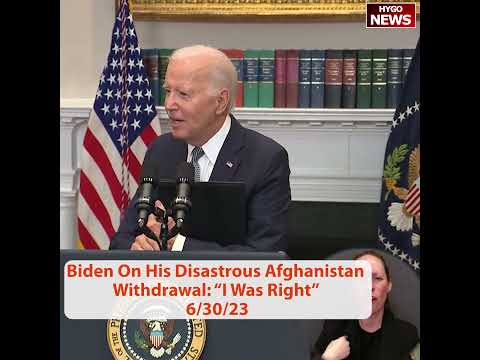
Biden on His Disastrous Afghanistan Withdrawal: “I Was Right”
On June 30, 2023, when confronted by a reporter about the State Department’s after-action review of the Afghanistan withdrawal — a report that documented failures and mistakes in both the planning and execution of the pullout — President Biden flatly denied any failure and declared: “I was right.” The exchange, captured on video, showed Biden refusing to acknowledge the findings of his own administration’s review and instead claiming that events had vindicated his decision to withdraw. The defiant stance came nearly two years after the chaotic August 2021 evacuation that resulted in the deaths of 13 U.S. service members and left an unknown number of Americans and Afghan allies stranded behind Taliban lines.
”Do You Admit Failure in Afghanistan?”
A reporter posed the question directly, referencing the State Department’s after-action review that had just been released: “Mr. President, do you admit failure in Afghanistan? Mistakes? There was a report on Afghanistan withdrawal, saying there was failure, mistakes. Do you admit there was mistakes during the withdrawal and before?”
Biden’s response was immediate and unequivocal: “No, no. All the evidence is coming back.”
The denial was striking in its breadth. The reporter had asked not just about the withdrawal itself but about the period “before” — encompassing the planning phase during which the administration failed to anticipate the rapid collapse of the Afghan government and military. Biden’s “no, no” dismissed both categories of failure without engaging with any of the specific findings in the report.
”I Said Al-Qaeda Would Not Be There”
Biden then pivoted to a series of claims about his own predictions: “Remember what I said about Afghanistan? I said Al-Qaeda would not be there. I said it wouldn’t be there. I said we’d get help from the Taliban. What’s happening now? What’s going on? Read your press. I was right.”
The claims were factually problematic on several levels. Biden’s assertion that Al-Qaeda “would not be there” contradicted U.S. intelligence assessments and reports from United Nations monitoring teams that had documented the continued presence of Al-Qaeda elements in Afghanistan following the Taliban takeover. A July 2022 U.S. drone strike in Kabul had killed Al-Qaeda leader Ayman al-Zawahiri, who was living in a Taliban-controlled area of the Afghan capital — directly contradicting Biden’s claim that Al-Qaeda was no longer in Afghanistan.
Biden’s statement that “we’d get help from the Taliban” was equally difficult to defend. While the U.S. had engaged in negotiations with the Taliban through the Doha Agreement, the Taliban’s conduct following the withdrawal had not constituted “help” by any reasonable measure. The Taliban had seized control of the country in a matter of days during August 2021, imposed authoritarian rule, severely restricted women’s rights, closed girls’ schools, and been repeatedly accused by international observers of harboring terrorism-linked groups. The idea that the Taliban had been helpful to U.S. interests was contradicted by the record.
”Read Your Press. I Was Right.”
Biden’s instruction to the reporter to “read your press” was cryptic and unexplained. He appeared to be suggesting that media coverage somehow supported his claim that the withdrawal had been vindicated, but he offered no specific examples or citations. The dismissive tone — essentially telling the reporter that the evidence was in front of them if they would only look — was a deflection from the substance of the question.
The follow-up from the reporter underscored Biden’s disconnect from the actual topic: “So — so — so the report is from the State Department, actually, about the withdrawal.” The reporter was pointing out that the question was not about Biden’s broader predictions but about a specific government review that documented concrete failures. Biden had not addressed the report’s findings at all.
The State Department After-Action Review
The State Department’s after-action review, released on June 30, 2023, was the most comprehensive internal assessment of the August 2021 withdrawal. The review found that senior administration officials bore responsibility for the chaotic evacuation, including for failing to decide which Afghans should be eligible for evacuation, issuing changing guidance that created confusion on the ground, and inadequately preparing for the possibility that the Afghan government and military would collapse rapidly.
The report was notable not just for its findings but for its presentation. The administration released only 24 of the 87-page report, and it was published on a Friday afternoon before a holiday weekend — a timing choice that critics described as a deliberate effort to minimize media coverage. House Oversight Committee Chairman Michael Comer accused the administration of trying to hide its “culpability in the chaotic and deadly evacuation.”
The review blamed both the Trump and Biden administrations for aspects of the withdrawal but specifically cited Biden-era officials for decisions made in the critical months leading up to the collapse. Despite this, Biden refused to accept any responsibility, choosing instead to declare himself vindicated.
The Human Cost Biden Refused to Acknowledge
The August 2021 withdrawal was one of the most criticized military operations in recent American history. On August 26, 2021, a suicide bombing at Abbey Gate outside Hamid Karzai International Airport in Kabul killed 13 U.S. service members and an estimated 170 Afghan civilians. The attack occurred during the chaotic final days of the evacuation, when thousands of desperate Afghans crowded around the airport seeking to flee Taliban rule.
In the weeks and months following the withdrawal, reports emerged of Americans left behind in Afghanistan, Afghan allies who had been promised evacuation but were abandoned, and the Taliban’s systematic persecution of those who had cooperated with the U.S. and NATO forces. The administration had initially claimed that the number of Americans remaining was small, but the actual figure remained disputed and the State Department continued efforts to facilitate departures well into 2022 and 2023.
Biden’s declaration that he “was right” about Afghanistan came against this backdrop. For the families of the 13 fallen service members and for the Afghan allies who were left behind, the claim that everything had gone according to plan was not only factually inaccurate but deeply insulting.
Biden’s Pattern of Refusing Accountability
The Afghanistan exchange was part of a broader pattern in which Biden refused to accept responsibility for policy failures. On the same day, he had similarly refused to acknowledge that the Supreme Court’s ruling against his student loan program reflected any overreach on his part, instead blaming Republicans and accusing the Court of misinterpreting the Constitution.
The Afghanistan deflection was arguably more consequential. While the student loan case involved a policy dispute, the Afghanistan withdrawal involved American lives lost and allies abandoned. Biden’s refusal to engage with the State Department’s own findings, his factually dubious claims about Al-Qaeda and the Taliban, and his dismissive instruction to reporters to “read your press” all pointed to a President unwilling to confront the consequences of his decisions.
Key Takeaways
- When asked directly whether he admitted failure or mistakes in Afghanistan, Biden said “No, no” and declared “I was right,” refusing to engage with the State Department’s after-action review.
- Biden claimed that Al-Qaeda “would not be there” and that the U.S. would “get help from the Taliban,” both assertions contradicted by intelligence assessments and the Taliban’s subsequent conduct.
- Biden told the reporter to “read your press” without specifying what coverage he was referencing, prompting the reporter to point out the question was about the State Department’s own report.
- The State Department review found that senior Biden administration officials bore responsibility for the chaotic evacuation, but only 24 of 87 pages were released, on a Friday before a holiday weekend.
- The withdrawal resulted in the deaths of 13 U.S. service members in a suicide bombing at Abbey Gate and left an unknown number of Americans and Afghan allies stranded.