 HYGO News
 Biden NSA Jake Sullivan: Biden Focused On 'Relief To Consumers At The Pump'
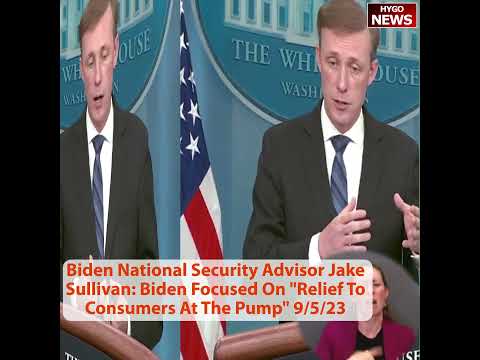
Biden NSA Jake Sullivan: Biden Focused On “Relief To Consumers At The Pump”
On September 5, 2023, during a White House briefing, National Security Advisor Jake Sullivan claimed that the Biden administration was focused on delivering “relief to consumers at the pump.” The statement was made in response to a reporter’s question about whether Saudi Arabia’s oil production cuts would change the administration’s approach to diplomatic engagement with Riyadh. Sullivan’s answer — that the administration stood for “a stable, effective supply of energy to the global markets” — was notable for the gap between the rhetoric and the reality Americans were experiencing at gas stations across the country.
The Exchange
A reporter pressed Sullivan on the implications of Saudi Arabia’s decision to extend voluntary oil production cuts, asking: “Does that change the calculation at all though for communications in the future with the Saudis? I mean, does it make it more pressing to engage with them on this issue?”
Sullivan’s response was measured but revealing: “We have, obviously, regular engagement with the Saudis at multiple levels. And the thing that we ultimately stand for is a stable, effective supply of energy to the global markets so that we can in fact deliver relief to consumers at the pump and also that we do this in a way that is consistent with the energy transition over time.”
The answer contained two claims worth examining. First, that the administration was delivering “relief to consumers at the pump.” Second, that energy policy needed to be “consistent with the energy transition over time” — a reference to the administration’s broader climate and clean energy agenda.
The Gas Price Reality
Sullivan’s claim that the Biden administration was focused on delivering relief at the pump was difficult to square with the price data Americans could see on gas station signs every day. When President Biden took office on January 20, 2021, the national average price for a gallon of regular gasoline was approximately $2.39. By September 2023, when Sullivan made this statement, the national average was hovering around $3.80 per gallon.
At no point during the Biden presidency had gas prices returned to the level Biden inherited. The peak had come in June 2022, when the national average briefly exceeded $5.00 per gallon — a record high that contributed significantly to voter dissatisfaction with the administration’s handling of the economy. While prices had come down from that peak, the decline from an all-time high back to merely elevated levels was not the “relief” most consumers had in mind.
The administration had taken several steps in response to high gas prices, most notably releasing oil from the Strategic Petroleum Reserve (SPR). Between March 2022 and the end of that year, the administration released approximately 180 million barrels from the SPR, temporarily bringing the reserve to its lowest level since 1984. Critics argued that this amounted to a short-term political fix that depleted a strategic national asset and would eventually need to be replenished at potentially higher prices.
The Saudi Relationship
The reporter’s question about Saudi Arabia touched on one of the most awkward aspects of Biden’s energy policy. As a candidate, Biden had vowed to make Saudi Arabia a “pariah” over the murder of journalist Jamal Khashoggi. Once in office, however, the realities of global oil markets forced the administration into a more conciliatory posture.
In July 2022, Biden traveled to Saudi Arabia and met with Crown Prince Mohammed bin Salman — the same leader U.S. intelligence assessed had approved the Khashoggi operation. The trip was widely seen as a humbling reversal, made necessary by the administration’s need for Saudi cooperation on oil production to help lower gas prices heading into the 2022 midterm elections.
Despite that diplomatic outreach, Saudi Arabia and Russia continued to coordinate oil production cuts through the OPEC+ framework. In the weeks before Sullivan’s September 2023 briefing, Saudi Arabia had announced it would extend a voluntary production cut of one million barrels per day through the end of the year. The decision signaled that Riyadh was prioritizing higher oil prices over Washington’s preferences — a dynamic that undermined Sullivan’s claim of effective engagement.
Sullivan’s assertion that the administration had “regular engagement with the Saudis at multiple levels” was accurate in a narrow sense but obscured the fact that this engagement had not produced the outcomes the administration wanted. Saudi Arabia was cutting production, oil prices were rising, and American consumers were paying significantly more at the pump than they had when Biden took office.
The “Energy Transition” Caveat
The second notable element of Sullivan’s response was his reference to pursuing energy policy “in a way that is consistent with the energy transition over time.” This was a diplomatic way of acknowledging the fundamental tension at the heart of Biden’s energy policy: the administration was simultaneously asking oil-producing nations to increase supply in the short term while pursuing long-term policies designed to reduce dependence on fossil fuels.
This tension manifested in specific policy decisions. The administration had paused new oil and gas leasing on federal lands early in Biden’s term, restricted drilling permits, and invested heavily in renewable energy through the Inflation Reduction Act. These actions signaled to energy markets that the administration viewed fossil fuel production as a transitional necessity rather than a long-term priority — which in turn discouraged the kind of domestic production increases that could have helped lower prices.
Energy industry executives repeatedly pointed out the contradiction: the administration was asking OPEC to produce more oil while simultaneously making it harder and less attractive to produce oil domestically. Sullivan’s briefing-room language about balancing “relief at the pump” with the “energy transition” captured this contradiction in a single sentence.
The Broader Briefing Context
Sullivan’s appearance at the September 5 briefing covered a range of topics beyond energy. He discussed Biden’s request to Congress for $25 billion in World Bank financing, which prompted a pointed question from a reporter about fairness: “Credit card delinquencies have spiked. Mortgage rates are through the roof. Inflation remains a problem… and the president wants to increase funding to foreign nations through the World Bank. How is that fair to citizens in, say, Scranton?”
Sullivan’s response — that World Bank investment would “end up reducing the costs and burdens on working people in Minneapolis or Scranton” — reflected the same pattern visible in his gas price answer: abstract claims about long-term benefits deployed to deflect from immediate economic pain that voters could feel in their daily lives.
The briefing also included Sullivan’s revisionist framing of the administration’s foreign policy challenges. When a reporter noted that U.S. relationships with Russia, China, North Korea, and Iran all appeared worse than before Biden took office, Sullivan deflected responsibility by blaming the Trump administration for “letting Iran’s nuclear program out of the box” and claimed that summit diplomacy with North Korea had failed.
Key Takeaways
- On September 5, 2023, National Security Advisor Jake Sullivan claimed Biden was focused on “relief to consumers at the pump” even though gas prices had never returned to the $2.39 per gallon level Biden inherited on Inauguration Day.
- Sullivan’s comments came as Saudi Arabia extended voluntary oil production cuts of one million barrels per day, undercutting the administration’s claims of effective diplomatic engagement with Riyadh.
- Sullivan acknowledged the administration was balancing pump relief with the “energy transition over time,” highlighting the tension between Biden’s climate agenda and his promises to lower gas prices.
- The administration had depleted the Strategic Petroleum Reserve to its lowest level since 1984 in an effort to temporarily lower gas prices, drawing criticism that it was sacrificing long-term strategic assets for short-term political relief.
- The briefing took place amid broader economic concerns including spiking credit card delinquencies and elevated mortgage rates, which reporters pressed Sullivan on.