 HYGO News
 Biden not sign a bill that would impose the terms of the tentative agreement on those four unions?
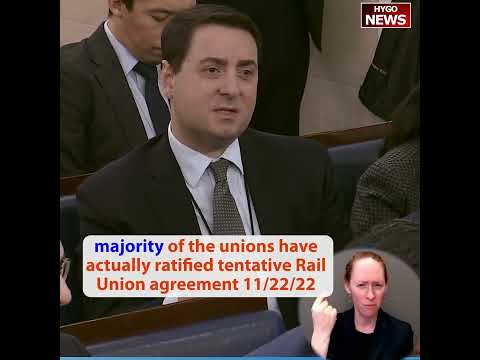
Reporter Asks if Biden Would Sign a Bill Imposing the Tentative Railroad Agreement on Four Rejecting Unions — KJP Refuses to Answer
On 11/22/2022, a reporter pressed White House Press Secretary Karine Jean-Pierre on a critical policy question about the looming railroad strike. Four of the twelve railroad unions had rejected the tentative agreement the Biden administration had helped negotiate. If Congress passed legislation imposing the tentative agreement’s terms on those four unions — effectively preventing a strike by forcing the deal — would President Biden sign it? The reporter’s framing was precise: “Are you suggesting that the President would not sign a bill that would impose the terms of the tentative agreement on those four unions?” KJP refused to answer: “I’m not going to get into hypotheticals from here.” The refusal to address the core question left the status of a potential nationwide railroad strike unclear just days before the strike deadline.
The Railroad Strike Context
By late November 2022, the U.S. was approaching a nationwide railroad strike that threatened to paralyze the economy. The dispute centered on working conditions — particularly paid sick leave — for railroad workers whose unions had been negotiating with the major railroad companies for over two years.
In September 2022, the Biden administration had helped negotiate a tentative agreement that included wage increases, bonuses, and some scheduling flexibility. The administration had publicly celebrated the deal as evidence of Biden’s pro-labor credentials and negotiating skills. But the tentative agreement had to be ratified by all twelve unions involved in the negotiations to become binding.
Eight unions ratified the agreement. Four did not. The rejecting unions objected primarily to the inadequate sick leave provisions — workers would receive essentially no paid sick days, meaning they would be penalized for missing work due to illness. This was unacceptable to workers who had been suffering under harsh scheduling regimes that forced them to work while sick or risk their jobs.
Without ratification from all twelve unions, the agreement wasn’t binding, and strikes would become legally permissible on December 9, 2022. A nationwide railroad strike would have shut down freight rail, disrupted supply chains, idled Amtrak service, and caused economic damage estimated at $2 billion per day.
Congress and the White House faced a choice: let the strike happen, negotiate a new agreement, or use congressional authority under the Railway Labor Act to impose the existing tentative agreement on the rejecting unions.
The Reporter’s Specific Question
The reporter’s question identified the specific legislative option. “Are you suggesting that the President would not sign a bill that would impose the terms of the tentative agreement on those four unions?” the reporter asked.
This was a precise, answerable question. Either Biden would sign such legislation or he wouldn’t. The answer had major implications:
If Biden would sign: Congress would likely pass imposition legislation, the rejecting unions would be forced to accept the agreement, and the strike would be prevented. Biden would be complicit in overriding the workers’ democratic decision to reject the contract.
If Biden would not sign: Congress couldn’t effectively impose the agreement, the strike would likely happen or require new negotiations, and Biden would be honoring the rejecting unions’ democratic decision.
The question mattered because it would determine congressional strategy. If Biden’s position was known, Congress could act accordingly. If his position was unknown, Congress had to guess.
”I’m Not Going to Get Into Hypotheticals”
KJP’s response was the standard non-answer. “I’m not going to get into hypotheticals from here. What I’m saying is we’ve been very clear that both sides need to come together to reach a resolution,” KJP said.
The “hypotheticals” framing was disingenuous. The question wasn’t hypothetical — it was about concrete legislation that was being actively discussed in Congress. The Railway Labor Act provided clear authority for Congress to impose contract terms. Legislation was being drafted. The question was whether Biden would sign it.
Characterizing a near-term legislative question as a hypothetical allowed KJP to avoid taking a position. But it was the same as saying “we won’t tell you what Biden will do” — which was a politically significant statement in itself.
The “both sides need to come together” language was also problematic. It implied that the dispute could be resolved through continued negotiation — but the negotiations had already failed. Four unions had rejected the tentative agreement. Telling them to “come together” with the railroads for another round of negotiations ignored that the previous round had failed to address their specific concerns about sick leave.
The Pro-Labor Contradiction
Biden had built his political identity around being the most pro-labor president since FDR. His 2020 campaign had emphasized worker rights, union support, and collective bargaining. His administration had made nominally pro-labor decisions — appointments to the National Labor Relations Board, support for union organizing, and praise for striking workers in various industries.
But the railroad strike situation put Biden in a position where his pro-labor stance would be tested directly. The rejecting unions had democratically decided that the tentative agreement was inadequate — specifically because it denied them paid sick leave. If Biden signed legislation forcing them to accept the inadequate contract, he would be using federal power to override workers’ democratic decisions in favor of corporate interests.
This was not an abstract question. It was a concrete test of whether Biden’s pro-labor rhetoric would survive when it conflicted with broader economic concerns about supply chains and inflation.
What Actually Happened
Biden’s eventual position was revealing. On November 28, 2022 — just days after this exchange — Biden publicly asked Congress to pass legislation imposing the tentative agreement on the rejecting unions. Biden framed this as preventing economic catastrophe while acknowledging it was “a difficult decision.”
Congress complied. On December 2, 2022, both the House and Senate passed legislation imposing the tentative agreement’s terms on all unions. The House also passed a separate bill adding paid sick leave, but the Senate rejected the sick leave amendment. Biden signed the imposition legislation without the sick leave provisions.
The outcome was that:
- The strike was prevented
- The rejecting unions were forced to accept the agreement they had rejected
- The workers did not get paid sick leave
- Biden used presidential and federal power to override workers’ democratic decisions
- The railroads got the deal they wanted without having to offer additional concessions
This was the opposite of what his pro-labor rhetoric had suggested. Biden had sided with railroads against workers on the specific issue the workers cared about most. Labor unions and progressive Democrats were bitterly disappointed, viewing the decision as a betrayal.
The “Not Going to Get Into Hypotheticals” Pattern
KJP’s refusal to answer the railroad question fit a broader pattern of avoiding commitments until the last possible moment. On multiple major policy questions throughout 2022, KJP had used variations of “not going to get into hypotheticals” to avoid taking positions.
The pattern allowed the White House to maintain maximum flexibility while providing minimum information. Each “hypothetical” refusal preserved the administration’s ability to pivot based on political circumstances. But the pattern also meant that reporters, members of Congress, and the public rarely got clear information about what the White House was going to do — only about what it was saying publicly at any given moment.
For the railroad unions specifically, the refusal to clarify Biden’s position meant they had to guess how aggressively to fight for additional concessions. If they knew Biden would sign imposition legislation, their leverage was limited. If they knew Biden would not sign, their leverage was substantial. KJP’s refusal to answer kept them in the dark.
Key Takeaways
- A reporter asked KJP directly if Biden would sign legislation imposing the tentative railroad agreement on the four rejecting unions.
- KJP refused to answer: “I’m not going to get into hypotheticals from here.”
- Four of twelve railroad unions had rejected the tentative agreement, primarily over inadequate paid sick leave provisions.
- On November 28, 2022, Biden publicly asked Congress to impose the agreement, which Congress did on December 2.
- Biden signed the imposition legislation without sick leave provisions — siding with railroads against workers despite his pro-labor rhetoric.
Transcript Highlights
The following is transcribed from the video audio (unverified — AI-generated from audio).
- The majority of the unions involved have actually ratified the contract.
- If you’re urging both sides to come to the table, the companies don’t have a particular incentive to do so.
- Are you suggesting that the President would not sign a bill that would impose the terms of the tentative agreement on those four unions?
- I’m not going to get into hypotheticals from here.
- What I’m saying is we’ve been very clear that both sides need to come together to reach a resolution.
Full transcript: 100 words transcribed via Whisper AI.