 HYGO News
 Biden: my largest deficit reduction in history; Trump: added more debt than any predecessor
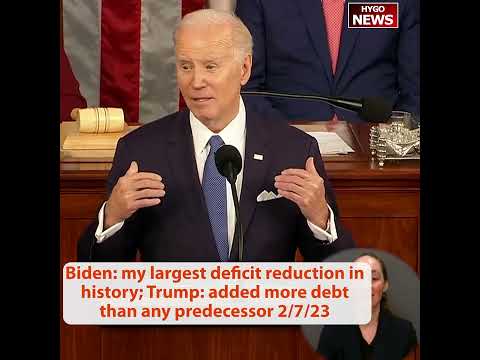
Biden Claims $1.7T Deficit Cut In SOTU: “Largest Deficit Reduction In American History”
In his February 2023 State of the Union address, President Joe Biden made sweeping claims about deficit reduction contrasting his record with Trump’s. “In the last two years, my administration has cut the deficit by more than $1.7 trillion. The largest deficit reduction in American history,” Biden declared. He then attacked Trump’s record: “Under the previous administration, the American deficit went up four years in a row because those record deficits, no president added more to the national debt in any four years than my predecessor.” Biden continued with the striking claim: “Only 25 percent of the entire national debt that took over 200 years to accumulate was added by just one administration alone. The last one.” He concluded with characteristic insistence: “They’re the facts. Check it out. Check it out.” The claims combined accurate data points with contested framings that fact-checkers would examine closely.
The $1.7 Trillion Deficit Cut Claim
$1.7T claim:
Specific number — Cited.
Two-year period — Framed.
Deficit reduction — Claimed.
Administration credit — Sought.
Verifiable — Data point.
Biden’s $1.7 trillion deficit cut over two years was specific claim that could be verified. Deficit did decline over period, but causes were debated. Administration sought credit, but much of reduction was pandemic emergency spending ending.
The “Largest in History” Framing
Largest claim:
Historical superlative — Used.
Record-breaking — Framing.
Political — Impact.
Technically — Accurate on dollars.
Contextually — Debatable.
The “largest deficit reduction in American history” was superlative framing. Technically accurate on raw dollar amount, but contextually debatable. Inflation-adjusted or percentage-of-GDP measurements told different stories. Political framing was strategic.
The Pandemic Context Ignored
Pandemic context:
2021 deficit — Pandemic peak.
Emergency spending — Temporary.
Natural decline — Expected.
Post-pandemic — Normalization.
Biden credit — Overstated.
The pandemic context was ignored in the claim. 2021 deficit was pandemic peak with emergency spending. Natural decline as emergency programs ended was expected regardless of administration policies. Biden’s credit was overstated by not acknowledging this.
”Went Up Four Years in a Row”
Trump deficits:
Four years — Up.
2017-2020 — Period.
Yes, technically — True.
Context — Varied.
Pandemic 2020 — Final year.
Trump’s four years of deficit increases were technically true. Years 2017-2020 saw rising deficits. Context varied — 2020 was pandemic year. Framing as pure Trump policy failure ignored 2020 emergency response context.
”No President Added More Debt”
Debt claim:
Four-year comparison — Used.
Trump era — Referenced.
Substantial — True.
Context limited — Again.
Historical — Comparison.
The “no president added more to the national debt in any four years” claim had some truth but limited context. Inflation, crisis spending, Bush-era wars, and other factors affected comparisons. Historical comparison required careful analysis.
The 25% of All National Debt Claim
25% claim:
Striking number — Memorable.
One administration — Specified.
200+ years accumulation — Baseline.
Mathematical — Check.
Accurate-ish — Partially.
The “25% of entire national debt in one administration” was striking memorable number. 200+ years as baseline was accurate. Mathematical check showed partial accuracy depending on measurement methodology. Effective rhetorical framing.
The Trump-Era Debt Reality
Debt reality:
TCJA 2017 — Tax cuts.
Pandemic spending — 2020 massive.
Spending continuation — Various.
Multi-cause — Attribution.
Politically — Blamed.
Trump-era debt came from TCJA 2017 tax cuts contributing, massive 2020 pandemic spending (bipartisan CARES Act), various ongoing spending, multi-cause attribution. Politically blamed on Trump but causes were more diverse.
The Bipartisan Pandemic Spending
Bipartisan:
CARES Act — 2020.
Bipartisan support — Overwhelming.
Biden voted — Senate still serving.
$2 trillion — Initial package.
Shared — Responsibility.
The CARES Act in 2020 had overwhelming bipartisan support. $2 trillion initial package and follow-on bills had Democratic backing. Biden (then not yet president) supported these spending increases. Shared responsibility for pandemic debt increase.
”They’re the Facts”
Biden framing:
“Facts” — Assertion.
Confidence — Projected.
Challenge — Implicit.
Fact-checkers — Invited.
Political — Rhetoric.
Biden’s “they’re the facts” projection of confidence with implicit challenge to fact-checkers was political rhetoric. Some claims were facts; others were contested framings of facts. Mixed accuracy required careful fact-checking.
”Check It Out, Check It Out”
Repeated challenge:
Double repetition — Insistent.
Biden characteristic — Style.
Confidence — Projected.
Fact-check invitation — Made.
Risk — Of detailed analysis.
Biden’s “check it out, check it out” double repetition was characteristic style. Projected confidence. Invited detailed fact-checking analysis. But this invitation carried risk — detailed analysis sometimes revealed nuances Biden didn’t acknowledge.
The Fact-Check Reality
Fact-check reality:
$1.7T cut — Yes but pandemic end.
“Largest in history” — Yes dollar-wise.
Trump 4 years up — Yes technically.
25% of debt — Roughly accurate.
Framings — Mixed accuracy.
Fact-checking the claims: $1.7T cut was real but largely pandemic emergency spending ending. “Largest in history” was dollar-wise true, context-wise debatable. Trump’s four years up was technical truth. 25% was roughly accurate. Framings had mixed accuracy.
The CBO Data Available
CBO data:
Congressional Budget Office — Nonpartisan.
Deficit data — Maintained.
Historical — Comparisons available.
Analysis — Professional.
Baseline — For verification.
Congressional Budget Office nonpartisan deficit data was available for verification. Historical comparisons could be made. Professional analysis was available. CBO was baseline for verification of these claims.
The 2020 COVID Context
COVID context:
Emergency — Response.
Spending necessary — Broadly agreed.
Deficit spike — 2020-21.
Temporary programs — Most.
Natural end — Expected.
The 2020 COVID context was emergency response requiring spending that was broadly agreed necessary. Deficit spike in 2020-21 was temporary due to most emergency programs. Natural end was expected regardless of administration.
The TCJA Tax Cut Contribution
TCJA:
2017 tax cuts — Trump signed.
Revenue reduction — Substantial.
Deficit contribution — Real.
Republican priority — Initially.
Permanent corporate — Rate cuts.
The TCJA (Tax Cuts and Jobs Act) 2017 contributed substantially to deficit through revenue reduction. Republican priority initially. Corporate rate cuts permanent. Individual provisions sunset. Real contribution to Trump-era debt increase.
The Structural Deficit Question
Structural:
Ongoing — Gap.
Revenue-spending — Mismatch.
Both parties — Contribute.
Entitlement — Driver.
Long-term — Issue.
The structural deficit question was ongoing gap between revenues and spending. Both parties contributed through different mechanisms. Entitlement programs were long-term driver. This was beyond single administration blame.
The Biden Policy Contributions
Biden contributions:
ARP 2021 — $1.9T.
Infrastructure — $1T+.
IRA — Various.
CHIPS Act — Major.
Net effect — Complex.
Biden’s own policy contributions to debt included American Rescue Plan ($1.9T), Infrastructure ($1T+), Inflation Reduction Act, CHIPS Act. Net effect on debt was complex — some with offsets, some without. Attribution was complicated.
The Political Messaging Strategy
Strategy:
Trump blame — Forward.
Biden credit — Sought.
Deficit reduction — Claimed.
Fiscal responsibility — Framed.
2024 preview — Message.
Biden’s political messaging strategy put forward Trump blame for debt while seeking deficit reduction credit for himself. Fiscal responsibility was framed as Biden’s priority. This was preview for 2024 campaign messaging.
The SOTU Performance Elements
Performance:
Enthusiastic delivery — Biden.
Rising voice — At points.
Insistent — “Check it out.”
Energy — Mostly present.
Confidence — Projected.
Biden’s State of the Union performance elements on this passage included enthusiastic delivery, rising voice at points, insistent “check it out” repetition, mostly present energy, projected confidence. Performance was reasonably successful.
The GOP Reaction
GOP reaction:
Skeptical — Of claims.
Fact-check pushback — Expected.
Context disputes — Offered.
Media battles — Anticipated.
Political response — Coordinated.
GOP reaction was skeptical of Biden’s claims, with expected fact-check pushback. Context disputes were offered. Media battles anticipated. Political response was coordinated to challenge Biden’s framing.
The Republican Counter-Framing
Counter-framing:
Pandemic spending — End noted.
Emergency — Naturally ended.
Biden spending — Contributed.
Structural deficit — Worse.
Both parties — Hypocrisy.
Republican counter-framing noted pandemic spending naturally ending, emphasized Biden’s own spending contributions, pointed to structural deficit worsening, noted bipartisan hypocrisy on debt. Substantive counter-arguments existed.
The Fact-Checker Verdicts
Verdicts:
Washington Post — Would grade.
PolitiFact — Would rate.
FactCheck.org — Would analyze.
AP — Would review.
Mixed verdicts — Expected.
Fact-checker verdicts from Washington Post, PolitiFact, FactCheck.org, AP would analyze claims in detail. Mixed verdicts were expected — some claims true, some technically true but misleading, some contested framings.
The Long-Term Debt Trajectory
Trajectory:
Rising — Consistently.
Cross-party — Addition.
Interest payments — Growing.
Entitlement — Pressure.
Unsustainable — Eventually.
The long-term debt trajectory was consistently rising across parties. Interest payments were growing as rates rose. Entitlement pressure was increasing. Current path eventually unsustainable regardless of short-term claims.
The 2024 Campaign Implications
Campaign implications:
Economic messaging — Central.
Fiscal record — Defended.
Trump blame — Used.
GOP attacks — Expected.
Voter resonance — Variable.
The 2024 campaign implications included economic messaging being central, fiscal record being defended, Trump blame being used, GOP attacks expected, variable voter resonance. Deficit and debt mattered politically.
The Policy Substance
Substance:
Deficit reduction — Some real.
Pandemic end — Mechanical.
Structural — Not addressed.
Future — Concerning.
Honest assessment — Limited.
Policy substance included some real deficit reduction, mechanical pandemic-end reductions, structural issues not fully addressed, concerning future trajectory. Honest assessment of these dimensions was limited in political messaging.
The SOTU Medium
Medium:
Joint session — Congress.
National TV — Broadcast.
Policy platform — Presented.
Political theater — Part.
Annual — Event.
The State of the Union medium as joint session of Congress, national TV broadcast, policy platform presented, political theater as part of event, annual constitutional tradition was significant communication opportunity for Biden.
The Biden SOTU Performance Overall
Overall:
Well-received — Mostly.
Energy present — Generally.
Some stumbles — Minor.
Heckling handled — Notably.
Political success — Arguably.
The overall Biden SOTU performance was well-received mostly with present energy generally. Some minor stumbles. Heckling from GOP was notably handled. Arguable political success given low expectations.
The McCarthy Debut
McCarthy:
First SOTU — As Speaker.
Behind Biden — Seating.
Restrained — Mostly.
Applause — Selective.
Navigation — Careful.
Kevin McCarthy’s first State of the Union as Speaker had him seated behind Biden. He was restrained mostly. Selective applause. Careful navigation of political theater. New role management.
The Fact Base Underneath
Fact base:
$1.7T — Yes.
Pandemic end — Major factor.
Trump debt — Also real.
Context — Complex.
Political — Framing.
The fact base underneath claims was mixed. $1.7T deficit reduction yes. Pandemic end was major factor. Trump debt increases were also real. Context was complex. Political framing simplified complicated reality.
Key Takeaways
- Biden claimed in SOTU: “In the last two years, my administration has cut the deficit by more than $1.7 trillion. The largest deficit reduction in American history.”
- He attacked Trump: “The American deficit went up four years in a row.”
- He made striking claim: “No president added more to the national debt in any four years than my predecessor.”
- The memorable statistic: “Only 25 percent of the entire national debt that took over 200 years to accumulate was added by just one administration alone. The last one.”
- He concluded with characteristic insistence: “They’re the facts. Check it out. Check it out.”
- The claims combined accurate data with contested framings — $1.7T cut was largely pandemic spending ending, not entirely policy choice.
Transcript Highlights
The following is transcribed from the video audio (unverified — AI-generated from audio).
- In the last two years, my administration has cut the deficit by more than $1.7 trillion. The largest deficit reduction in American history.
- Under the previous administration, the American deficit went up four years in a row because those record deficits.
- No president added more to the national debt in any four years than my predecessor.
- Only 25 percent of the entire national debt that took over 200 years to accumulate was added by just one administration alone.
- The last one.
- They’re the facts. Check it out. Check it out.
Full transcript: 90 words transcribed via Whisper AI.