 HYGO News
 Biden: I hope to God to continue at least next 2 years, maybe beyond that. keep the faith
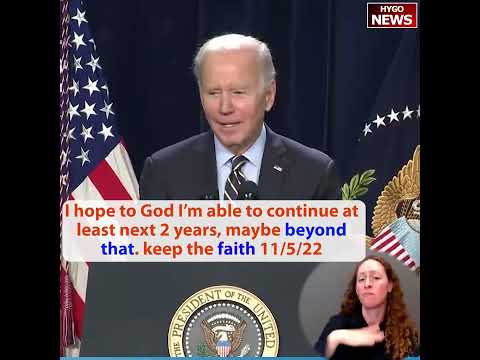
Biden: “I Hope to God I’m Able to Continue for at Least the Next Two Years, Maybe Beyond That” — Hedging on 2024 While Invoking Grandpa Finnegan’s “Keep the Faith”
On 11/5/2022, President Biden closed a rally at Jones Elementary School in Joliet, Illinois — three days before the midterm elections — with a statement that raised more questions about his political future than it answered: “I hope to God I’m able to continue to do that for at least the next two years, maybe beyond that.” The phrasing — “hope to God,” “at least,” “maybe beyond” — introduced uncertainty about whether Biden would seek reelection in 2024, whether his health would permit him to serve, or both. He then pivoted to his signature closing story about Grandpa Finnegan in Scranton telling him to “keep the faith” — one of the most frequently recycled Biden anecdotes in existence.
”I Hope to God”
Biden’s statement contained multiple layers of ambiguity. “I hope to God I’m able to continue to do that for at least the next two years, maybe beyond that,” Biden said.
The phrase “hope to God” suggested the outcome was not within Biden’s control — that whether he could continue depended on forces beyond his own decision-making. This was different from “I intend to” or “I plan to” or even “I will.” “Hope to God” framed continuation as something he was praying for rather than something he was planning.
“At least the next two years” referred to the remainder of his current term — January 2023 through January 2025. By specifying “at least” two years, Biden was establishing the bare minimum expectation: he would try to finish the job he was elected to do. The qualifier suggested this was not a given.
“Maybe beyond that” was the 2024 hedge. Biden had previously told interviewers his “intention” was to run for reelection, but this formulation — “maybe beyond” — was weaker than an intention. It was a possibility, not a plan.
The three phrases together — “hope to God,” “at least two years,” “maybe beyond” — painted a picture of a president uncertain about his own future capacity, asking for divine assistance to complete his term, and leaving reelection as a tentative possibility rather than a commitment.
The Health Subtext
Biden’s statement was impossible to separate from the ongoing conversation about his age and fitness. At 79 years old in November 2022 — already the oldest person to serve as president — Biden would be 82 at the start of a potential second term and 86 at its conclusion. Polls consistently showed large majorities of Americans, including Democrats, had concerns about Biden’s age and capacity to serve another term.
The “hope to God” framing echoed Biden’s own acknowledgment in an MSNBC interview weeks earlier where he said he was “a big believer in fate” and “could get a disease tomorrow” or “drop dead tomorrow.” These were not the words of a president confident in his physical ability to serve — they were the words of a man aware of his mortality in a way that no previous modern president had expressed publicly while in office.
The statement also came during a period when Biden’s public speaking difficulties were intensifying. October 2022 had produced a dense catalog of verbal stumbles, confused statements, and mid-sentence abandonments. The compilation of “don’t jump” repetitions, the senator-to-president skip, the “54 states” claim, and dozens of garbled sentences had made Biden’s cognitive fitness a mainstream topic of discussion — not just in conservative media but across the political spectrum.
Grandpa Finnegan’s Faith
Biden closed with one of his most beloved — and most repeated — personal stories. “Every time I’d walk out of my Grandpa Finnegan’s home up in Scranton, he’d yell, ‘Joey, keep the faith!’” Biden said. “And my grandmother would yell, ‘No, Joey, spread it.’ Let’s go spread the faith!”
The Grandpa Finnegan story appeared in virtually every Biden rally, speech, and public appearance. Like the “I married up” line, the sister’s age joke, and the “poorest man in Congress” anecdote, it was part of a small rotation of pre-loaded closing lines that Biden deployed regardless of venue, topic, or audience.
The story’s ubiquity had transformed it from a charming personal touch into a verbal routine — a script Biden performed rather than a memory he shared. Its placement as a closing line at every event meant audiences who followed Biden’s appearances could recite it along with him, which either demonstrated its effectiveness as a signature or revealed the narrowness of Biden’s ad-lib repertoire.
”Take Them to the Polls”
Biden transitioned from the faith line to a get-out-the-vote appeal. “Let’s go spread the faith. Take them to the polls. Help them out. Convince them to work. Convince them to show up and vote,” Biden said.
“And I’ll take my chances. Democrat or Republican, they haven’t voted. They haven’t voted because they know what’s going on. They really do,” Biden continued — making an unusual argument that non-voters were informed citizens who simply hadn’t been motivated to participate, rather than disengaged or apathetic.
The claim that non-voters “know what’s going on” and would vote Democratic if mobilized was a standard Democratic turnout theory: the party’s coalition included millions of potential voters who agreed with Democratic positions but needed motivation to actually cast ballots. The theory drove the party’s closing strategy of rallying the base in deep-blue areas rather than persuading swing voters in competitive territory.
The Illinois Context
Biden delivered these remarks in Joliet, Illinois — part of a closing campaign swing through safely Democratic states. Illinois was not competitive; Biden had won it by 17 points in 2020. The choice to spend the final weekend before midterms in Illinois rather than Georgia, Nevada, Arizona, or Pennsylvania confirmed the calculus that Biden’s presence in swing states would hurt more than help.
The Joliet rally was designed to energize Democratic base voters in the Chicago metropolitan area, boosting turnout that could help in competitive downballot races. But the president’s closing weekend schedule — Illinois, Maryland, California — read like an itinerary designed to avoid the states where the election would actually be decided.
2024: The Question That Wouldn’t Go Away
Biden’s “maybe beyond that” hedge was consistent with the mixed signals he had been sending about 2024 throughout the fall. In some settings, he said his “intention” was to run. In others, he said Dr. Biden supported the idea. In still others — like this Joliet closing — he expressed “hope” rather than commitment and left reelection as a “maybe.”
The ambiguity served a political purpose: committing definitively to running would make Biden a lame duck if he later changed his mind, while definitively ruling it out would undermine his authority for the remainder of his term. The hedge kept both options alive.
But the “hope to God” framing went beyond strategic ambiguity into something more personal and concerning. It suggested a president who genuinely wasn’t sure whether he could physically or mentally sustain the demands of the office for four more years — a vulnerability he was expressing publicly, on camera, at campaign rallies.
Key Takeaways
- Biden said “I hope to God I’m able to continue for at least the next two years, maybe beyond that” — hedging on both completing his term and running for reelection.
- The “hope to God” framing suggested the outcome was beyond his control, echoing earlier comments about potentially getting a disease or “dropping dead tomorrow.”
- He closed with the Grandpa Finnegan “keep the faith” story — one of his most frequently recycled anecdotes, deployed at virtually every public appearance.
- Biden urged supporters to “take them to the polls” and claimed non-voters “know what’s going on” — standard Democratic base turnout theory.
- The remarks were delivered in deep-blue Illinois rather than any competitive swing state, confirming Biden’s campaign trail was limited to safe territory.
Transcript Highlights
The following is transcribed from the video audio (unverified — AI-generated from audio).
- I hope to God I’m able to continue to do that for at least the next two years, maybe beyond that.
- Every time I walk out of my Grandpa Finnegan’s home in Scranton, he yells, Joey, keep the faith!
- And my grandmother yells, no, Joey, spread it.
- Let’s go spread the faith. Take them to the polls. Help them out.
- Convince them to show up and vote. And I’ll take my chances.
- They haven’t voted because they know what’s going on. They really do.
Full transcript: 102 words transcribed via Whisper AI.