 HYGO News
 Biden: Hurricane Idalia Category 3 LANDFILL, Says Can't Secure Border Until He's Given Billions
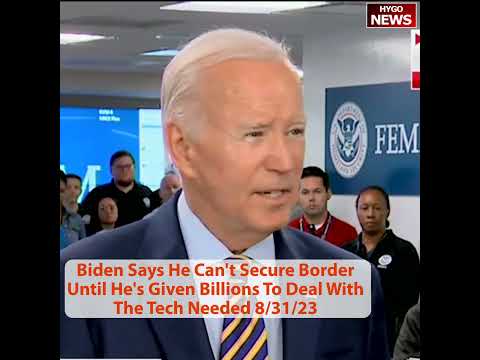
Biden Says Hurricane Idalia Made “Landfill,” Then Claims He Cannot Secure Border Without $15 Billion
On August 31, 2023, President Joe Biden delivered remarks at FEMA headquarters about Hurricane Idalia and managed to produce two noteworthy moments in rapid succession. First, Biden mispronounced “landfall” as “landfill” while describing the Category 3 hurricane’s impact on Florida, referring to “that category three storm that made landfill.” He then pivoted to the southern border crisis, claiming he needed approximately $15 billion from Congress “along the border to be able to deal with the technology needed” to address drug trafficking, framing border security as something he could not accomplish without massive congressional funding.
The clip captured both Biden’s persistent verbal difficulties and his standard border crisis deflection strategy in a single appearance, providing critics with another concise illustration of the dual problems plaguing his presidency.
The “Landfill” Gaffe
Biden’s mispronunciation of “landfall” as “landfill” during remarks about a major hurricane was the type of verbal error that would be minor in isolation but carried outsized significance given the pattern it belonged to.
“We then recover, at least doing an initial assessment of that category three storm that made landfill,” Biden said, apparently unaware of the substitution.
The word “landfall” is one of the most basic terms in hurricane and weather reporting vocabulary. It refers to the moment a storm’s center crosses a coastline. A “landfill,” by contrast, is a site for the disposal of waste. The confusion of these two very different words during prepared remarks about a natural disaster suggested that Biden was either not processing the words he was reading or was unable to distinguish between similar-sounding terms in real time.
This was not a case of an unfamiliar or technical term tripping up a speaker. “Landfall” is a word that any president discussing a hurricane would be expected to use fluently and correctly. The mispronunciation came during prepared remarks at FEMA headquarters, a setting where the president had access to written talking points and teleprompter assistance, making the error more concerning than an off-the-cuff slip might have been.
The gaffe added to a growing catalog of verbal stumbles that had become a defining feature of Biden’s public appearances. Previous instances included confusing cities, misremembering names of his own cabinet members, reading teleprompter instructions aloud, and constructing sentences that trailed off or contradicted themselves. Each individual error could be explained away, but the cumulative pattern pointed to persistent difficulty with verbal precision and real-time cognitive processing.
The $15 Billion Border Demand
Immediately after the landfill gaffe, Biden shifted topics to the southern border, making a claim that drew its own criticism.
“And one of the other things I’ve been asking the Congress for, it was a need about $15 billion along the border to be able to deal with the technology needed to be able to determine whether or not these precursor drugs are making it into Mexico or into the United States and dealing with that,” Biden said. “So there’s more to do there as well.”
The statement was significant for several reasons. First, Biden framed border security as dependent on congressional funding of $15 billion for technology, specifically for drug detection. This framing was consistent with the administration’s ongoing strategy of presenting border security as something that required legislative action rather than executive enforcement decisions.
Second, the focus on technology for detecting precursor drugs, while a legitimate concern, represented only a small slice of the border security challenge. The primary crisis at the southern border was the unprecedented flow of illegal crossings by migrants, which had set records throughout Biden’s presidency. By narrowing his border discussion to drug detection technology, Biden avoided addressing the broader enforcement failures that were driving the crisis.
Third, the $15 billion price tag was itself a political construct. The Trump administration had demonstrated that significant improvements in border security could be achieved through executive actions such as the Remain in Mexico policy, safe third country agreements, and enhanced ICE enforcement, none of which required billions in new technology spending. Biden’s framing suggested that border security was primarily a technology problem requiring massive spending, rather than a policy choice his administration had made by reversing effective enforcement measures.
The Pattern of Congressional Blame-Shifting
Biden’s border funding claim at FEMA headquarters was part of a consistent strategy of blaming Congress for the border crisis while ignoring the executive actions that had created it.
Upon taking office in January 2021, Biden had issued a series of executive orders that halted border wall construction, ended the Remain in Mexico policy, imposed a deportation moratorium, and narrowed ICE enforcement priorities. These actions did not require congressional approval and were directly responsible for the signals that triggered the unprecedented surge in illegal crossings.
By subsequently claiming that he needed billions from Congress to secure the border, Biden was essentially arguing that he could unilaterally open the border through executive action but could not secure it without legislative help. This internal contradiction was rarely challenged directly in press briefings but was obvious to anyone following the timeline of policy decisions and their consequences.
The strategy served a dual political purpose: it shifted blame for the border crisis from the administration to congressional Republicans, and it created a framework in which any border security legislation could be loaded with other Democratic priorities, such as immigration amnesty provisions, ensuring that Republican opposition could be framed as obstructing border security rather than rejecting unrelated policy riders.
The FEMA Visit Context
Both moments occurred during the same hastily arranged FEMA visit that had been added to Biden’s schedule only after the administration faced backlash for his handling of concurrent crises. Biden had originally planned no public events for August 31, and the FEMA appearance was designed to project engagement with the Hurricane Idalia response following weeks of criticism over his Maui wildfire response.
The fact that Biden’s scripted, staff-managed appearance at FEMA still produced multiple gaffe-worthy moments underscored the challenge facing the administration’s communications operation. If a carefully controlled environment with prepared remarks, teleprompter support, and a friendly venue like FEMA headquarters could not prevent “landfill” and a meandering border funding tangent, it raised questions about what more demanding settings might produce.
Hurricane Idalia’s Damage Assessment
The hurricane Biden was attempting to discuss had caused substantial damage across a wide area. The storm made landfall near Keaton Beach with 125 mph winds, producing devastating storm surge along the coast. Communities from Cedar Key to Steinhatchee experienced flooding, structural damage, and infrastructure disruption.
As the storm moved northeast, it continued to produce heavy rainfall and strong winds across Georgia and into the Carolinas. The total economic damage from Idalia was estimated at over $2.5 billion, with residential, commercial, and agricultural losses spread across multiple states.
Additional Context
Biden’s FEMA visit on August 31 produced multiple viral clips across several separately clipped moments: the jokes at the opening, the question avoidance, the “where am I going” confusion, the “landfill” mispronunciation, the climate change deniers attack, and the border funding demand. Together, these clips from a single brief appearance painted a comprehensive picture of a president struggling with basic communication tasks.
The border discussion during a hurricane response event was also notable for its incongruity. The purpose of the FEMA visit was ostensibly to discuss the hurricane response, yet Biden drifted into a discussion of border funding that had no direct connection to Hurricane Idalia, suggesting either a lack of message discipline or a deliberate attempt to work border talking points into any available setting.
Key Takeaways
- Biden mispronounced “landfall” as “landfill” during prepared remarks about Hurricane Idalia at FEMA headquarters, adding to his extensive catalog of verbal errors during scripted appearances.
- Biden claimed he needed approximately $15 billion from Congress for border technology to detect drug precursors, framing border security as dependent on congressional spending rather than executive enforcement decisions.
- The border funding request contradicted the reality that Biden had unilaterally reversed effective Trump-era border enforcement policies through executive action without requiring any congressional approval.
- Both moments occurred during a hastily scheduled FEMA visit that was added to the president’s calendar only after backlash over his handling of the Maui wildfires and other concurrent crises.
- The incongruity of discussing border spending during a hurricane response event illustrated the administration’s tendency to weave policy talking points into any available setting regardless of context.