 HYGO News
 Biden Homeland Security Advisor Won't Answer How Much Of U.S. Electrical Grid Is 'In Danger'
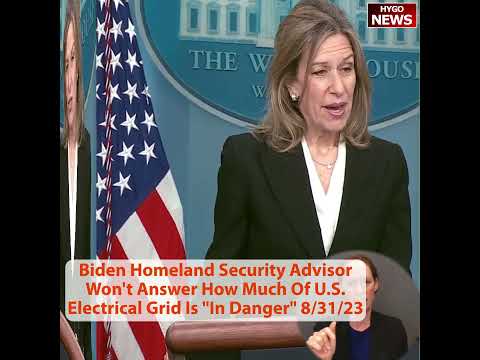
Biden Homeland Security Advisor Refuses to Answer How Much of U.S. Electrical Grid Is “In Danger”
On August 30, 2023, a reporter asked Biden Homeland Security Advisor Dr. Liz Sherwood-Randall about the state of the U.S. electrical grid in the wake of Hurricane Idalia, which had caused widespread power outages across Florida. The reporter asked a series of direct questions: had the administration conducted an assessment of grid vulnerabilities, what percentage of the grid needed upgrades, and how concerned should Americans be? Sherwood-Randall offered a vague response about investing in “the grid of the future,” and when the reporter pressed for specifics about how much of the grid was in danger, she abruptly shut down the line of questioning: “I think we should go on to others. Thanks.” Jean-Pierre then immediately moved to a different reporter.
The dismissive response highlighted the administration’s pattern of avoiding substantive answers about critical infrastructure vulnerabilities while touting its spending on green energy initiatives.
The Full Exchange
The reporter framed the question within the context of Hurricane Idalia’s impact: “Can you say a few words about the state of the U.S. electrical grid? The outages that we saw with Idalia raise concerns about that. I mean, can you — have you done an assessment? Do you know what percentage of the electrical grid is in need of upgrades? And how serious of a threat is that? How concerned should Americans be?”
Sherwood-Randall’s initial response pivoted immediately to spending talking points: “So, we are investing an enormous amount to ensure that we have the grid of the future that we need, both to power our clean energy future and also to provide resilient power to the American people.”
The response was notable for what it avoided. The reporter had asked four specific questions: about the state of the grid, whether an assessment had been done, what percentage needed upgrades, and how concerned Americans should be. Sherwood-Randall answered none of them, instead offering a forward-looking statement about investment in a future grid.
The reporter tried once more, distilling the question to its simplest form: “But can you say how much of the grid is in danger or is at risk or antiquated?”
Sherwood-Randall’s response was curt and final: “I think we should go on to others. Thanks.”
Jean-Pierre immediately moved on: “Go ahead, Kayla,” directing the briefing to a different reporter and ending any further inquiry into the electrical grid’s vulnerabilities.
The State of the U.S. Electrical Grid
The questions the reporter asked were not hypothetical or partisan. The American electrical grid faced well-documented challenges that had been identified by government agencies, industry groups, and independent analysts for years.
The American Society of Civil Engineers had given the nation’s energy infrastructure a grade of C-minus in its 2021 Infrastructure Report Card, noting that the majority of the grid was built between the 1950s and 1970s and was operating beyond its originally intended lifespan. Many of the nation’s approximately 7,300 power plants, 160,000 miles of high-voltage transmission lines, and millions of miles of local distribution lines were aging and increasingly vulnerable to extreme weather events.
The Department of Energy’s own reports had identified significant vulnerabilities in the grid’s ability to withstand and recover from both natural disasters and cyberattacks. A 2021 National Academy of Sciences study concluded that the grid faced “increasing risks from climate-related extreme weather events” and that significant investment was needed to modernize infrastructure and improve resilience.
Hurricane Idalia’s impact on the Florida grid illustrated these vulnerabilities in real time. At the peak of the storm’s impact, over 500,000 customers in Florida were without power. While utility crews worked to restore service, the outages affected hospitals, water treatment facilities, and other critical services. The speed with which a single hurricane could disrupt power for hundreds of thousands of people underscored the reporter’s question about how much of the grid was at risk.
Why the Administration Wouldn’t Answer
Sherwood-Randall’s refusal to provide specifics about grid vulnerabilities likely reflected several overlapping considerations.
First, an honest assessment of the grid’s condition would have been politically embarrassing. Despite the Biden administration’s massive spending on climate and energy initiatives through the Inflation Reduction Act and the Infrastructure Investment and Jobs Act, much of that funding was directed toward building new renewable energy capacity rather than hardening existing infrastructure. Acknowledging that a significant percentage of the grid was “in danger” or “antiquated” would have raised questions about the administration’s spending priorities.
Second, the administration’s energy policy was focused on transitioning the grid away from fossil fuels and toward renewable sources, a process that introduced its own reliability challenges. The push to retire baseload coal and natural gas plants before adequate replacement capacity was built created vulnerabilities that the administration preferred not to discuss publicly. Grid operators in multiple regions had warned about potential reliability shortfalls during extreme weather events.
Third, providing specific numbers about grid vulnerabilities could have been used by critics to challenge the administration’s broader energy agenda. If, for example, the administration acknowledged that 30 or 40 percent of the grid needed significant upgrades, the obvious follow-up question would be why hundreds of billions in energy spending were going toward green energy subsidies rather than grid hardening.
The Clean Energy Priority
Sherwood-Randall’s reference to “the grid of the future” and a “clean energy future” was telling. Rather than addressing the current state of the grid, she oriented her answer entirely around the administration’s forward-looking energy transition goals. This framing suggested that the administration viewed grid modernization primarily through the lens of clean energy transition rather than resilience and reliability.
The Inflation Reduction Act included billions in tax credits and subsidies for renewable energy projects, electric vehicles, and clean energy manufacturing, but critics argued that insufficient attention was being paid to the reliability and resilience of the existing grid during the transition period. Adding intermittent renewable capacity without simultaneously strengthening the transmission and distribution infrastructure risked creating a grid that was greener on paper but less reliable in practice.
The Infrastructure Investment Gap
The Biden administration’s bipartisan Infrastructure Investment and Jobs Act, signed in November 2021, did include funding for grid modernization, including approximately $65 billion for power infrastructure. However, the deployment of that funding was slow, with much of it still in the planning and application stages by August 2023. The gap between announced spending and actual grid improvements meant that Americans were living with the same vulnerable infrastructure while being told that help was on the way.
Additional Context
The reporter’s questions about the electrical grid came during a period when grid reliability was a growing national concern. In December 2022, Winter Storm Elliott had knocked out power to millions across the eastern United States and pushed several regional grid operators to the brink of rolling blackouts. Texas had famously experienced a catastrophic grid failure during Winter Storm Uri in February 2021, killing over 200 people.
These events had elevated public awareness of grid vulnerabilities and made questions about grid resilience highly relevant to the Hurricane Idalia discussion. Sherwood-Randall’s dismissal of the questions, rather than providing a substantive response, suggested the administration was either unprepared to discuss the grid’s actual condition or unwilling to be transparent about the challenges ahead.
The exchange also underscored a broader pattern within the Biden administration of deflecting difficult questions about infrastructure, energy policy, and emergency preparedness by referencing long-term spending commitments rather than addressing current realities.
Key Takeaways
- Biden Homeland Security Advisor Dr. Liz Sherwood-Randall refused to answer how much of the U.S. electrical grid was “in danger” or antiquated, dismissing the question with “I think we should go on to others.”
- The reporter asked four specific questions about grid assessments, upgrade needs, and risk levels, none of which Sherwood-Randall answered, instead pivoting to talking points about investing in “the grid of the future.”
- Hurricane Idalia had just knocked out power to over 500,000 Florida customers, making the grid vulnerability question directly relevant to the day’s events.
- The American Society of Civil Engineers had graded the nation’s energy infrastructure a C-minus, with much of the grid built decades ago and operating beyond its intended lifespan.
- The administration’s energy spending was heavily weighted toward clean energy transition rather than hardening existing infrastructure, a priority that Sherwood-Randall’s “grid of the future” language reinforced rather than addressed.