 HYGO News
 Biden fumbling mumbling: I hope — I — I , — again, to ad-lib a second here — I — , — you — anyway
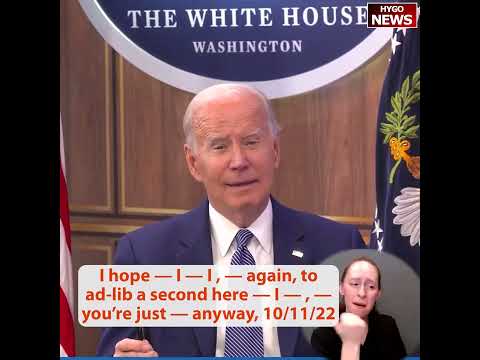
Biden Fumbles Through Virtual Fire Summit Remarks: “I Hope — I — I — Again, to Ad-Lib a Second Here — I — You’re Just — Anyway”
On 10/11/2022, President Biden delivered virtual remarks at the Summit on Fire Prevention and Control from the South Court Auditorium — the White House’s purpose-built set with a digital backdrop. Biden struggled visibly to form coherent sentences, fumbling through multiple false starts, losing his place mid-thought, and eventually giving up with “you’re just — anyway, you’re an incredible group of individuals.” The attempt to “ad-lib” — which Biden announced while doing it — devolved into a string of half-started sentences, self-corrections, and verbal dead ends that captured the speaking difficulties drawing increasing public scrutiny.
”I Can’t Quite See What — I Can’t See”
Biden opened his remarks with visible confusion about the virtual setup. “I hope — I can’t quite see what — I can’t see in the front there, I think,” Biden said, apparently struggling to see the audience through the virtual format.
“And I actually wish I could be there with you in person. You know, I mean it,” Biden continued, adding the qualifier “I mean it” — a verbal tic Biden deployed frequently, seemingly to preempt skepticism about the sincerity of his statements. The phrase appeared in virtually every Biden speech, often attached to routine remarks that no one would question, creating an unintentional effect of drawing attention to whether he meant the things he was saying.
The virtual format itself was notable. Biden regularly delivered remarks from the South Court Auditorium rather than the Oval Office or other traditional presidential venues. The room featured elaborate digital screens that displayed backgrounds designed to look like the White House or other settings — an arrangement critics compared to a television set. The setup allowed for teleprompter use and controlled environments, but Biden’s difficulties persisted regardless.
”To Ad-Lib a Second Here”
The most striking passage came when Biden attempted to depart from his prepared remarks. “You know, and I’ve had — and by the way, I again, to add a little bit second here — I — you know, you’re also, what people don’t realize, you’re the same folks who are there holding the boot in the corner to raise money for the people who just lost their home,” Biden said.
The sentence was nearly impossible to parse. Biden appeared to be trying to praise firefighters for their community involvement beyond firefighting — specifically the tradition of firefighters holding out a boot at intersections to collect donations for families affected by fires or other emergencies. But getting from the intention to the words required navigating a maze of false starts, parenthetical insertions, and lost trains of thought.
Biden then added his characteristic emphasis: “Not a joke. That’s what you do. That’s what you do.” The repetition of “that’s what you do” and the insistence “not a joke” were patterns Biden fell into when he sensed he was losing coherence — repeating simple declarative statements to regain footing before attempting the next thought.
”You’re the One — You’re Just — Anyway”
The passage concluded with Biden trailing off entirely. “You’re the ones who line the little league fields. You’re the one — you’re just — anyway, you’re an incredible group of individuals,” Biden said. “You know, in Delaware.”
The “anyway” was an implicit acknowledgment that the thought had gotten away from him. Biden was attempting to list the ways firefighters serve their communities — holding donation boots, lining little league fields — but couldn’t sustain the list or find a natural conclusion. The pivot to “you’re an incredible group of individuals” was a generic compliment used to escape a verbal cul-de-sac, and the trailing “you know, in Delaware” seemed to be the beginning of another thought that Biden decided not to pursue.
The passage encapsulated a pattern that had become familiar to anyone watching Biden’s public appearances in 2022: the president would begin a thought, lose the thread partway through, attempt to recover with a restart, lose it again, and eventually abandon the sentence with a filler phrase or generic statement.
The South Court Auditorium
Biden’s use of the South Court Auditorium for the virtual summit was part of a broader pattern that drew criticism throughout his presidency. The auditorium, located in the Eisenhower Executive Office Building adjacent to the White House, had been converted into a studio with large digital screens that could display any backdrop — including realistic images of the White House itself.
Critics noted that Biden used the set more frequently than any previous president, raising questions about why the president was delivering remarks from a facsimile of the White House rather than the actual White House. Some observers speculated the setup was preferred because it allowed for larger teleprompters and more controlled conditions. Others argued it was simply a modern communications tool that previous presidents hadn’t had available.
Regardless of the reason, the artificial setting added to the perception that Biden’s public appearances were carefully managed to minimize the risk of unscripted moments — a strategy undermined by the very ad-lib difficulties on display in the fire summit remarks.
The Fire Summit Context
The Summit on Fire Prevention and Control was a legitimate policy event focused on federal support for firefighters, fire prevention resources, and emergency response coordination. Fire prevention week is observed annually in October, and presidential remarks at fire-related events are routine.
Biden had personal connections to the firefighting community that he frequently referenced. He often told stories about a house fire that damaged his family’s home in 2004, and he had cultivated relationships with fire service unions throughout his political career. The International Association of Fire Fighters was one of the first major unions to endorse Biden’s 2020 presidential campaign.
The policy substance of Biden’s remarks — praising firefighters’ community service, acknowledging their sacrifices, and affirming federal support — was uncontroversial. But coverage of the event focused almost entirely on the verbal difficulties rather than the policy content, continuing a pattern where Biden’s delivery overshadowed his message.
The Verbal Pattern in October 2022
Biden’s fire summit remarks came during a particularly dense period of verbal stumbles in October 2022. In the same week, Biden had struggled with teleprompter speed in Puerto Rico, started sudden screaming at a Maryland factory tour, claimed his son Beau died in Iraq rather than of brain cancer at Walter Reed, and made the “progeny” misstatement about tribal lands in Colorado.
The accumulation of incidents intensified public discussion about Biden’s fitness for office — a conversation the White House consistently refused to engage with. Press Secretary Karine Jean-Pierre deflected questions about Biden’s verbal difficulties, and allies in media characterized concerns as ageist or politically motivated.
But the video evidence continued to accumulate. Each event — the stumbles, the false starts, the mid-sentence abandonments, the confused statements — was individually defensible as a minor gaffe, but the pattern across dozens of appearances told a story that individual incidents did not.
Key Takeaways
- Biden fumbled through virtual fire summit remarks, producing a string of half-started sentences and self-corrections that were nearly impossible to parse.
- He announced he was going to “ad-lib” and then immediately lost his train of thought, eventually giving up with “you’re just — anyway.”
- Biden used the South Court Auditorium’s digital set rather than traditional White House venues, a choice critics questioned as designed to minimize unscripted risk.
- The stumbles came during a dense week of verbal difficulties including the Beau/Iraq claim, Puerto Rico teleprompter struggles, and screaming episodes.
- The policy substance — praising firefighters’ community service — was entirely overshadowed by the delivery.
Transcript Highlights
The following is transcribed from the video audio (unverified — AI-generated from audio).
- I hope — I can’t quite see what — I can’t see in the front there, I think.
- I actually wish I could be there with you in person. You know, I mean it.
- I again, to add a little bit second here — I — you know, you’re also, what people don’t realize, you’re the same folks holding the boot in the corner.
- Not a joke. That’s what you do. That’s what you do.
- You’re the ones who line the little league fields. You’re the one — you’re just — anyway, you’re an incredible group of individuals.
- You know, in Delaware.
Full transcript: 120 words transcribed via Whisper AI.