 HYGO News
 Biden forgets name of his own DHS Mayorkas, White Supremacy is the Greatest Terrorist
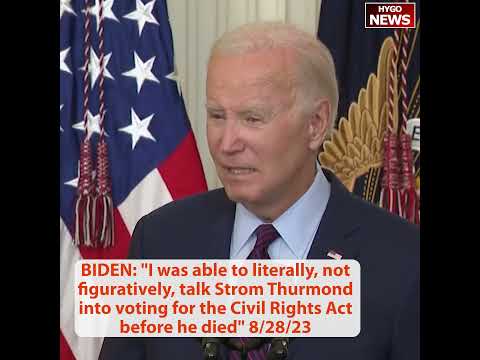
Biden Forgets Name of His Own DHS Secretary Mayorkas, Claims White Supremacy Is the Greatest Terrorist Threat
On August 28, 2023, President Joe Biden delivered remarks at a reception commemorating the 60th anniversary of the founding of the Lawyers’ Committee for Civil Rights Under Law. The event, which brought together civil rights advocates and legal professionals, was intended to highlight the administration’s commitment to civil rights. Instead, the appearance generated headlines for a series of notable gaffes, including Biden forgetting the name of his own Department of Homeland Security Secretary Alejandro Mayorkas and making a historically inaccurate claim about Senator Strom Thurmond and the Civil Rights Act.
The clip compiled multiple moments from Biden’s public appearances that day, including his remarks at the Lawyers’ Committee reception and his meeting with civil rights leaders at the White House, offering a concentrated look at a particularly gaffe-filled day for the then-80-year-old president.
Biden Forgets DHS Secretary Mayorkas’s Name
One of the most discussed moments from the reception came when Biden attempted to acknowledge his own cabinet member, DHS Secretary Alejandro Mayorkas, who was present at the event.
Rather than using Mayorkas’s name, Biden stumbled through the reference: “Secretary of Homeland Security, a guy who took the job. Thank you for taking the job, pal.”
The inability to recall the name of one of his most prominent cabinet officials drew immediate attention. Mayorkas had been a central figure in the administration’s handling of the border crisis and had been the subject of impeachment proceedings initiated by House Republicans. As one of the most frequently discussed members of Biden’s cabinet, his name was a regular fixture in political news coverage, making the lapse all the more striking.
This was not an isolated incident. Throughout his presidency, Biden had repeatedly struggled to recall the names of his own appointees, cabinet members, and world leaders during public appearances, fueling ongoing concerns about his cognitive fitness for office.
The White Supremacy Claim
During the same reception, Biden made a sweeping declaration about domestic terrorism that drew criticism from political opponents.
“The U.S. intelligence community has determined that domestic terrorism rooted in white supremacy is the greatest terrorist threat we face in the homeland,” Biden stated.
Biden offered this assertion without citing specific data, studies, or intelligence reports to substantiate the claim. While some intelligence assessments had flagged domestic violent extremism as a growing concern, critics noted that Biden’s characterization oversimplified a complex threat landscape and was used as a political talking point rather than a serious policy discussion.
The claim had become a recurring theme in Biden’s rhetoric on domestic security. He had made similar statements multiple times throughout his presidency, often in the context of events focused on racial justice or civil rights. Critics argued that by repeatedly emphasizing white supremacy as the top domestic terror threat, Biden was engaging in divisive rhetoric that failed to address the full spectrum of security challenges facing the country, including threats from other extremist ideologies and the crisis at the southern border.
The Strom Thurmond Fabrication
Perhaps the most factually problematic moment of the evening came when Biden claimed he had personally convinced the late Senator Strom Thurmond of South Carolina to support the Civil Rights Act.
“I was able to literally, not figuratively, talk Strom Thurmond into voting for the Civil Rights Act before he died,” Biden told the audience.
This statement contained multiple historical inaccuracies that were quickly identified by fact-checkers and political commentators.
First and most fundamentally, Thurmond voted against the Civil Rights Act of 1964. Far from being persuaded to support the legislation, Thurmond mounted the longest one-person filibuster in Senate history at the time, speaking for over 24 hours and 18 minutes in an attempt to block the bill’s passage. Thurmond was one of the most vocal and determined opponents of the Civil Rights Act, making Biden’s claim that he convinced Thurmond to vote for it demonstrably false.
Second, the timeline made the claim impossible on its face. The Civil Rights Act was passed in 1964, when Biden was just 21 years old and had no political office or influence. Biden was not elected to the United States Senate until 1972, with his first term beginning in January 1973, nearly a decade after the Civil Rights Act became law. Thurmond did not pass away until June 2003, almost 40 years after the legislation was enacted.
While Biden and Thurmond did serve together in the Senate for decades and were known to have a working relationship despite their ideological differences, Biden’s suggestion that he played a role in Thurmond’s position on the Civil Rights Act was a fabrication. Biden had a documented history of embellishing his involvement in the civil rights movement, despite evidence that as a young man he had no meaningful participation in civil rights activism. His early political career included working closely with segregationist senators like James Eastland of Mississippi.
Biden Versus the Teleprompter
The event also produced another teleprompter struggle that highlighted Biden’s difficulty with prepared remarks. While discussing a civil rights figure, Biden read aloud his own teleprompter correction in real time.
“He pursued a righteous calling that threw him brought him back here. I was gonna say threw him back here, but it brought him back here, kinda threw him as well, back here to Washington,” Biden said, visibly working through a sentence that had apparently been revised on the teleprompter.
The moment illustrated a recurring challenge for Biden, who frequently read teleprompter instructions or stage directions aloud, or stumbled when text was modified during a speech. These incidents became a staple of political commentary and social media discussion throughout his time in office, as critics pointed to them as evidence of declining mental acuity.
Additional Context
The August 28, 2023 appearances came during a period of intensifying scrutiny over Biden’s fitness for office. At 80 years old, Biden was already the oldest person to serve as president, and questions about his mental sharpness had become a persistent theme in political coverage.
These concerns would only grow in the months that followed, eventually culminating in Biden’s disastrous debate performance against Donald Trump in June 2024, which accelerated calls from within his own party for him to step aside. Biden ultimately withdrew from the 2024 presidential race in July 2024.
The Lawyers’ Committee for Civil Rights Under Law, the organization hosting the reception where these remarks were made, was founded in 1963 at the request of President John F. Kennedy. The committee was established to involve private attorneys in providing legal services to address racial discrimination. Its 60th anniversary was meant to be a celebratory occasion, but the attention instead focused on Biden’s verbal missteps and historical inaccuracies.
Alejandro Mayorkas, the DHS secretary whose name Biden could not recall, went on to become the first sitting cabinet member to be impeached by the House of Representatives in February 2024, though the Senate dismissed the charges without a trial.
Key Takeaways
- Biden forgot the name of his own DHS Secretary Alejandro Mayorkas during a public reception, referring to him only as “the guy who took the job” and “pal.”
- Biden claimed without supporting evidence that “domestic terrorism rooted in white supremacy is the greatest terrorist threat we face in the homeland.”
- Biden falsely claimed he convinced Senator Strom Thurmond to vote for the Civil Rights Act, when in reality Thurmond voted against it and filibustered it for over 24 hours. Biden was only 21 years old and held no political office when the act was passed in 1964.
- Biden struggled with his teleprompter, reading aloud a mid-sentence correction rather than smoothly delivering the revised line.
- The event highlighted the ongoing concerns about Biden’s cognitive fitness that would intensify throughout 2023 and into 2024, ultimately contributing to his withdrawal from the presidential race.