 HYGO News
 Biden FEMA Admin Won't Comment On 'Who Was In Charge' During Maui Wildfires Disaster
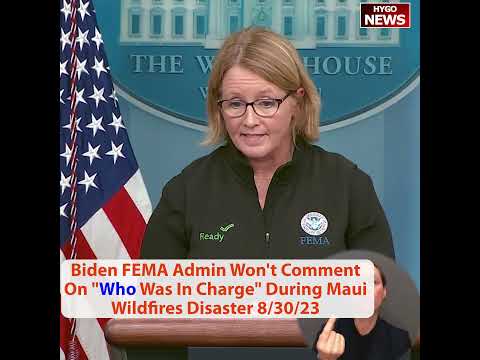
Biden FEMA Admin Refuses to Comment on “Who Was in Charge” During Maui Wildfires Disaster
On August 30, 2023, a reporter pressed Biden FEMA Administrator Deanne Criswell on one of the most urgent and unanswered questions surrounding the Maui wildfires: who was in charge during the critical hours when the fires burned through Lahaina and in the chaotic aftermath? Despite being the head of the nation’s emergency management agency and possessing decades of experience in emergency response, Criswell declined to assess how local officials had handled the disaster, saying only that she “was not there” and would be “out of line” to comment.
When asked whether she was prepared to testify before Congress about the federal response, Criswell offered a carefully worded reply: she would be happy to testify “on what the federal role was in this process,” a limitation that conspicuously excluded any assessment of the state and local failures that had contributed to the disaster’s devastating death toll.
The Full Exchange
The reporter set up the question with the weight it deserved: “I’m going to take you back to Hawaii, if I could, Administrator, because there is still a lot of questions among officials in Maui and Lahaina and across Hawaii about who was in charge in the hours as the fires burned and in the hours after.”
The reporter then noted Criswell’s extensive background: “You’re a veteran local emergency management official, state emergency management official, now at the federal level. How do you assess how officials there responded? Are there lessons to be learned, perhaps, for other communities? And is your agency prepared to work with congressional Republicans if they launch investigations, as they say they will?”
Criswell’s response was a masterclass in bureaucratic evasion: “Again, I was not there during the response, and so I would be out of line to assess how they responded during the time because I did not experience what they were experiencing.”
The reporter pressed on the question of whether Criswell had been briefed by FEMA personnel who were on the ground in Hawaii. Criswell’s answer revealed the thin nature of the federal presence: “What I was briefed on throughout the time is my Regional Administrator Bob Fenton happened to be in Oahu for another meeting.”
The phrase “happened to be” was telling. Rather than describing a deliberate federal deployment to address the disaster, Criswell was acknowledging that the FEMA regional administrator’s presence in Hawaii was coincidental, a result of a pre-existing meeting rather than a rapid response to the catastrophe.
On the question of congressional testimony, the reporter asked directly: “And if congressional Republicans want you or other agency officials to testify about what went on in Hawaii, are you willing to do so?”
Criswell’s response was measured and limiting: “I’m happy to testify on what the federal role was in this process.” The careful phrasing, restricting her testimony to “the federal role,” signaled that the FEMA administrator had no intention of addressing the broader failures in the Maui response, even under oath.
The Leadership Vacuum in Lahaina
The question of “who was in charge” was not rhetorical. The Maui wildfires exposed a catastrophic leadership vacuum at every level of government during the most critical hours of the disaster.
At the county level, Maui County’s emergency management administrator, Herman Andaya, made the fateful decision not to activate the island’s outdoor warning siren system as the fires advanced on Lahaina. Andaya later defended the decision by claiming he was concerned that residents might interpret the sirens as a tsunami warning and flee toward the ocean, directly into the path of the fire. Emergency management experts widely criticized this reasoning, noting that the sirens were designed for all hazards, not exclusively tsunamis, and that any warning was better than no warning at all.
The failure to sound the sirens meant that many Lahaina residents received no audible alert about the approaching fires. Cell towers were destroyed early in the disaster, cutting off digital communication. Many people learned about the fire only when they saw flames approaching their homes, leaving virtually no time for evacuation.
Andaya resigned from his position shortly after the disaster, but his departure did not answer the broader question of who was coordinating the response during the critical initial hours. Maui County officials, state agencies, and federal resources all appeared to have operated in separate channels with minimal coordination.
FEMA’s Responsibility
Criswell’s insistence that she could not assess the local response because she “was not there” was a notable departure from the standard expected of a federal emergency management administrator. The head of FEMA was expected to be fully briefed on all aspects of a major disaster response, including the performance of state and local partners. After-action assessments of emergency responses were a fundamental part of the emergency management discipline, and Criswell’s background as a veteran emergency management professional made her more than qualified to offer such an assessment.
Her refusal to do so was widely interpreted as a political decision rather than a professional one. Criticizing the local response in Maui would have meant criticizing Democratic officials in a Democratic state, something the Biden administration’s FEMA administrator was apparently unwilling to do, even when the failures had contributed to over 100 deaths.
The revelation that FEMA’s regional administrator had only been in Hawaii by coincidence raised additional questions about the agency’s preparedness and response capabilities. The Maui wildfires were a major disaster on American soil, and the federal government’s premier emergency management agency appeared to have stumbled into the response rather than executing a deliberate, rapid deployment.
The Congressional Investigation
House Republicans’ plans to investigate the federal response to the Maui wildfires reflected growing bipartisan concern about accountability. While Democrats were less vocal about demanding investigations, the sheer scale of the disaster and the evident failures at every level of government made some form of review politically unavoidable.
Criswell’s willingness to testify only about “the federal role” rather than the overall response suggested the administration was preparing to draw a narrow circle around federal actions while deflecting responsibility for the local and state failures that were arguably more directly responsible for the death toll. This approach would have allowed FEMA to present its own actions in the most favorable light while avoiding uncomfortable questions about the broader leadership failures.
Failures That Cost Lives
The emergency management failures during the Maui wildfires were not abstract bureaucratic shortcomings. They had direct, measurable consequences in human lives.
The failure to activate warning sirens left thousands of Lahaina residents without advance notice. The destruction of cell infrastructure eliminated digital warning capability. The lack of a coordinated evacuation plan for Lahaina, despite the community’s known wildfire risk, meant that when residents did attempt to flee, they encountered jammed roads, downed power lines, and no clear guidance on safe routes.
Hawaiian Electric’s decision not to de-energize power lines despite extreme wind conditions was identified as a probable ignition source for the fires. The utility’s lines, many of which had not been properly maintained or upgraded, were toppled by hurricane-force winds and ignited dry vegetation. The absence of a pre-established power shutoff protocol, a safety measure that had become standard practice in wildfire-prone areas of California, represented a fundamental failure of preparation.
Additional Context
The Maui wildfires killed at least 100 people, destroyed approximately 2,200 structures, and caused an estimated $5.5 billion in damage. The town of Lahaina, a historic whaling community and popular tourist destination, was almost entirely destroyed. Many of the victims were elderly or mobility-impaired residents who were unable to evacuate quickly enough without advance warning.
In the months following the disaster, multiple investigations and lawsuits were launched, including criminal investigations into potential negligence by Hawaiian Electric and local officials. The question of “who was in charge” that the reporter raised with Criswell would become one of the central threads of these proceedings.
Key Takeaways
- FEMA Administrator Deanne Criswell refused to assess how local officials responded during the Maui wildfires, stating “I was not there” despite her decades of emergency management experience and obligation to be fully briefed on major disasters.
- Criswell revealed that FEMA’s regional administrator was only in Hawaii by coincidence, having been on Oahu for a pre-existing meeting, rather than as part of a deliberate federal response.
- When asked about congressional testimony, Criswell said she would testify only about “the federal role,” conspicuously excluding any assessment of state and local failures.
- The question of “who was in charge” reflected catastrophic leadership failures including the decision not to activate warning sirens, the destruction of communication infrastructure, and the absence of a coordinated evacuation plan.
- Criswell’s evasive answers were widely interpreted as political protection for Democratic state and local officials whose failures had contributed to the death toll.