 HYGO News
 Biden FEMA Admin: No Plans To Provide Maui Wildfire Victims Anything Beyond One-Time $700 Checks
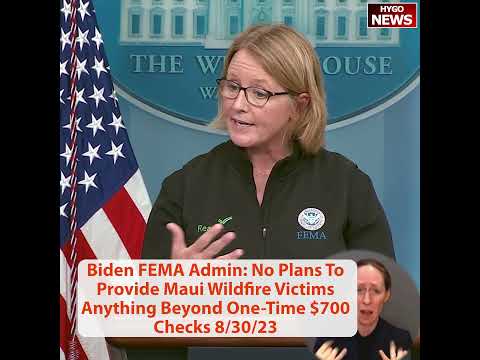
Biden FEMA Admin Confirms No Plans to Provide Maui Wildfire Victims Anything Beyond One-Time $700 Checks
On August 30, 2023, a reporter pressed Biden FEMA Administrator Deanne Criswell about the Critical Needs Assistance payments being provided to victims of the catastrophic Maui wildfires. The reporter specifically asked whether anything was being done to raise the $700 cap given the extreme cost of living in Hawaii and the Lahaina community. Criswell’s response confirmed what many had feared: the $700 was the extent of immediate emergency assistance, and victims who had exhausted that money were essentially “on their own” while waiting for access to additional aid through a longer bureaucratic process.
The exchange became one of the most cited moments of the federal response to the Maui wildfires, crystallizing public anger over the perceived inadequacy of the government’s assistance to families who had lost everything in the deadliest wildfire in modern American history.
The Full Exchange
The reporter laid out the concern directly: “About the critical needs assistance that was provided to those in Maui, $700 in payments to individuals there given the cost of living in Hawaii specifically in the Lahaina community. Is anything being done right now, are there considerations or efforts being made to try to raise that cap, that $700 figure for those who are there?”
Criswell’s answer was bureaucratic and detached: “Yeah, the $700 figure of critical needs assistance is really just that amount of funding for some of the very immediate needs that individuals have. Every year the main part of our assistance, which is our individual and household program, adjusts annually based on inflation. This year it’s $41,000 of a cap that individuals can get.”
The reporter then clarified the gap between the immediate $700 payment and the additional assistance: “$700 is it for now and then they can pursue those other monies going forward, but if people have run through that money right now they’re on their own until they get access to the further assistance coming.”
Criswell did not dispute this characterization. Instead, she pivoted to registration numbers: “And we already have, I think it was 12,000 individuals that registered” for assistance in Maui.
The exchange confirmed three critical points: the $700 was the only immediate cash assistance available, additional aid required a separate application process that would take time, and families who had already spent their $700 had no further safety net while they waited.
Why $700 Was Insulting in Hawaii
To understand the outrage over the $700 figure, it was essential to consider the economic reality of Hawaii, and particularly the Lahaina community on Maui’s west side.
Hawaii consistently ranked as the most expensive state in the United States across virtually every cost-of-living metric. The median home price in Lahaina before the fires was approximately $1.1 million. Monthly rents for even modest apartments on Maui typically exceeded $2,000 and could reach $3,000 or more. A gallon of milk cost over $7. A modest grocery run for a family could easily exceed $200.
In this context, $700 was not enough to cover a week’s worth of basic living expenses for a displaced family. It would not cover a single month’s rent. It would not cover the cost of replacing essential clothing, toiletries, and household items for a family of four. For people who had literally watched their homes, vehicles, and all possessions burn to ash, $700 was a figure so inadequate as to feel like an insult.
The $41,000 maximum that Criswell cited as potentially available through the Individual and Household Program sounded more substantial, but it came with significant caveats. The process to access those funds required documentation, inspections, and approvals that could take weeks or months. Many Maui fire victims had lost all their documents in the fire. And $41,000, while better than $700, was still a fraction of what most families needed to rebuild their lives in one of the most expensive housing markets in the country.
The Contrast With Other Federal Spending
The $700 payment became even more politically explosive when set against the backdrop of the Biden administration’s spending priorities elsewhere. At the time of the Maui wildfires, the United States had committed over $75 billion in aid to Ukraine since Russia’s invasion in February 2022. The administration was actively seeking additional billions in military and economic assistance.
The contrast was inescapable: American families who had lost everything in a natural disaster were receiving $700 in immediate aid, while the federal government was sending billions overseas. Critics did not argue that the Ukraine situation was unimportant, but rather that the disparity in urgency and generosity between foreign aid and domestic disaster relief revealed the administration’s priorities.
The comparison extended beyond Ukraine. The administration had allocated billions for climate initiatives through the Inflation Reduction Act, billions more for infrastructure projects, and had overseen significant increases in federal spending across numerous categories. Against this backdrop, the $700 FEMA payment looked not like a funding limitation but like a priority choice.
FEMA’s Structural Problems
Criswell’s answer about the $700 being “just that amount of funding for some of the very immediate needs” revealed a structural problem with FEMA’s disaster assistance framework that went beyond any single administration’s policies.
The Critical Needs Assistance program was designed as a rapid-deployment tool to help disaster victims address their most urgent needs in the immediate aftermath of an event: food, water, basic supplies, and temporary shelter costs. The $700 figure was a standardized amount applied nationally, regardless of local cost-of-living differences, meaning a family in rural Mississippi received the same immediate assistance as a family in Lahaina, Hawaii, despite vastly different costs of living.
This one-size-fits-all approach had been a known deficiency in FEMA’s assistance programs for years, but no administration had addressed it. The Maui wildfires simply brought the problem into sharp public focus because of the extreme disparity between the assistance amount and the local economic reality.
The 12,000 Registration Figure
Criswell’s mention that approximately 12,000 individuals had registered for FEMA assistance in Maui, with over $15 million distributed, provided some scale to the disaster’s impact. With Lahaina’s pre-fire population of approximately 13,000, the registration figure suggested that the vast majority of the town’s residents had been affected severely enough to seek federal help.
The $15 million distributed figure, while sounding significant in isolation, averaged out to approximately $1,250 per registered individual, slightly above the $700 Critical Needs Assistance baseline but still far below what was needed for meaningful recovery in Hawaii’s economy.
Additional Context
The FEMA $700 payment controversy became one of the defining symbols of the Biden administration’s Maui response, alongside the president’s “no comment” from the beach, his comparison of the Lahaina disaster to a kitchen fire at his own home, and his delayed visit to the island. Together, these moments created a narrative of federal indifference that persisted throughout the recovery process and became a significant issue in the 2024 presidential campaign.
In the months following the disaster, Congress approved additional disaster relief funding, and FEMA expanded its assistance programs for Maui victims. However, the slow pace of recovery, the challenges of rebuilding in Hawaii’s regulatory environment, and the ongoing displacement of thousands of Lahaina residents kept the issue in the public consciousness well beyond the initial emergency.
Key Takeaways
- FEMA Administrator Deanne Criswell confirmed that the $700 Critical Needs Assistance payment was the only immediate cash aid for Maui wildfire victims, with additional assistance available only through a longer application process.
- A reporter noted that victims who had spent their $700 were “on their own” while waiting for further aid, a characterization Criswell did not dispute.
- The $700 figure was widely criticized as insulting given Hawaii’s extreme cost of living, where median home prices exceeded $1 million and basic necessities cost far more than the national average.
- Approximately 12,000 individuals had registered for FEMA assistance in Maui at the time, with about $15 million distributed, averaging roughly $1,250 per person.
- The payment became a symbol of the disconnect between the administration’s spending on foreign aid and climate initiatives versus its assistance to American disaster victims.