 HYGO News
 Biden FEMA Admin: No Plans To Provide Maui Beyond One-Time $700; Climate Change? Who Was In Charge?
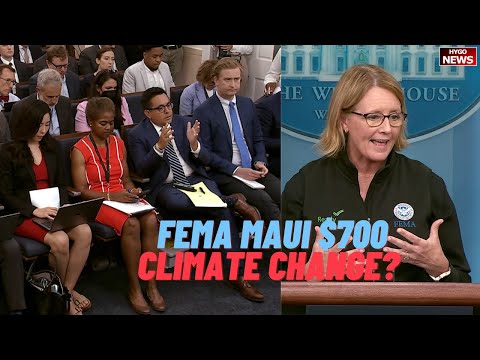
Biden FEMA Admin: No Plans to Provide Maui Wildfire Victims Anything Beyond One-Time $700 Checks
On August 30, 2023, Biden FEMA Administrator Deanne Criswell faced questions from reporters about the federal response to the devastating Maui wildfires that had struck the island earlier that month. In a series of exchanges that drew sharp criticism, Criswell confirmed that there were no immediate plans to increase the one-time $700 Critical Needs Assistance payments to wildfire victims, deflected questions about climate change’s role in the disaster, and refused to assess how local officials had responded during the crisis, saying only that she “was not there.”
The press conference captured three distinct moments of frustration: the inadequacy of federal financial assistance, the administration’s attempt to link the disaster to climate change, and the refusal to provide accountability for the chaotic response during the deadliest wildfire in modern American history.
The $700 Payment Controversy
A reporter pressed Criswell about the $700 Critical Needs Assistance payments that had become a flashpoint of public anger, particularly given the extreme cost of living in Hawaii and the Lahaina community specifically.
“About the critical needs assistance that was provided to those in Maui, $700 in payments to individuals there given the cost of living in Hawaii specifically in the Lahaina community,” the reporter began. “Is anything being done right now, are there considerations or efforts being made to try to raise that cap, that $700 figure for those who are there?”
Criswell’s response did little to reassure victims: “Yeah, the $700 figure of critical needs assistance is really just that amount of funding for some of the very immediate needs that individuals have. Every year the main part of our assistance, which is our individual and household program, adjusts annually based on inflation. This year it’s $41,000 of a cap that individuals can get.”
The reporter pressed further, noting the immediate reality facing displaced families: “$700 is it for now and then they can pursue those other monies going forward, but if people have run through that money right now they’re on their own until they get access to the further assistance coming.”
Criswell acknowledged that approximately 12,000 individuals had registered for assistance in Maui and that “somewhere over $15 million” had been distributed, but her answer effectively confirmed that the $700 was the extent of immediate relief, with additional assistance available only through a longer application process.
The $700 figure became a symbol of the Biden administration’s perceived indifference to the Maui disaster. Critics pointed out the stark contrast between the relatively modest assistance offered to American citizens who had lost everything and the billions of dollars the administration was sending to Ukraine. The optics were made worse by the fact that President Biden was on vacation in Delaware during the early stages of the disaster response and had initially offered a one-word response of “no comment” when asked about the rising death toll.
The Climate Change Deflection
A second reporter shifted to the topic of climate change, asking Criswell directly: “To what extent do you attribute climate change as a cause of this storm and the other weather events that we’re seeing over the last weeks and months?”
Criswell’s response was carefully hedged: “You know, I’m not going to attribute the cause of the storm, but what I can say is that we are seeing an increase in the number of severe weather events.”
She then pivoted to a broader talking point: “What we saw with this storm, as we have seen with several of our hurricanes over the last few years, is that they are intensifying more rapidly due to the elevated heat of the water temperature in the Gulf or in the Pacific or whether it’s in the Atlantic. These storms are intensifying so fast that our local emergency management officials have less time to warn and evacuate and get people to safety.”
The response drew criticism from multiple directions. Those skeptical of climate change narratives noted that the FEMA administrator was attempting to tie a wildfire in Hawaii to ocean temperatures and hurricane patterns, topics that were not directly relevant to the dry, wind-driven fire conditions in Lahaina. Meanwhile, the administration’s critics argued that Criswell was using a natural disaster as an opportunity to promote the climate agenda rather than focusing on the immediate needs of victims.
Local residents and investigators would later point to more immediate factors in the Lahaina disaster, including the failure of Hawaiian Electric’s power lines, which were not shut off despite high wind warnings, the delayed activation of emergency sirens, and the apparent lack of coordination between county, state, and federal agencies during the critical early hours of the fire.
Who Was in Charge?
The most pointed exchange came when a reporter pressed Criswell on the question of accountability during the disaster response.
“There’s still a lot of questions among officials in Maui and Lahaina and across Hawaii about who was in charge in the hours as the fires burned and in the hours after,” the reporter said. “You’re a veteran local emergency management official, state emergency management official, now at the federal level. How do you assess how officials there responded? Are there lessons to be learned, perhaps, for other communities? And is your agency prepared to work with congressional Republicans if they launch investigations, as they say they will?”
Criswell’s response was evasive: “Again, I was not there during the response, and so I would be out of line to assess how they responded during the time because I did not experience what they were experiencing.”
When the reporter asked whether she had been “properly briefed by FEMA authorities in Hawaii that would have been working with those officials,” Criswell offered only that her Regional Administrator Bob Fenton “happened to be in Oahu for another meeting” at the time.
On the question of congressional investigations, Criswell said she was “happy to testify on what the federal role was in this process,” a careful phrasing that limited her potential testimony to federal actions while avoiding any assessment of the local failures that had contributed to the disaster’s devastating toll.
The Lahaina Wildfire Disaster
The August 2023 Maui wildfires were the deadliest in modern American history, killing at least 100 people and destroying the historic town of Lahaina almost entirely. Driven by powerful winds from a passing hurricane and dry conditions, the fires moved through the town with devastating speed, trapping residents who had received little or no warning.
The disaster exposed catastrophic failures at every level of emergency management. Hawaii’s emergency management administrator, Herman Andaya, had declined to activate the island’s outdoor warning sirens during the fire, later saying he was worried residents might confuse the sirens with a tsunami warning and flee toward the fire rather than away from it. Andaya resigned shortly after the disaster.
Communication failures compounded the crisis. Cell towers were destroyed early in the fire, leaving residents unable to receive digital alerts or call for help. Power lines operated by Hawaiian Electric ignited dry vegetation, and the utility had not implemented a power shutoff protocol despite the extreme fire conditions.
Additional Context
The Biden administration’s response to the Maui wildfires became a significant political liability. President Biden’s initial reactions were widely criticized, from his “no comment” response to questions about the death toll to his later comparison of the disaster to a small kitchen fire at his Delaware home, a remark that struck many as tone-deaf and self-centered.
The $700 Critical Needs Assistance payment remained a focal point of criticism throughout the recovery process. While FEMA officials repeatedly explained that additional assistance was available through other programs, the reality on the ground was that displaced families in one of the most expensive housing markets in the country were struggling to survive with grossly inadequate immediate relief.
The political fallout from the Maui response contributed to broader perceptions that the Biden administration was more responsive to international crises than to domestic emergencies affecting American citizens. The contrast between the swift and substantial aid packages for Ukraine and the paltry initial assistance for Maui residents became a persistent talking point in the 2024 presidential campaign.
Key Takeaways
- FEMA Administrator Deanne Criswell confirmed on August 30, 2023 that the one-time $700 Critical Needs Assistance payment was the only immediate relief available to Maui wildfire victims, with the maximum $41,000 in additional assistance requiring a separate application process.
- When asked about climate change’s role in the disaster, Criswell declined to attribute causation directly but steered the conversation toward rising ocean temperatures and intensifying storms, a framing that critics saw as a pivot to the administration’s climate agenda.
- Criswell refused to assess the local emergency response in Maui, stating “I was not there” and carefully limiting her willingness to testify to “what the federal role was in this process.”
- Approximately 12,000 individuals had registered for FEMA assistance and over $15 million had been distributed at the time of the press conference, amounts that critics called woefully inadequate given the scale of destruction.
- The Maui wildfire response became one of the Biden administration’s most significant political liabilities, highlighting perceived indifference to domestic emergencies while billions were directed to international priorities.