 HYGO News
 Biden, Even After Dems Doubted Legality Of His Bailout: 'The Court Misinterpreted The Constitution'
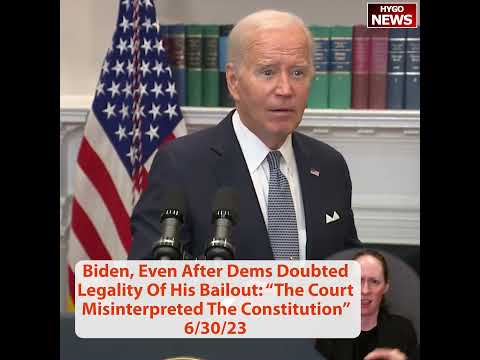
Biden, Even After Dems Doubted Legality of His Bailout: “The Court Misinterpreted The Constitution”
On June 30, 2023, moments after the Supreme Court issued its 6-3 ruling striking down his $400 billion student loan forgiveness program, President Biden lashed out at the justices and blamed Republicans, refusing to accept that he had overstepped his authority. When a reporter asked directly, “Did you overstep your authority?” Biden responded dismissively as he shuffled away from the lectern: “I think the Court misinterpreted the Constitution.” The defiant statement came despite the fact that members of his own party, including former House Speaker Nancy Pelosi, had previously expressed doubts about the legality of the very program the Court had just invalidated.
Biden’s Defiant Response
Biden’s brief appearance before the press after the ruling was characterized by defiance rather than any acknowledgment that his administration had pursued a legally dubious strategy. Rather than addressing the substance of the Court’s opinion or the legal reasoning behind the 6-3 majority decision, Biden chose to attack the institution itself by accusing the justices of misreading the nation’s founding document.
The exchange was captured on video: a reporter called out asking whether Biden had overstepped his authority. Biden, already turning away from the podium, delivered his one-line rebuttal that the Court had misinterpreted the Constitution and then departed without taking further questions. The brevity of the response and his physical departure from the lectern conveyed a President unwilling to engage with the legal merits of the ruling.
The response was notable for its constitutional implications. Biden was not merely disagreeing with a policy outcome but was asserting that six of the nine Supreme Court justices had fundamentally misunderstood the Constitution. Coming from the head of the executive branch about a co-equal branch of government, the accusation carried significant weight and drew criticism from legal scholars who argued that the ruling was grounded in well-established separation of powers principles.
The Supreme Court’s Ruling in Biden v. Nebraska
The Supreme Court ruled 6-3 in Biden v. Nebraska that Biden’s student loan forgiveness program was unlawful. The decision found that Biden had overstepped his authority by using the HEROES Act of 2003 as justification for canceling hundreds of billions of dollars in student debt without explicit congressional authorization.
The case had a long legal history before reaching the high court. Six Republican state attorneys general had sued the Biden administration, arguing that the student loan bailout violated the separation of powers. Separately, two borrowers who did not qualify for Biden’s forgiveness plan brought their own challenge in Department of Education v. Brown. The 8th U.S. Circuit Court of Appeals had extended a block on Biden’s plan in November 2022, and the Department of Justice had asked the Supreme Court to lift that block, which the justices refused to do.
The final ruling put the definitive end to a program that Biden had unilaterally announced in August 2022. The program would have canceled up to $10,000 in student debt for borrowers earning $125,000 a year or less and up to $20,000 for recipients of Pell Grants. The total cost was estimated at over $400 billion.
Democrats Had Doubted the Legality
What made Biden’s defiant response particularly notable was that prominent members of his own party had previously questioned whether the President possessed the legal authority to cancel student loans through executive action.
Former House Speaker Nancy Pelosi had stated in a July 2021 press conference: “People think that the President of the United States has the power for debt forgiveness. He does not. He can postpone. He can delay. But he does not have that power. That has to be an act of Congress.” The Supreme Court majority cited Pelosi’s own words in its opinion as evidence that even Democratic leaders understood the limits of executive authority on this issue.
The fact that Pelosi, one of the most powerful Democrats in Washington and a staunch Biden ally, had publicly outlined the same constitutional position the Court adopted in its ruling undercut Biden’s claim that the justices had “misinterpreted the Constitution.” If the Court had misread the Constitution, then Pelosi had done so as well, along with numerous legal scholars who had warned from the outset that the program was on shaky legal ground.
A Political Calculation That Failed
Biden had announced the massive student loan forgiveness in August 2022, widely viewed as a strategic move to energize younger voters ahead of the November 2022 midterm elections. The timing was seen as an attempt to lock in Gen Z and Millennial support by offering up to $20,000 in debt relief to borrowers who were already struggling with the economic consequences of inflation and a rising cost of living.
However, the legal challenges were immediate and predictable. Constitutional law experts had warned that the HEROES Act, passed in the wake of the September 11 attacks to assist military personnel and their families, was never intended to authorize blanket debt cancellation on such a massive scale. The administration’s argument that the COVID-19 pandemic justified the use of emergency powers to cancel $400 billion in debt stretched the statute well beyond its original purpose.
The political strategy ultimately backfired. By promising relief through executive action rather than pursuing the more difficult but constitutionally sound route of passing legislation through Congress, the administration set up millions of borrowers for disappointment. When the Supreme Court struck down the program, those borrowers were left with nothing, and the administration bore responsibility for having raised expectations it could not legally fulfill.
Constitutional Separation of Powers
The ruling reinforced the principle that major economic policy decisions of this magnitude require action by Congress, not unilateral executive action. The Court’s application of the major questions doctrine held that when an agency claims authority to make decisions of vast economic and political significance, it must point to clear congressional authorization.
Biden’s claim that the Court “misinterpreted the Constitution” was at odds with the core principle at stake: that the power of the purse belongs to Congress, not the President. Canceling $400 billion in obligations owed to the federal government was, in effect, a spending decision that only Congress had the authority to make.
The ruling also served as a rebuke to the broader trend of executive overreach that had characterized the Biden administration’s approach to policy. By attempting to achieve through executive action what would have required bipartisan legislation, the administration set a precedent that the Court was unwilling to allow.
Key Takeaways
- Biden accused the Supreme Court of misinterpreting the Constitution after the justices struck down his $400 billion student loan forgiveness program 6-3 in Biden v. Nebraska on June 30, 2023.
- When asked directly whether he had overstepped his authority, Biden dismissed the question and shuffled away from the lectern, refusing to engage with the legal merits of the ruling.
- The ruling came despite the fact that prominent Democrats, including House Speaker Nancy Pelosi, had previously stated that the President lacked the authority to cancel student debt unilaterally.
- Six Republican state attorneys general challenged the program on separation of powers grounds, and the Supreme Court agreed that Biden had exceeded his authority under the HEROES Act.
- Biden had announced the forgiveness program in August 2022 as a political strategy to energize younger voters ahead of the midterms, canceling up to $10,000 for borrowers earning under $125,000 and up to $20,000 for Pell Grant recipients.