 HYGO News
 Biden Econ Advisor Brian Deese LIES About Poll Which Really Shows Most Americans Are Not Better Off
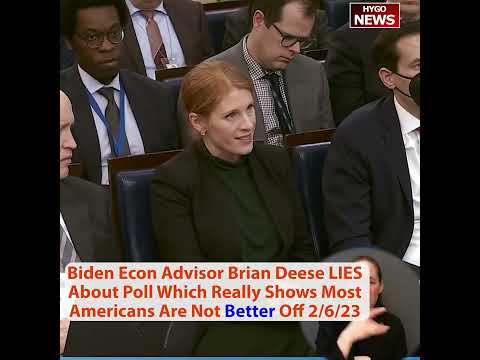
Brian Deese’s Poll Misreading: 41% Say Worse Off — Deese Claims “Two-Thirds” Are Better
In February 2023 during a White House briefing appearance by National Economic Council Director Brian Deese, a reporter confronted him with polling data showing substantial economic dissatisfaction. “Another polling question, you mentioned how the President said Friday that the state of the economy is strong. We had a poll out over the weekend ABC News that found that 41% of Americans say they’re worse off financially now than before this President took office. How do you explain the disconnect there of why this administration’s message about the strong economy is not getting through?” the reporter asked. Deese’s response contained what critics labeled a poll misreading: “Right, so I think the poll that you just said is actually consistent. So about two-thirds of Americans say that their circumstances are better than before we say it either way.” The claim that “two-thirds” were better off was contradicted by the poll showing 41% worse off — leaving only 59% combined in “better” or “same” categories.
The Reporter’s Specific Data
Data:
ABC News poll — Reputable.
Over weekend — Recent.
41% worse off — Financially.
Since Biden took office — Timeframe.
Specific question — Asked.
The ABC News poll data was specific and concerning. 41% of Americans saying they were worse off financially since Biden took office was substantial number. This wasn’t small minority — it was near-plurality.
The Disconnect Question
Disconnect:
Biden claim — Economy strong.
Public perception — 41% worse off.
Gap — Clear.
Messaging problem — Evident.
Explanation sought — For gap.
The reporter’s “disconnect” framing was effective. If economy was strong, why did 41% feel worse off? The gap between administration messaging and public perception required explanation rather than denial.
”The Poll Is Actually Consistent”
Deese’s response:
“Actually consistent” — With strong economy claim.
Spin element — Evident.
Framing shift — Attempted.
Interpretation — Favorable.
Challenge — To face value.
Deese’s claim that the poll was “actually consistent” with administration messaging was immediate spin attempt. The poll showing 41% feel worse off didn’t obviously support “strong economy” narrative. The framing required creative interpretation.
”Two-Thirds Better or Same”
The two-thirds claim:
Two-thirds — Claim.
Better than before — Framing.
Combined categories — “Better” plus “same”?
Math issue — Possibly.
Questionable — Assertion.
The two-thirds figure was questionable. If 41% said worse off, only 59% remained in other categories. If that 59% split between “better” and “same,” math didn’t reach two-thirds specifically better. Deese’s number was problematic.
The Poll Math Examined
Math examination:
Total 100% — Poll.
41% worse — Direct.
59% remaining — Split.
Better — Portion.
Same — Portion.
Split unclear — From transcript.
The math examination showed if 41% were worse off, the remaining 59% was split between “better” and “same” responses. Without exact split, Deese’s “two-thirds better” claim couldn’t be precisely evaluated but seemed questionable.
The “We Say It Either Way” Construction
Either way:
Better or same — Combined.
Framing device — Used.
Favorable math — Constructed.
Public perception — Overstated?
Spin mechanics — Visible.
The “we say it either way” construction combined “better” and “same” responses into favorable figure. This was framing device common in political messaging. Technical accuracy vs. substantive meaning was tensioned.
The Logical Issue
Logical issue:
If 41% worse — Cannot be 2/3 better.
Math contradicts — Claim.
Either/or construction — Doesn’t work.
Better ≠ same — Normally.
Problem — Visible.
The logical issue was that if 41% said worse off, the remainder couldn’t provide 2/3 specifically “better.” Combining “better” and “same” was different claim. Either-or construction didn’t match “two-thirds better” phrasing.
Brian Deese the Director
Director:
National Economic Council — Head.
Biden adviser — Senior.
Economic messaging — Role.
Public communications — Part of job.
Departing — 2023.
Brian Deese was Director of National Economic Council, senior Biden economic adviser with economic messaging role. He was departing in 2023. His public communications were important administration economic messaging.
The “LIES” Title Characterization
Title framing:
“LIES” — Strong.
Partisan framing — Likely.
Spin vs. lie — Distinction.
Deese misleading — Perhaps.
Context — Matters.
The “LIES” title characterization was strong framing. Deese’s number may have been misleading or technically constructed rather than outright lie. But characterizing poll as showing 2/3 better when 41% said worse off was problematic construction.
The Administration Economic Messaging
Economic messaging:
Strong economy — Claim.
Job creation — Cited.
Inflation improving — Noted.
Accomplishment focus — Primary.
Perception challenge — Real.
Administration economic messaging emphasized strong economy claims, job creation numbers, inflation improving trends, accomplishment focus primarily. Perception challenge was real — public feeling didn’t match messaging.
The Public Perception Drivers
Perception drivers:
Grocery prices — Daily.
Gas prices — Visible.
Housing costs — Crushing.
Interest rates — Rising.
Daily reality — Felt.
Public perception of economy was driven by grocery prices that rose daily, visible gas prices, crushing housing costs, rising interest rates. Daily reality was felt directly. Macro statistics didn’t match micro experience.
The Inflation Cumulative Effect
Cumulative inflation:
2021-2023 — Substantial.
Prices — Higher.
Returns to lower — Rare.
Cumulative — Experience.
Memory — Effect.
The cumulative inflation effect meant prices were higher even if inflation rate moderated. Prices rarely returned to pre-inflation levels — they just rose more slowly. Cumulative experience and memory affected perception.
The Macro vs. Micro Disconnect
Disconnect:
Macro statistics — Improving.
Micro experience — Struggling.
Messaging gap — Real.
Political problem — Created.
Communication challenge — Substantial.
The macro vs. micro disconnect was substantive challenge. Macro statistics might improve while individual experience remained difficult. Messaging gap was real. Political problem was created. Communication challenge was substantial.
The Poll Numbers in Context
Context:
41% worse off — Substantial.
Pre-Biden comparison — Specific.
Economic narrative — Challenged.
Persistence — Pattern.
Problem — For reelection.
The 41% worse off figure in context was substantial — a near-plurality saying worse off than before Biden took office. This specifically framed against Biden’s tenure rather than general economic sentiment.
The Deese Spin Pattern
Pattern:
Unfavorable poll — Reframe.
Favorable construction — Impose.
Technical argument — Deploy.
Public doubt — Persist.
Messaging limitation — Exposed.
The Deese spin pattern was familiar: take unfavorable poll, reframe favorably, impose technical argument. Public doubt persisted despite spin. Messaging limitations were exposed through examination.
The 2024 Electoral Dimension
Electoral dimension:
Economic perception — Central.
41% worse off — Vote impact.
Reelection challenge — Real.
Messaging inadequate — Evidenced.
Strategic rethinking — Needed.
The 2024 electoral dimension of 41% worse off polling was clear. Economic perception was central to elections. This percentage of electorate feeling worse off was reelection challenge. Messaging inadequacy was evidenced. Strategic rethinking needed.
The Biden Economy Record
Record:
Jobs — Strong growth.
Unemployment — Low.
GDP — Positive.
Inflation — Moderated.
Housing — Expensive.
Wages — Behind inflation often.
Biden’s economy record was mixed. Jobs and unemployment numbers were good. GDP was positive. Inflation was moderating. But housing was expensive, wage gains often trailed inflation, and overall feeling was challenged.
The Wage vs. Inflation Dynamic
Wage dynamic:
Real wages — Mixed.
Some groups — Gained.
Other groups — Lost ground.
Perception — Mostly negative.
Aggregation — Hides variation.
The wage vs. inflation dynamic was mixed across groups. Some gained real wages while others lost ground. Perception was mostly negative due to focus on price increases. Aggregation hid variation affecting political messaging.
The Administrative Response Limits
Response limits:
Data construction — Available.
Spin techniques — Used.
Reality constraints — Real.
Public perception — Persistent.
Eventually — Catches up.
The administrative response limits were evident. Data construction techniques were available. Spin was used. But reality constraints were real. Public perception persistence wasn’t easily changed. Eventually reality caught up with messaging.
The Press Briefing Challenge
Briefing challenge:
Expert presentations — Economic.
Technical questions — Complex.
Polling confrontation — Direct.
Response required — Immediate.
Stakes — Political.
Press briefings with economic experts like Deese presented technical question complexity. Direct polling confrontations required immediate response. Political stakes were real. Performance mattered for messaging.
The Reporter Pressure
Reporter pressure:
Specific poll — Cited.
Numbers provided — Direct.
Disconnect framed — Smart.
Explanation demanded — Legitimate.
Professional — Approach.
The reporter’s pressure through specific poll citation, direct numbers, smart disconnect framing, legitimate explanation demand, professional approach was quality work. This was substantive questioning.
The ABC News Poll Credibility
Poll credibility:
ABC News — Major network.
Ipsos partnership — Reputable.
Professional methodology — Standard.
Sample size — Adequate.
Credible — Source.
The ABC News poll was credible source from major network with reputable Ipsos partnership, professional methodology, adequate sample. Not partisan or methodologically questionable. Data had to be addressed substantively.
The Spin vs. Substance Tension
Spin tension:
Message discipline — Priority.
Reality — Competing.
Public observation — Watching.
Credibility — At stake.
Long-term — Cost.
The spin vs. substance tension was real in political communication. Message discipline was priority. Reality competed with preferred narrative. Public observation noticed. Credibility was at stake. Long-term costs accumulated.
The Departure Context
Departure:
Deese leaving — Announced.
Final appearances — Some.
Lael Brainard — Successor.
Transition — Underway.
Final messaging — Continued.
Deese’s departure from NEC was announced with successor Lael Brainard taking over. Final appearances continued. Transition was underway. Final messaging from Deese continued established administration line.
The Long-Term Economic Trajectory
Trajectory:
2023-2024 — Improvement gradually.
Inflation declining — Eventually.
Growth continuing — Pattern.
Perception lagging — Reality.
Political — Complication.
The long-term economic trajectory saw gradual improvement through 2023-2024 with inflation declining eventually, growth continuing pattern, perception lagging reality, political complication remaining. Economic reality and political perception didn’t always align.
Key Takeaways
- A reporter cited ABC News poll: 41% of Americans say they’re worse off financially than before Biden took office.
- The reporter asked: “How do you explain the disconnect there of why this administration’s message about the strong economy is not getting through?”
- Brian Deese responded that the poll was “actually consistent” with administration messaging.
- He claimed: “About two-thirds of Americans say that their circumstances are better than before we say it either way.”
- The math was questionable — if 41% said worse off, only 59% remained to split between “better” and “same.”
- The “two-thirds better” construction appeared to combine “better” and “same” categories into favorable number.
Transcript Highlights
The following is transcribed from the video audio (unverified — AI-generated from audio).
- Thanks, Brian. Another polling question, you know, touched on it a little bit with some of my colleagues’ questions.
- You mentioned how the President said Friday that the state of the economy is strong.
- We had a poll out over the weekend ABC News that found that 41% of Americans say they’re worse off financially now than before this President took office.
- How do you explain the disconnect there of why this administration’s message about the strong economy is not getting through?
- Right, so I think the poll that you just said is actually consistent.
- So about two-thirds of Americans say that their circumstances are better than before we say it either way.
Full transcript: 113 words transcribed via Whisper AI.