 HYGO News
 Biden's Final Foreign Policy Speech: 'America Is Stronger, Adversaries Are Weaker'; Afghan Resettlement, Climate Claims
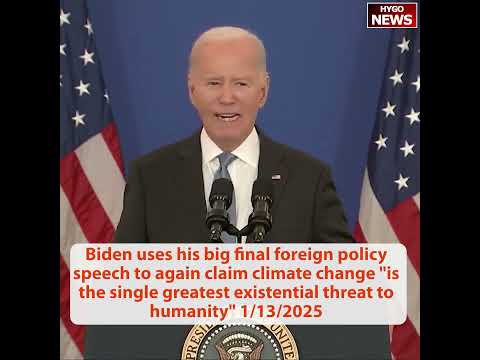
Biden’s Final Foreign Policy Speech: “America Is Stronger, Adversaries Are Weaker”; Afghan Resettlement, Climate Claims
On January 13, 2025, President Biden delivered his final major foreign policy address, making the case that America was stronger and its adversaries weaker than when he took office four years earlier. The speech covered Afghan resettlement efforts, the end of the post-Cold War era, climate change as the “greatest existential threat to humanity,” and a brief mention of the service members killed during the Afghanistan withdrawal. The address drew sharp criticism from those who viewed it as disconnected from the realities of Biden’s foreign policy record.
”America Is Stronger, Our Adversaries Are Weaker”
Biden opened with a sweeping assessment of his administration’s legacy on the world stage.
“Compared to four years ago, America is stronger,” Biden declared. “Our alliances are stronger. Our adversaries and competitors are weaker. We have not gone to war to make these things happen.”
He claimed to have elevated American power across the board: “During my presidency, I’ve increased America’s power at every dimension. We’ve increased our diplomatic power.”
Biden also framed the moment as a turning point in global affairs: “The post-Cold War period is over. A new era has begun. In these four years, we faced crises that we’ve been tested. We’ve come through those tests stronger, in my view, than we entered those tests.”
Afghan Resettlement: “Done So Much”
Biden highlighted the resettlement of Afghan families in the United States as an achievement of his presidency.
“I’ve done so much to help thousands of Afghan families resettle in the United States,” Biden said.
The video description noted the parenthetical “(Unvetted)” alongside this claim, referencing criticism that the vetting process for Afghan evacuees brought to the United States during and after the chaotic August 2021 withdrawal was inadequate. Reports had surfaced of individuals with incomplete or problematic background checks being admitted, raising security concerns.
A Brief Mention of Fallen Service Members
Biden referenced the 13 U.S. service members killed in the suicide bombing at Abbey Gate at Kabul airport during the August 2021 withdrawal, though only in passing.
“And I grieve those brave service members whose lives were lost during the withdrawal,” Biden said.
The brevity of the mention drew criticism from Gold Star families and their supporters, who noted that Biden had been accused of not saying the fallen service members’ names publicly. The three-second reference stood in contrast to the lengthy defense of his foreign policy achievements that surrounded it.
Climate Change: “The Single Greatest Existential Threat”
Biden also used the address to reassert his position on climate change, taking aim at the incoming Trump administration.
“I know some in the incoming administration are skeptical about the need for clean energy,” Biden said. “They don’t even believe climate change is real. I think they come from a different century. They’re wrong. They are dead wrong. It’s the single greatest existential threat to humanity.”
The remarks continued Biden’s longstanding framing of climate policy as both a moral imperative and a national security priority, a position that the incoming Trump administration had explicitly rejected.
Afghanistan: “Neither Has Occurred”
Biden defended the withdrawal from Afghanistan by arguing that the dire predictions made by critics had not come true.
“Remember, critics said if we ended the war, it would damage our alliances and create threats to our homeland from foreign-directed terrorism out of a safe haven in Afghanistan,” Biden said. “Neither has occurred. Neither has occurred.”
The claim was disputed by critics who pointed to the New Orleans attack on New Year’s Day 2025 and to ongoing concerns about individuals with ties to terrorism who had crossed the southern border during the Biden administration’s tenure. While the New Orleans attack was linked to ISIS inspiration rather than an Afghan safe haven, opponents argued that Biden’s broader border and immigration policies had created separate security vulnerabilities.
Key Takeaways
- Biden claimed “America is stronger” and its “adversaries and competitors are weaker” after four years of his presidency, asserting he had “increased America’s power at every dimension.”
- He highlighted Afghan resettlement in the United States as an accomplishment, though critics questioned the vetting of evacuees.
- Biden’s reference to the 13 service members killed during the Afghanistan withdrawal was limited to a brief passing mention, drawing criticism from Gold Star families.
- He called climate change “the single greatest existential threat to humanity” and said incoming Trump officials who disagree “come from a different century.”
- Biden claimed neither alliance damage nor Afghanistan-based foreign terrorism had materialized, stating “Neither has occurred.”