 HYGO News
 Biden Darts Out Without Taking Any Questions: 'Name Me One Major Issue We Haven't Been Able To Do'
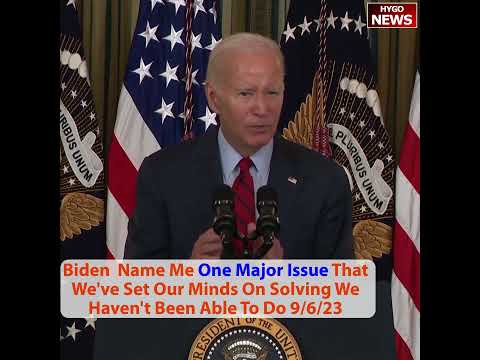
Biden Darts Out Without Taking Any Questions: “Name Me One Major Issue We Haven’t Been Able To Do”
On September 6, 2023, President Biden delivered remarks in the State Dining Room celebrating the ILWU-PMA labor contract covering America’s West Coast ports. During his ten-minute appearance — his only public event of the day — Biden issued a sweeping challenge: “Name me one major issue that we’ve set our mind on solving we haven’t been able to do.” He then boasted that “inflation is down to around 3%, about one third of what it was one year ago.” After delivering these claims, Biden left the podium without taking a single question from the assembled press.
The Event
The occasion was the finalization of a new contract between the International Longshore and Warehouse Union (ILWU) and the Pacific Maritime Association (PMA). The agreement covered workers at America’s West Coast ports, which handle a significant portion of the nation’s imports and exports. The contract resolution ended a prolonged labor dispute that had raised concerns about supply chain disruptions.
For the Biden administration, which had made labor relations and union support a central part of its economic messaging, the ILWU-PMA deal was a legitimate achievement to highlight. The event gave Biden an opportunity to appear before cameras in a controlled setting with a positive story to tell.
But the event occurred on the same day that White House Press Secretary Karine Jean-Pierre spent much of her briefing defending Biden’s masking behavior at the previous day’s Medal of Honor ceremony. Reporters had multiple lines of questioning they wanted to pursue with the president directly. Biden’s decision to deliver prepared remarks and depart without questions ensured none of those follow-ups would happen.
”Name Me One Major Issue”
Biden’s challenge to his critics was delivered with characteristic confidence: “Name me one major issue that we’ve set our mind on solving we haven’t been able to do.”
The statement was structured as an invitation to debate, but it was issued moments before Biden left the room without allowing anyone to respond. The rhetorical question was not rhetorical by design — Biden appeared to genuinely believe no one could name such an issue. By leaving immediately afterward, he ensured the question would not be answered in his presence.
Had reporters been given the opportunity, there was no shortage of issues they could have raised. The southern border had seen record illegal crossings throughout 2023. Inflation, while declining from its 2022 peak, had driven cumulative price increases that left consumers paying significantly more for everyday goods than when Biden took office. The withdrawal from Afghanistan in August 2021 remained a point of contention. Student loan forgiveness had been struck down by the Supreme Court. Crime rates in major cities continued to concern voters.
Biden’s framing — “set our mind on solving” — also contained a built-in escape hatch. Any issue that remained unresolved could be categorized as one the administration had not yet “set its mind on,” rather than one it had tried and failed to address.
The Inflation Claim
Biden’s most specific economic claim was about inflation: “Today inflation is down to around 3%, about one third of what it was one year ago. That’s near the slowest point in over two years.”
The statement was technically accurate in a narrow sense. The year-over-year Consumer Price Index (CPI) rate had indeed fallen from its peak of around 9% in mid-2022 to approximately 3.7% by August 2023. Measured purely by the rate of price increases, inflation was declining.
But the framing was misleading in a way that had become a recurring feature of the administration’s economic messaging. Saying “inflation is down” implied prices were falling. They were not. Prices were still rising — just at a slower rate than the previous year. The cumulative effect of inflation since Biden took office in January 2021 meant that overall prices had increased by approximately 16% during his presidency.
For consumers, the distinction between “the rate of inflation is declining” and “prices are going down” was not academic. A family paying 16% more for groceries, housing, and fuel than they were in January 2021 did not experience relief when told the rate of increase had slowed. They were still paying more, and the price increases that had already occurred were not being reversed.
Biden’s framing consistently treated the decline in the inflation rate as though it were a decline in prices. This gap between the administration’s messaging and consumers’ lived experience was one of the persistent challenges for the White House’s economic narrative throughout 2023.
The No-Questions Pattern
Biden’s departure without taking questions was consistent with a pattern that had drawn sustained criticism throughout his presidency. By September 2023, Biden had held fewer solo press conferences than any of his recent predecessors at the same point in their terms.
The format of the ILWU-PMA event was characteristic: a controlled setting, prepared remarks on a favorable topic, and an immediate exit. This approach allowed the administration to generate positive media coverage of the event itself while avoiding the unscripted exchanges that produced most of Biden’s problematic moments.
On this particular day, reporters had an unusual number of topics they would have liked to address. Biden’s masking behavior at the Medal of Honor ceremony, Jean-Pierre’s troubled briefing defending it, the president’s own maskless entry and joking about it earlier in this very event — all of these were fresh developments that Biden himself could have been asked to explain. His departure without questions meant that the only person who had to defend Biden’s actions was Jean-Pierre, who had already demonstrated the difficulty of doing so.
The Irony of the Boast
There was an unintentional irony in Biden’s challenge. “Name me one major issue that we’ve set our mind on solving we haven’t been able to do” was a statement of supreme confidence in his administration’s accomplishments. It was delivered at an event where Biden’s only public appearance of the day lasted ten minutes, where he entered without a mask while on COVID protocol, joked about violating the protocol, made economic claims that obscured the cumulative impact of inflation on American households, and left without allowing a single question.
The gap between the swagger of the statement and the constrained, question-averse format of the appearance encapsulated a broader dynamic of the Biden presidency. The administration regularly claimed transformative achievements while avoiding the open, adversarial exchanges where those claims could be tested.
Biden’s challenge was effective precisely because it went unanswered — not because no answer existed, but because the president did not stay long enough for anyone to give one.
Key Takeaways
- On September 6, 2023, Biden challenged critics to “name me one major issue” his administration had not solved, then left without taking questions.
- Biden claimed inflation was “down to around 3%,” which was accurate for the year-over-year rate but obscured cumulative price increases of approximately 16% since he took office.
- The ILWU-PMA event was Biden’s only public appearance of the day and lasted approximately ten minutes.
- Biden’s departure without questions prevented reporters from asking about the Medal of Honor masking controversy that had dominated the White House briefing earlier that day.
- The rhetorical challenge, delivered seconds before an exit, ensured the boast could not be tested in the president’s presence.