 HYGO News
 Biden Creepy Whisper To Claim Bidenomics Working, Even As Prices Surge; Harris Thanks Lowering Costs
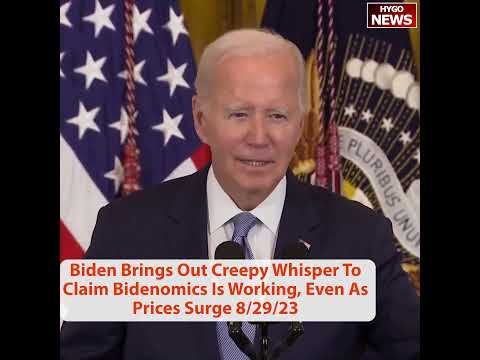
Biden Uses Creepy Whisper to Claim Bidenomics Is Working, Even as Prices Surge; Harris Thanks Biden for Lowering Costs
On August 29, 2023, President Joe Biden deployed his signature creepy whisper to declare that “Bidenomics” was working during a White House event. Leaning into the microphone, Biden said in a hushed tone: “The Financial Times and the Wall Street Journal, I don’t think they meant it as a compliment when they started referring to my economic policies as Bidenomics. Well, guess what? It’s working!”
Vice President Kamala Harris followed with her own contribution to the disconnect from reality: “I want to thank, of course, our nation’s champion, President Biden, for your leadership and commitment to lowering costs for working families in every way.”
At the time of these remarks, consumer prices were 16.9 percent higher than when Biden took office in January 2021, making the administration’s claims about economic success and lowering costs difficult for most Americans to reconcile with their everyday experience at the grocery store, the gas pump, and the housing market.
Biden’s Creepy Whisper
Biden’s habit of suddenly dropping his voice to a low, breathy whisper during speeches and public remarks had become one of the most discussed and parodied mannerisms of his presidency. Rather than conveying intimacy or emphasis, the whisper was widely perceived as unsettling, earning the “creepy” descriptor that attached to it across media coverage and social media commentary.
The whisper technique appeared to be Biden’s attempt to create a moment of dramatic emphasis, leaning into the microphone and lowering his voice as if sharing a secret with the audience. In practice, the effect was jarring, as an 80-year-old president would shift abruptly from his normal speaking voice to a hushed, intense whisper, often while making claims that were at odds with reality.
In this instance, Biden used the whisper to deliver his punchline about Bidenomics, apparently believing the dramatic delivery would make the claim more convincing. The contrast between the theatrical delivery and the lived experience of Americans dealing with persistent inflation only amplified the perception that the president was out of touch with the economic pressures facing ordinary families.
The Bidenomics Branding Effort
The “Bidenomics” label was a deliberate branding strategy launched by the White House in mid-2023 as the administration sought to take credit for what it characterized as a strong economy. The strategy involved the president and other senior officials repeatedly using the term in speeches, press conferences, and media appearances, attempting to own a label that had originally been used by critics.
The core argument behind Bidenomics was that the Biden administration’s economic policies, including the Inflation Reduction Act, the CHIPS and Science Act, and the Infrastructure Investment and Jobs Act, were producing results in the form of job creation, manufacturing investment, and gradually declining inflation rates.
However, the branding effort faced a fundamental problem: the American public was not buying it. Poll after poll showed that voters overwhelmingly disapproved of Biden’s handling of the economy. A CBS News/YouGov poll from August 2023 found that only 34 percent of Americans approved of Biden’s economic management. Gallup polling showed that Americans rated the economy as the most important problem facing the country, and by wide margins they blamed Biden’s policies for inflation and higher costs.
The disconnect was grounded in simple math. While the administration pointed to falling inflation rates, meaning prices were rising more slowly, prices themselves remained dramatically elevated compared to pre-Biden levels. The 16.9 percent cumulative increase in consumer prices since January 2021 meant that families were paying substantially more for groceries, rent, gas, utilities, and virtually every other category of spending. A slowing rate of increase did not make prices go down; it simply meant they were going up less quickly.
Harris Thanking Biden for Lowering Costs
Vice President Harris’s statement thanking Biden for “lowering costs for working families in every way” was particularly notable for its sweeping nature. The claim was not qualified or limited to a specific category; Harris said “in every way,” a characterization that was contradicted by virtually every measure of consumer costs available at the time.
Grocery prices had risen approximately 20 percent since Biden took office. The median price of existing homes had surged past $400,000. Rent had increased by double digits in most major markets. Gas prices, while down from their mid-2022 peak, remained significantly higher than pre-Biden levels. Auto insurance, health insurance premiums, and childcare costs had all risen substantially.
Harris’s statement reflected the administration’s strategy of simply asserting economic success and hoping repetition would shape public perception, regardless of the underlying data. The approach was reminiscent of political messaging tactics that rely on volume and confidence rather than factual accuracy, and it contributed to the erosion of public trust in both Biden and Harris as reliable narrators of the nation’s economic condition.
The Inflation Reality
By August 2023, the cumulative impact of inflation under the Biden administration had fundamentally altered the economic landscape for American families. While the official inflation rate had declined from its peak of 9.1 percent in June 2022, the damage to purchasing power was already baked in.
The Bureau of Labor Statistics data told a story that directly contradicted the Bidenomics narrative. Real wages, adjusted for inflation, had failed to keep pace with price increases for much of Biden’s term, meaning workers were effectively earning less in purchasing power terms even as nominal wages rose. Lower-income families, who spend a higher percentage of their income on necessities like food, energy, and housing, were disproportionately affected.
The Federal Reserve’s aggressive interest rate hikes, implemented to combat the inflation that many economists attributed in part to the administration’s $1.9 trillion American Rescue Plan spending in 2021, had pushed mortgage rates to their highest levels in over 20 years. This effectively locked many potential homebuyers out of the market and froze existing homeowners in place, unable to sell without giving up their lower-rate mortgages.
The Political Consequences of Bidenomics
The Bidenomics branding effort was ultimately abandoned by the White House as it became clear that the strategy was backfiring. By late 2023, the administration had quietly shifted away from the term, recognizing that it had become associated in the public mind not with economic success but with high prices and economic hardship.
The economic messaging failure contributed significantly to Biden’s political difficulties throughout 2023 and into 2024. Voters consistently rated the economy as their top concern and gave Biden poor marks on the issue, creating a drag on his approval ratings and re-election prospects.
Additional Context
The August 29 event where Biden and Harris made these remarks was part of a broader White House push to highlight the administration’s economic agenda. The event came during a period when the administration was attempting to draw a contrast between its economic record and the Republicans’ policy proposals, a messaging strategy that required convincing the public that the economy was, in fact, performing well under Biden’s leadership.
The creepy whisper moment and Harris’s extravagant praise for Biden’s cost-lowering achievements became widely shared clips that undercut the very narrative they were intended to advance. For many viewers, the clips served as evidence that the administration was either deliberately misleading the public about economic conditions or was genuinely unaware of the financial pressures facing American families.
Key Takeaways
- Biden used his signature creepy whisper to declare “Bidenomics is working” during an August 29, 2023 White House event, a claim widely contradicted by consumer experience.
- Vice President Harris thanked Biden for “lowering costs for working families in every way,” despite consumer prices being 16.9 percent higher than when Biden took office.
- The “Bidenomics” branding strategy was intended to take ownership of the economic narrative but ultimately backfired, as voters consistently rated the economy poorly and blamed Biden’s policies for inflation.
- Real-world data showed dramatic increases in grocery prices, housing costs, rent, gas, and insurance that made the administration’s claims of economic success ring hollow for most American families.
- The Bidenomics label was quietly abandoned by the White House by late 2023, after it became clear the brand was more associated with high prices than with economic achievement.