 HYGO News
 Biden: Courts said, "No, we're on Biden's side" Update: 10/21/22 appeals court temporarily blocks it
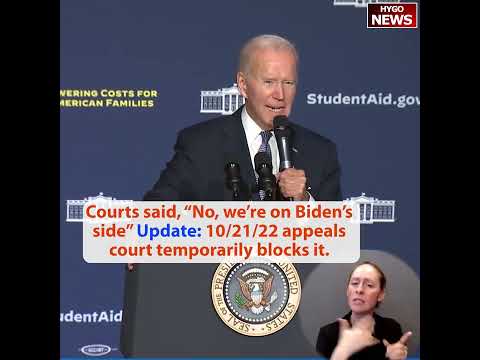
Biden Declares “The Courts Said No, We’re on Biden’s Side” on Student Loans — Hours Later, Appeals Court Blocks the Entire Program
On 10/21/2022, President Biden told an audience at Delaware State University that Republicans had tried to block his student loan forgiveness plan in court but failed: “Just yesterday, a state court and the Supreme Court said, ‘No, we’re on Biden’s side.’” Hours later, the Eighth Circuit Court of Appeals issued an order temporarily blocking the entire program — prohibiting the Biden administration “from discharging any student loan debt under the Cancellation program” until further court proceedings. The timing made Biden’s triumphant claim about judicial support one of the most poorly aged presidential statements of 2022. The Supreme Court would ultimately strike down the program entirely in June 2023.
”We’re on Biden’s Side”
Biden delivered the line with the confidence of a president who believed the legal challenges to his program were behind him. “They’ve been fighting us in the courts,” Biden said, referring to Republican attorneys general and governors. “But just yesterday, a state court and the Supreme Court said, ‘No, we’re on Biden’s side.’”
The statement was misleading even before the appeals court reversed it hours later. Biden was referencing narrow procedural rulings — a state court dismissal and a Supreme Court denial of an emergency stay request — that addressed questions of standing (whether plaintiffs had the legal right to sue) rather than the merits of the program. Neither ruling said the courts were “on Biden’s side” in the sense that the program was constitutional. They said specific plaintiffs in specific cases hadn’t demonstrated the right to challenge it.
The distinction between standing and merits is fundamental to legal analysis but was collapsed by Biden’s characterization. Telling an audience “the courts are on Biden’s side” implied judicial endorsement of the program. What actually happened was that certain legal challenges failed on procedural grounds while others — with different plaintiffs who could demonstrate concrete harm — were advancing through the system.
The Eighth Circuit’s Order
The same day Biden spoke, the Eighth Circuit Court of Appeals issued an administrative stay in Biden v. Nebraska, the case brought by six Republican-led states (Nebraska, Missouri, Arkansas, Iowa, Kansas, and South Carolina). The order prohibited the Biden administration “from discharging any student loan debt under the Cancellation program” while the court considered the states’ request for a preliminary injunction.
The states argued they would suffer irreparable harm if the program proceeded — particularly Missouri, which demonstrated that the Missouri Higher Education Loan Authority (MOHELA), a major student loan servicer, would lose significant revenue if loans were forgiven. This concrete financial harm gave the states the standing that other challengers had lacked.
The Eighth Circuit’s stay was the first successful judicial block of the program, and it effectively halted any debt cancellation from proceeding. While Biden continued to accept applications — and would encourage more sign-ups in subsequent weeks — no actual forgiveness could occur while the stay was in effect.
”Republican Governors Are Doing Everything They Can”
Before making his court claim, Biden had framed the legal opposition as partisan obstruction. “Republican members of Congress and Republican governors are doing everything they can to deny this relief, even to their own constituents,” Biden said. “As soon as I announced my administration’s plan on student debt, they started attacking it, saying all kinds of things.”
“Their outrage is wrong and it’s hypocritical. But we’re not letting them get away with it,” Biden added.
The framing positioned the legal challenges as politically motivated attacks rather than legitimate constitutional questions. But the legal arguments were substantive and would ultimately prevail at the Supreme Court. The challengers argued that the HEROES Act of 2003 — the post-9/11 law Biden relied upon — was never intended to authorize the cancellation of hundreds of billions of dollars in debt for tens of millions of borrowers. The “major questions doctrine” — requiring clear congressional authorization for executive actions of vast economic and political significance — became the central legal framework for evaluating the program.
The Supreme Court’s eventual 6-3 ruling in Biden v. Nebraska would validate exactly what the “attacking” Republicans had argued: the executive branch lacked the authority to unilaterally cancel this scale of debt without explicit congressional authorization.
The Legal Timeline
Biden’s speech came at a critical inflection point in the program’s legal journey:
- August 24, 2022: Biden announced the forgiveness plan
- September-October 2022: Multiple lawsuits filed by Republican AGs, conservative groups, and individual plaintiffs
- October 13, 2022: A federal judge dismissed one challenge on standing grounds — the ruling Biden referenced as courts being “on his side”
- October 20, 2022: Supreme Court Justice Amy Coney Barrett denied an emergency stay request — the other ruling Biden cited
- October 21, 2022: Biden delivered his “courts are on Biden’s side” speech; that same day, the Eighth Circuit issued its stay blocking the program
- November 14, 2022: A federal judge in Texas separately struck down the program in Brown v. Department of Education
- February 28, 2023: Supreme Court heard oral arguments in Biden v. Nebraska
- June 30, 2023: Supreme Court ruled 6-3 that Biden exceeded his authority
The timeline showed Biden celebrating prematurely. He chose to highlight two favorable procedural rulings while the most significant legal challenge — the one that would ultimately succeed — was moving through the Eighth Circuit at that very moment.
The Political Function
Biden’s “courts are on our side” declaration served an important political function regardless of its accuracy. With the midterm election 18 days away, Biden needed borrowers to believe the forgiveness was coming. If potential beneficiaries believed the program would be struck down, the political benefit — millions of grateful voters heading to the polls — would evaporate.
By declaring judicial victory, Biden was reinforcing the message: sign up, the money is coming, Republicans tried to stop it but failed. The narrative kept borrower enthusiasm high and directed anger at Republican challengers rather than at the legal vulnerability of a program that constitutional scholars across the political spectrum had questioned.
The strategy had a downside: when the program was subsequently blocked and then struck down, the broken promise generated exactly the disillusionment Biden had tried to avoid. Millions of borrowers who had been told “the courts are on Biden’s side” discovered that the courts were definitively not.
”Their Outrage Is Wrong and Hypocritical”
Biden’s characterization of Republican opposition as “wrong and hypocritical” referred to the PPP loan comparison the administration had been making since August — that Republican members of Congress who received forgivable PPP loans had no standing to criticize student loan forgiveness. As discussed in earlier briefings, this comparison was structurally flawed: PPP loans were designed by Congress to be forgiven, while student loans were voluntary agreements being altered retroactively by executive action.
The “hypocritical” framing served the campaign narrative but didn’t address the legal argument. Hypocrisy — even if it existed — is not a legal defense. The question before the courts was whether Biden had the authority to cancel debt, not whether his critics were consistent.
Key Takeaways
- Biden declared “the courts said no, we’re on Biden’s side” regarding student loan forgiveness — hours before the Eighth Circuit blocked the entire program.
- He was referencing narrow procedural rulings on standing, not judicial endorsement of the program’s legality.
- The Eighth Circuit prohibited the administration from discharging any student loan debt while the case proceeded.
- Biden framed Republican legal challenges as “wrong and hypocritical” — but the Supreme Court would ultimately agree with the challengers, ruling 6-3 that Biden exceeded his authority.
- The premature victory declaration kept borrower enthusiasm high for the midterms but set up a broken promise when the program was struck down.
Transcript Highlights
The following is transcribed from the video audio (unverified — AI-generated from audio).
- Republican members of Congress and Republican governors are doing everything they can to deny this relief, even to their own constituents.
- As soon as I announced my plan on student debt, they started attacking it, saying all kinds of things.
- Their outrage is wrong and it’s hypocritical. But we’re not letting them get away with it.
- They’ve been fighting us in the courts.
- Just yesterday, state court and the Supreme Court said no, we’re on Biden’s side.
- We’re not letting them get away with it.
Full transcript: 104 words transcribed via Whisper AI.