 HYGO News
 Biden 'Convinced' Prices 'Not Gonna Go Up,' Inflation Will Subside By End Of NEXT Year, IR Act
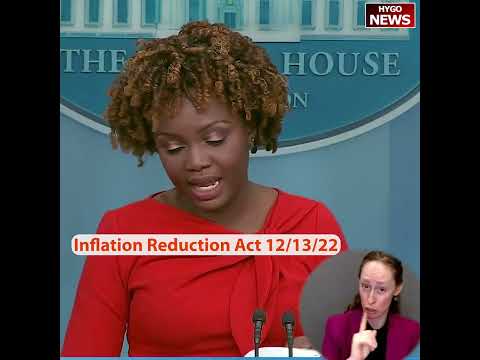
Biden: “I’m Convinced Prices Are Not Going to Go Up” — Says Predictions Come “Closer to End of Next Year” — KJP Hedges When Asked if Inflation Has Peaked
On 12/13/2022, President Biden made a striking prediction about inflation. Asked when prices would return to normal, Biden said: “I hope by the end of next year, when it’s much closer, I can make that prediction. I just, I’m convinced they’re not going to go up. I’m convinced they’re going to continue to go down.” The statement was notable for both its confidence and its long timeline — “end of next year” meant late 2023, a year away. When a reporter later asked White House Press Secretary Karine Jean-Pierre if the White House was confident inflation had peaked, KJP hedged: “He also said, you know, I’m not able to predict this as well in his comments today.” The exchange captured the tension between Biden’s confident predictions and the administration’s reluctance to make specific forecasts that could be proven wrong.
Biden’s Confident Prediction
Biden’s statement was unusually confident. “I’m convinced they’re not going to go up. I’m convinced they’re going to continue to go down,” Biden said.
The doubled “I’m convinced” was emphatic. Biden was expressing high certainty about future inflation trajectory. This level of certainty was unusual for a sitting president on economic predictions, which typically include hedging language to account for forecasting uncertainty.
The statement had multiple components:
“Prices are not going to go up” — A strong claim about price stability.
“They’re going to continue to go down” — A claim about continued disinflation.
Doubled “I’m convinced” — Emphasizing certainty.
Long-term framing — “End of next year” timeline.
The “End of Next Year” Timeline
Biden’s timeline was notable. “I hope by the end of next year, when it’s much closer, I can make that prediction,” Biden said.
“End of next year” meant late 2023 — a year from the statement’s context. This was a distant horizon for a prediction about returning to normal. Several aspects of this timeline were important:
Long horizon — A full year of continued inflation acknowledged.
Deferred accountability — Prediction couldn’t be tested for a year.
Political calendar — End of 2023 was still before peak 2024 campaign period.
Economic uncertainty — A year is a long forecasting period.
Continued concern — Implied that current conditions weren’t normal.
The timeline framing was actually an admission that the administration wasn’t expecting quick normalization. If prices were already near normal, Biden wouldn’t need to wait until end-of-next-year to assess. The timeline implicitly acknowledged continued economic abnormality.
The Contradiction in Biden’s Statement
Biden’s statement had an internal contradiction. He said:
“I hope by the end of next year… I can make that prediction” — Suggesting he couldn’t make the prediction now.
“I’m convinced they’re not going to go up” — But making a strong prediction anyway.
These two statements were in tension. Either Biden could confidently predict price behavior or he couldn’t. The first framing was appropriately humble; the second framing was confidently committed. Combining both in the same answer produced logical incoherence.
Possible interpretations:
Genuine uncertainty — Biden was unsure what to say.
Mixed messaging — Trying to be both humble and confident.
Verbal ad-libbing — Without consistent framework.
Political hedging — Giving quotable confident statements while preserving escape.
The Context of Biden’s Statement
Biden’s statement came in a specific political context. The November 2022 CPI report had been released that morning, showing moderating inflation. This was favorable political news that the administration wanted to emphasize.
The inflation data for November 2022:
Annual inflation of 7.1% — Down from 7.7% in October.
Monthly inflation moderating — Sequential improvements.
Core inflation easing — With some volatility.
Energy prices falling — Contributing to headline number.
Overall encouraging trajectory — Though still high by historical standards.
The data supported cautious optimism about inflation’s trajectory. Biden’s confident predictions went beyond cautious optimism to near-certainty. This overshoot was politically risky if subsequent data disappointed.
The Reporter’s Follow-Up to KJP
A reporter followed up with KJP to test the confident statement. “The President said he’s convinced inflation will continue to go down, but we have, of course, seen some unexpected spikes over the last past year. So, just to be clear, is the White House confident that inflation has in fact peaked?” the reporter asked.
The question had specific features:
Challenged the confidence — With recent history of spikes.
Sought specific claim — About inflation peaking.
Asked for institutional position — “The White House” not just Biden.
Requested clarity — “Just to be clear.”
The question was a test of whether the administration would back Biden’s confident claim with institutional endorsement. If the White House was confident inflation had peaked, that would be a significant policy statement. If it wasn’t, Biden’s statement would be exposed as overstatement.
KJP’s Hedge
KJP pulled back from Biden’s confidence. “He also said, you know, I’m not able to predict this as well in his comments today,” KJP said.
This was a significant hedge. KJP was citing Biden’s own admission of predictive limitations to qualify his confident statement. Effectively, KJP was using Biden’s hedged language to escape committing to his confident language.
The technique was politically sophisticated:
Not contradicting Biden — Didn’t disagree with the confident framing.
Using his own words — The hedged portion that preserved flexibility.
Avoiding institutional commitment — The White House didn’t have to endorse peak inflation claims.
Preserving options — If data turned negative, the hedged position could be emphasized.
But the technique also had cost. It implicitly acknowledged that Biden’s confident statements shouldn’t be taken at face value. His “I’m convinced” language was, apparently, not binding administration policy. The White House preserved flexibility that Biden himself had rhetorically given up.
The Gas Prices Claim
KJP pivoted to gas prices. “The President has been doing a lot of work on getting that gas prices down, and we have seen that fall about a dollar and 75 cents,” KJP said.
The gas price claim was politically resonant. Gas prices had been a major inflation contributor throughout 2022. The peak had been around $5.00/gallon in June 2022. By December 2022, prices had fallen to around $3.20/gallon — a decline of roughly $1.75.
The claim was accurate on its face. But the framing had limitations:
Administration credit — The decline was largely driven by broader factors.
Starting point selection — Peak-to-current made gains look bigger.
Global factors — Much of the change wasn’t administration-driven.
Future uncertainty — Gas prices could rise again.
The “President has been doing a lot of work” framing suggested that administration action had caused the decline. Critics argued that Biden’s earlier actions (canceling Keystone XL, various energy policy changes) had contributed to the high prices, and that the subsequent decline was mostly global market dynamics rather than administration policy.
The Health Insurance Claim
KJP mentioned health insurance savings. “Millions of Americans are going to save about 100 bucks per year on health insurance because of the work that the President’s done, because of the Inflation Reduction Act,” KJP said.
The $100-per-year figure was a specific administration talking point about Inflation Reduction Act benefits. The IRA had included various provisions affecting:
Medicare prescription drug prices — Eventually negotiated.
Insulin cost caps — For Medicare beneficiaries.
ACA premium subsidies — Extended.
Various other healthcare costs — Modified.
The $100 figure referenced ACA premium savings for eligible families. This was a real benefit for some families but was modest compared to broader inflation pressures. A $100/year savings didn’t offset hundreds of dollars of additional grocery costs or rent increases.
The Inflation Reduction Act Credit
KJP’s reference to the Inflation Reduction Act was part of consistent administration messaging. The IRA had been passed in August 2022 with extensive administration celebration. But its actual inflation-reduction effects were debated:
Modest near-term effects — Most provisions phased in over years.
Prescription drug negotiations — Started in 2026.
Energy provisions — Long-term climate focus rather than near-term inflation.
Deficit reduction claims — Were contested.
Actual IRA inflation impact — Estimated as modest by most analysts.
The administration’s framing — that the IRA was reducing inflation — was political messaging that didn’t fully match economic analysis. Most economists viewed the bill’s near-term inflation effects as small, with larger effects coming from Federal Reserve monetary policy.
”More Work to Do”
KJP concluded with the standard framing. “And so, look, we know there’s more work to do, and we’re going to continue,” KJP said.
“More work to do” was a catchall phrase that:
Acknowledged ongoing problems — Without specifying them.
Promised continued effort — Without specific commitments.
Closed the discussion — Moving toward ending the exchange.
Maintained flexibility — For future developments.
The phrase appeared regularly in administration messaging. Its utility was that it was always true (ongoing challenges always existed) and always forward-looking (future work always remained). It didn’t commit to specific actions or outcomes.
The Inflation Trajectory in Reality
The actual inflation trajectory after Biden’s December 2022 predictions was:
December 2022 — 6.5% annual, moderating. Mid-2023 — Around 3%, continued decline. Late 2023 — Around 3.4%, largely stable. Mid-2024 — Around 2.5-3%, mostly stable.
So Biden’s basic directional call was correct — inflation did continue declining. But the claim of “not going to go up” was slightly too confident. Inflation hit some bumps, with various monthly readings showing modest increases before continuing the broader downward trend.
By end of 2023 — Biden’s referenced timeline — prices were in the 3% range, still above the Fed’s 2% target. Whether this counted as “back to normal” depended on interpretation. Prices weren’t returning to pre-pandemic levels; inflation was just moderating to lower rates of growth.
The Political Risks of Specific Predictions
Biden’s specific prediction carried political risks. If inflation had spiked again (as it had during various periods of 2022), the “I’m convinced they’re not going to go up” statement would have been quoted back at him endlessly. Political opponents regularly used past confident predictions against presidents when those predictions proved wrong.
KJP’s hedging was partly insurance against this risk. By emphasizing Biden’s hedged language, the administration preserved ability to walk back the confident statement if needed. This political strategy was understandable but created the disconnection between Biden’s confident public statements and KJP’s cautious institutional framing.
Key Takeaways
- President Biden made a strongly confident statement about inflation: “I’m convinced they’re not going to go up. I’m convinced they’re going to continue to go down.”
- He also set an “end of next year” timeline for being able to predict prices returning to normal.
- A reporter asked KJP whether the White House was confident inflation had peaked.
- KJP hedged, citing Biden’s own admission that he was “not able to predict this” to qualify his confident statement.
- She pivoted to gas price declines ($1.75/gallon) and Inflation Reduction Act benefits ($100/year on health insurance).
- The exchange captured tension between Biden’s confident public predictions and the administration’s cautious institutional positioning.
Transcript Highlights
The following is transcribed from the video audio (unverified — AI-generated from audio).
- Can you say why you expect prices to get back to normal, Mr. President?
- I hope by the end of next year, when it’s much closer, I can make that prediction.
- I just, I’m convinced they’re not going to go up. I’m convinced they’re going to continue to go down.
- The President said he’s convinced inflation will continue to go down, but we have seen some unexpected spikes over the last past year.
- He also said, you know, I’m not able to predict this as well in his comments today.
- Millions of Americans are going to save about 100 bucks per year on health insurance because of the work that the President’s done, because of the Inflation Reduction Act.
Full transcript: 202 words transcribed via Whisper AI.