 HYGO News
 Biden Compares Student Loan Debt Bailout To Congress-Passed Paycheck Protection Program
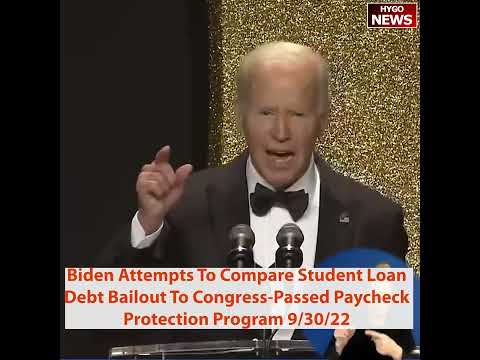
Biden Compares His Executive Student Loan Bailout to Congress-Passed PPP Loans, Attacks GOP: “I Don’t Want to Hear a Word” From Members Who Got Forgiveness
On 10/1/2022, President Biden used the Congressional Black Caucus Foundation’s Phoenix Awards Dinner to draw a direct comparison between his executive action canceling student loan debt and the Paycheck Protection Program that Congress passed with bipartisan support during the Trump administration. Biden attacked Republican members of Congress whose families received PPP loan forgiveness, saying “I don’t want to hear a word from those members of Congress whose families got tens of thousands of dollars and several million dollars in pandemic relief loan forgiveness.” The comparison became a central Democratic talking point heading into the 2022 midterms — but critics argued it fundamentally mischaracterized two very different programs.
The PPP Comparison
Biden’s argument was straightforward: Republicans who received forgivable PPP loans had no standing to criticize his student loan forgiveness plan. “I don’t want to hear a word from those members of Congress, if you notice, whose families got tens of thousands of dollars and several million dollars in pandemic relief loan forgiveness,” Biden said. “The same ones criticizing. Give me a break. Come on.”
The White House had been building this argument for weeks. In August 2022, after announcing the student loan forgiveness plan, the administration published a list of Republican members of Congress who had received PPP loan forgiveness — complete with dollar amounts — designed to create a hypocrisy narrative. The social media strategy was effective: individual posts naming specific members and their PPP forgiveness amounts went viral across platforms.
Why Critics Said the Comparison Failed
Despite its political effectiveness, the PPP-to-student-loan comparison had significant structural problems that critics were quick to identify.
The Paycheck Protection Program was created by Congress through the CARES Act, passed with overwhelming bipartisan support in March 2020. The loans were explicitly designed to be forgiven — that was the entire point. Businesses received money on the condition that they maintained their payrolls during government-mandated COVID lockdowns. If they met the conditions, the loans converted to grants. Forgiveness was not a retroactive policy change; it was the program’s core mechanism from the beginning.
Student loans, by contrast, were voluntary borrowing agreements with established repayment terms. Borrowers agreed to repay the money when they took the loans. Biden’s forgiveness program changed the terms after the fact through executive action, without congressional authorization. The legal distinction was significant — Congress never voted to forgive student debt, while PPP forgiveness was built into the legislation Congress passed.
There was also a constitutional dimension. PPP forgiveness was authorized by the legislative branch through its spending power. Biden’s student loan forgiveness relied on a novel interpretation of the HEROES Act of 2003, a post-9/11 law designed to help military personnel — not to authorize mass debt cancellation for the general population. Multiple legal challenges were filed, and the Supreme Court would ultimately strike down the program in Biden v. Nebraska in June 2023, ruling 6-3 that the administration had exceeded its authority.
”We’re the Big Spenders”
Biden framed his spending record defensively. “I’m so sick of Republicans saying we’re the big spenders. Give me a break. Give me a break,” Biden said.
The claim was difficult to square with the administration’s record. Biden had signed the $1.9 trillion American Rescue Plan, the $1.2 trillion Infrastructure Investment and Jobs Act, and the $740 billion Inflation Reduction Act — plus the student loan forgiveness plan estimated at $400 billion to $1 trillion. Combined federal spending under Biden represented one of the largest expansions of government outlays in American history outside of wartime.
Biden cited the Inflation Reduction Act as evidence of fiscal responsibility. “This bill is going to reduce the deficit by another 300 billion over 10 years because Medicare is going to be paying less for the drugs that are going out,” Biden said. But the $300 billion in projected deficit reduction was a fraction of the deficit increases from his earlier legislation, and the student loan forgiveness plan alone was projected to exceed it.
The Cost of Student Loan Forgiveness
Biden presented the forgiveness as affordable. “As a result, we can afford — I know I’m being banged up by the Republicans, but come bring it on — we can afford to cancel $10,000 in student debt and $20,000 if you had a Pell Grant,” Biden said. “For Americans making under $125,000.”
The $125,000 income threshold was itself controversial. Critics noted that an individual earning $124,999 was hardly struggling financially and that the program effectively transferred wealth from taxpayers — including those who never attended college, paid off their loans, or chose less expensive schools — to college graduates who earned above-median incomes.
The Penn Wharton Budget Model estimated the program would cost approximately $519 billion over ten years. The Committee for a Responsible Federal Budget estimated even higher costs when accounting for the extended payment pause and changes to income-driven repayment plans announced alongside the forgiveness. These figures dwarfed the $300 billion in IRA deficit savings Biden cited as making the program affordable.
The Political Strategy
The PPP comparison was part of a deliberate midterm election strategy. The White House calculated that student loan forgiveness would energize young voters — a key Democratic constituency — while the PPP hypocrisy argument would neutralize Republican criticism. The strategy targeted specific GOP members by name, creating personalized social media content showing their PPP forgiveness amounts alongside their statements opposing student debt cancellation.
The approach was politically sophisticated but legally vulnerable. By building an election-year initiative on executive authority rather than legislation, the administration created a benefit that could be — and ultimately was — struck down by the courts. The political promise of forgiveness generated enthusiasm, but the legal reality left millions of borrowers in limbo when the Supreme Court blocked the program.
The CBC Audience
Biden delivered these remarks at the Congressional Black Caucus Foundation dinner, a venue where student loan forgiveness was particularly resonant. Black borrowers carry disproportionately higher student debt loads on average, and the Pell Grant provision — offering $20,000 in forgiveness rather than $10,000 — was designed partly to address racial disparities in student debt. The CBC had been among the loudest congressional voices calling for student debt cancellation, with some members pushing for $50,000 or more in forgiveness.
The friendly audience cheered Biden’s combative tone, but the legal and fiscal questions the speech raised would not be resolved by applause.
Key Takeaways
- Biden compared his executive student loan forgiveness to the congressionally authorized PPP program, attacking GOP members who received PPP forgiveness while opposing student debt cancellation.
- The comparison was structurally flawed: PPP was designed by Congress to be forgiven, while student loans were voluntary agreements changed retroactively by executive action.
- Biden claimed the IRA’s $300 billion deficit reduction made forgiveness affordable, but the forgiveness plan itself was estimated to cost $400 billion to $1 trillion.
- The $125,000 income threshold meant borrowers earning well above median income qualified for taxpayer-funded relief.
- The Supreme Court struck down the broad forgiveness program in June 2023, ruling Biden exceeded his authority.
Transcript Highlights
The following is transcribed from the video audio (unverified — AI-generated from audio).
- I’m so sick of Republicans saying we’re the big spenders. Give me a break. Give me a break.
- This bill is going to reduce the deficit by another 300 billion over 10 years.
- We can afford to cancel $10,000 in student debt and $20,000 if you had a Pell Grant.
- I know I’m being banged up by the Republicans, but come bring it on.
- I don’t want to hear a word from those members of Congress whose families got tens of thousands of dollars in pandemic relief loan forgiveness.
- The same ones criticizing. Give me a break. Come on.
Full transcript: 137 words transcribed via Whisper AI.