 HYGO News
 Biden claims "real savings" on gas, $1.40 more than when he took office
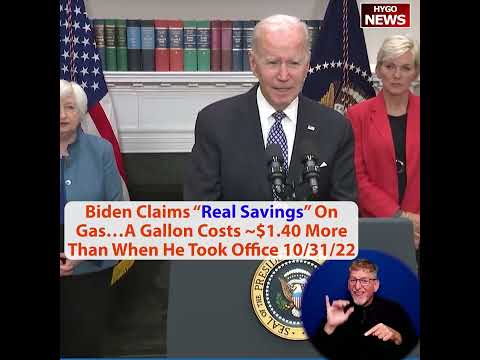
Biden Claims “$3.76 Gas” Is “Real Savings for American Families” — Gas Was $2.39 When He Took Office, Still $1.37 Higher
On 10/31/2022, President Biden delivered a White House speech claiming that falling gas prices represented “real savings for American families.” Biden said prices were “down more than a dollar twenty since their peak this summer” and that the average price of $3.76 per gallon was “adding up to real savings.” But gas was approximately $2.39 when Biden took office in January 2021 — meaning families were still paying roughly $1.37 more per gallon than before his presidency. Biden was celebrating a partial decline from a price spike that occurred entirely on his watch, achieved by draining the Strategic Petroleum Reserve to its lowest level since the 1980s.
”Real Savings for American Families”
Biden presented the gas price decline as an achievement. “Gas prices have actually come down, going into the Strategic Petroleum Reserve here at home in America,” Biden said. “They’re down more than a dollar twenty since their peak this summer and they’ve been falling for the best part of the last three weeks.”
“Today, the average price for a gallon of gas is $3.76,” Biden continued. “That’s adding up to real savings for American families. The difference between those prices — and this difference makes a difference in a difficult time.”
The framing was the Biden administration’s signature economic messaging technique: measuring progress from the worst point of a crisis rather than from the pre-crisis baseline. Gas had peaked above $5 per gallon nationally in June 2022. The decline to $3.76 represented a $1.24 drop from the peak. Biden characterized this decline as “savings” — as if families had received money rather than simply been charged less than the worst price in the nation’s history.
The actual math told a different story. Gas was approximately $2.39 per gallon on January 20, 2021. At $3.76 in late October 2022, families were paying $1.37 more per gallon than when Biden took office — a 57% increase. For a family filling a 15-gallon tank weekly, that represented roughly $1,070 more per year in gasoline costs compared to Inauguration Day.
Calling $3.76 gas “real savings” when the pre-Biden price was $2.39 was like a landlord raising rent from $1,000 to $2,500, then lowering it to $2,000 and claiming the tenant was “saving $500 a month."
"Going Into the Strategic Petroleum Reserve”
Biden explicitly credited the SPR drawdown for the price decline. “Gas prices have actually come down, going into the Strategic Petroleum Reserve here at home in America,” Biden said — appearing to mean “by tapping into” the reserve.
The acknowledgment was more candid than usual about the mechanism behind the price decline. Biden was not claiming that market forces, increased production, or the Inflation Reduction Act had lowered gas prices. He was saying he had drawn down America’s emergency oil stockpile to reduce consumer prices.
By October 2022, the SPR had been reduced from approximately 638 million barrels when Biden took office to roughly 400 million barrels — a drawdown of nearly 40% of the reserve. The 180-million-barrel release authorized in March 2022 was the largest in the SPR’s 47-year history, and additional releases continued through the fall.
The SPR releases had undeniably contributed to lower gas prices by adding supply to the market. But the approach had significant costs: the emergency reserve was at its lowest level in nearly four decades, leaving the country more vulnerable to genuine supply disruptions. Biden was spending down a national security asset to produce the “real savings” he was now celebrating — a short-term gain purchased with long-term strategic risk.
”Soaring Literally Around the World”
Biden attributed high gas prices to global factors. “Gas prices soaring literally around the world — not just here, but around the world,” Biden said, establishing the familiar defense that inflation was a global phenomenon beyond any single president’s control.
The global framing served its usual purpose: deflecting responsibility from domestic policy to international forces. It was true that gas prices had risen worldwide following Russia’s invasion of Ukraine. But the comparison obscured the fact that U.S. gas prices rose from a lower base and spiked higher than many peer economies — partly because Biden’s anti-fossil-fuel policies had constrained domestic production growth and made the U.S. more vulnerable to global supply disruptions.
Countries that had invested in domestic energy production and infrastructure — including those that maintained nuclear power capacity, expanded natural gas production, or developed energy independence strategies — experienced less severe price shocks. Biden’s policies had moved the United States in the opposite direction: canceling pipelines, restricting leasing, and signaling a rapid transition away from fossil fuels that discouraged the long-term investment needed to expand supply.
”Americans Across the Country Have Stepped Up”
Biden praised Americans for adapting to high prices. “Americans across the country have stepped up to do the right thing,” Biden said — a line that simultaneously credited consumers for coping and implied they had a responsibility to bear the burden.
The framing of high gas prices as something Americans needed to “step up” and endure — rather than a policy failure the government needed to fix — reflected a recurring tension in the administration’s messaging. On one hand, Biden claimed he was “bringing prices down” through his actions. On the other, he praised Americans for absorbing the costs. The two positions were contradictory: if Biden was successfully lowering prices, Americans shouldn’t need to “step up” to anything.
The “Real Savings” Math
Biden’s claim of “real savings” based on a $1.20 decline from the peak collapsed under basic arithmetic:
- Gas on Inauguration Day (Jan 2021): ~$2.39/gallon
- Gas at peak (June 2022): ~$5.01/gallon
- Gas at time of speech (Oct 2022): ~$3.76/gallon
- Increase from Inauguration Day: +$1.37/gallon (+57%)
- Decline from peak: -$1.25/gallon
- Net cost to families vs. pre-Biden: +$1.37/gallon
The “savings” Biden celebrated — the $1.25 decline from peak — was smaller than the $1.37 increase from his starting point. Americans were still significantly worse off at $3.76 than they had been at $2.39. Biden was taking credit for partially cleaning up a mess his policies helped create, using emergency reserves to temporarily mask the structural supply problems his energy agenda had produced.
The Midterm Timing
Biden’s speech came eight days before the November 8 midterm elections — the same day he threatened oil companies with windfall profits taxes. The double messaging — celebrating gas price declines while threatening the industry responsible for producing gasoline — captured the incoherence of the administration’s energy policy. Biden was simultaneously claiming credit for lower prices, threatening the companies that produced the fuel, and draining emergency reserves to maintain the decline through Election Day.
The SPR releases would slow significantly after the midterms, lending credibility to the political motivation thesis Biden repeatedly denied. The “real savings” were temporary by design — a pre-election benefit purchased with emergency reserves that would need to be replenished at higher prices.
Key Takeaways
- Biden claimed $3.76 gas represented “real savings” — gas was $2.39 when he took office, meaning families were still paying 57% more per gallon.
- He measured “savings” from the June $5.01 peak rather than from the $2.39 Inauguration Day baseline — a decline of $1.25 that was smaller than the $1.37 total increase.
- Biden explicitly credited the SPR drawdown for lower prices, acknowledging the emergency reserve was the mechanism behind the decline.
- The SPR had been reduced by nearly 40%, from 638 million to roughly 400 million barrels — its lowest level since the 1980s.
- The speech came 8 days before midterms, alongside windfall tax threats against the same oil companies producing the fuel Biden was celebrating as cheaper.
Transcript Highlights
The following is transcribed from the video audio (unverified — AI-generated from audio).
- Gas prices soaring literally around the world, not just here but around the world.
- Because of the action we’ve taken, gas prices have actually come down, going into the Strategic Petroleum Reserve.
- They’re down more than a dollar twenty since their peak this summer.
- Today the average price for a gallon of gas is $3.76. That’s adding up to real savings for American families.
- This difference makes a difference in a difficult time.
- Americans across the country have stepped up to do the right thing.
Full transcript: 112 words transcribed via Whisper AI.