 HYGO News
 Biden claims 'real progress' on inflation, wait for tax credits on solar panels if we can afford
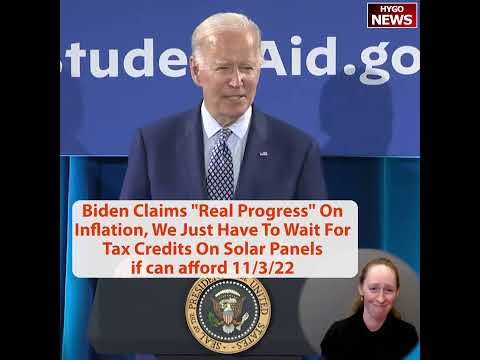
Biden Claims “Real Progress” on Inflation — Solution: Wait for Tax Credits on Solar Panels and Weatherizing Your Home to “Save $500 a Year”
On 11/3/2022, President Biden traveled to Albuquerque, New Mexico to deliver remarks on student debt relief and the economy, five days before the midterm elections. Biden acknowledged “it’s been a rough few years for hardworking Americans” and that “things are still really tough” — then claimed “we’re making real progress” and pointed to the Inflation Reduction Act’s $368 billion in climate spending as the solution. His pitch to struggling families: wait for tax credits on solar panels and weatherization that would “save the average family in America at least $500 a year.” The suggestion that families dealing with 8.2% inflation and thousands of dollars in additional annual costs should be excited about future savings on home improvements they likely couldn’t afford captured the disconnect between the administration’s legislative achievements and voters’ daily reality.
”It’s Been a Rough Few Years”
Biden opened with unusual candor about economic conditions. “I know it’s been a rough few years for hardworking Americans. A lot of families, things are still really tough,” Biden said.
The acknowledgment — “still really tough” — was more honest than most Biden economic statements, which typically emphasized progress and achievements. By November 2022, the “tough” was quantifiable: cumulative consumer price increases of approximately 13% since Biden took office, real wages declining for 18 consecutive months, mortgage rates above 7%, and grocery prices up 11.2% year-over-year.
“But there are bright spots,” Biden continued, pivoting quickly from the acknowledgment to his optimistic messaging. “So we’re making real progress.”
The juxtaposition — “things are still really tough” followed immediately by “we’re making real progress” — encapsulated the administration’s economic messaging challenge. The progress Biden cited was either future-tense (tax credits that hadn’t taken effect) or measured from the worst point of the crisis (gas prices down from their peak), while the “tough” part was present-tense and experienced daily by every family that bought groceries, paid rent, or filled a gas tank.
”A Lot of It Is Just Going to Kick In”
Biden’s “real progress” claim rested heavily on anticipated future benefits. “And by the way, a lot of it is just going to kick in beginning in January because we passed this profound legislation,” Biden said.
The admission that relief was “just going to kick in” — in January 2023, after the midterm election — was a tacit acknowledgment that the current situation had not yet improved for most families. Biden was asking voters to reward Democrats for benefits they hadn’t received yet, on the promise that relief was coming soon.
The “kick in” timeline was itself optimistic. Many IRA provisions wouldn’t take effect for years. Medicare drug price negotiations wouldn’t begin until 2026. Clean energy manufacturing incentives would require years of factory construction and production ramp-up. The tax credits Biden was about to describe required homeowners to make substantial upfront investments.
Solar Panels and Weatherization
Biden’s specific example of how the IRA would help families revealed the gap between his legislative achievements and voters’ immediate concerns. “We passed legislation providing $368 billion in help to deal with global warming,” Biden said. “Well, guess what? It’s estimated that what’s available to people for their homes — weatherizing their homes, solar panels, a whole range of things — it’s estimated it’s going to save the average family in America at least $500 a year.”
The $500-per-year savings figure — even if accurate — required several steps before families could access it:
Step 1: Afford the upfront cost. A residential solar panel system cost $15,000 to $25,000 before incentives in 2022. Home weatherization projects (insulation, windows, HVAC upgrades) could cost $5,000 to $20,000. The IRA provided tax credits covering up to 30% of these costs, but families still needed to finance 70% out of pocket — a difficult proposition when inflation was consuming household budgets and credit card rates were surging.
Step 2: Be a homeowner. Tax credits for solar panels and weatherization applied to homeowner improvements. The roughly one-third of Americans who rented their homes were excluded from these benefits entirely. Renters — who were disproportionately lower-income and most affected by inflation — couldn’t install solar panels or weatherize homes they didn’t own.
Step 3: Wait for the savings to materialize. Solar panel savings accrued over time through reduced electricity bills. The $500-per-year estimate represented the annual energy cost reduction after making a five-figure investment — meaning the payback period could be 15-20 years after the 30% tax credit.
Step 4: File taxes to claim the credit. The savings came as a tax credit, not a direct payment. Families needed to pay the full cost upfront, then claim the credit when filing their next tax return — a timing mismatch that required available capital most struggling families didn’t have.
$500 vs. $8,000
The $500 annual savings Biden cited from climate provisions was dwarfed by the annual cost of inflation. With cumulative consumer price increases of approximately 13% since January 2021, the average American household was paying roughly $8,000 more per year for the same goods and services — a figure calculated by multiple economic analyses based on CPI data and average household spending.
Biden was offering $500 in potential future savings — contingent on buying solar panels and weatherization — to offset $8,000 in current inflation costs. The ratio was approximately 16:1 — families were losing $16 to inflation for every $1 they might save through climate tax credits, assuming they could afford the upfront investment, owned their home, and waited years for the savings to materialize.
The Student Debt Rally
Biden delivered these remarks at a student debt relief event in Albuquerque, designed to energize young voters before the midterms. The student loan forgiveness program — which Biden was still promoting despite the Eighth Circuit Court of Appeals having blocked it — was another example of benefits promised but not yet delivered.
The pattern across Biden’s closing midterm argument was consistent: vote for us because of what we’re going to do, not because of what we’ve done. Student loan forgiveness was blocked by courts. Drug pricing changes wouldn’t take effect until 2026. Solar panel tax credits required upfront investment most families couldn’t afford. Gas prices were down from their peak but still 57% above Inauguration Day levels.
The ask to voters was: trust that future benefits will eventually offset present pain, and vote accordingly. Five days before the midterms, this was the strongest case the administration could make — which said something about how weak the case based on current conditions would have been.
”It’s Going to Save the Environment”
Biden concluded with a dual benefit claim. “It’s estimated it’s going to save the average family in America at least $500 a year. And it’s going to save the environment,” Biden said.
The environmental benefit was arguably the IRA’s most significant impact — the $368 billion in climate spending represented the largest federal investment in clean energy in American history. But positioning environmental protection as an inflation solution confused the legislative purpose. The IRA was primarily a climate bill marketed as inflation reduction; Biden’s pitch to inflation-weary families was that the climate spending would somehow address their grocery bills — a connection that didn’t exist.
Key Takeaways
- Biden acknowledged “things are still really tough” then claimed “real progress” — citing future tax credits for solar panels and weatherization that hadn’t taken effect.
- He said the IRA would “save the average family at least $500 a year” — requiring a $15,000-$25,000 upfront investment in solar panels that most families couldn’t afford.
- The $500 potential savings was dwarfed by the roughly $8,000 in additional annual costs families faced from 13% cumulative inflation.
- The tax credits applied only to homeowners, excluding the one-third of Americans who rented — disproportionately lower-income families most affected by inflation.
- Biden admitted “a lot of it is just going to kick in beginning in January” — asking voters to reward Democrats for benefits they hadn’t received yet.
Transcript Highlights
The following is transcribed from the video audio (unverified — AI-generated from audio).
- I know it’s been a rough few years for hardworking Americans. A lot of families, things are still really tough. But there are bright spots.
- We’re making real progress. A lot of it is just going to kick in beginning in January.
- We passed legislation providing $368 billion in help to deal with global warming.
- What’s available to people for their homes — weatherizing their homes, solar panels, a whole range of things.
- It’s estimated it’s going to save the average family in America at least $500 a year.
- And it’s going to save the environment.
Full transcript: 140 words transcribed via Whisper AI.