 HYGO News
 Biden called Kyrsten Sinema: "a tremendous" Does he regret making that statement
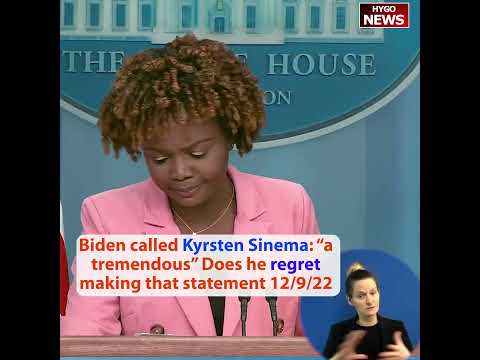
KJP on Biden Calling Sinema “Tremendous Advocate” Days Before Her Independent Switch — Reads Prepared Remarks in Response to “Regret” Question
On 12/9/2022, a reporter asked White House Press Secretary Karine Jean-Pierre about President Biden’s Arizona speech earlier that week in which he had called Senator Kyrsten Sinema “a tremendous advocate for the people of Arizona and a leader in so many issues important to this state.” The question had political weight because Sinema had just announced she was leaving the Democratic Party to become an Independent. “Does he regret making that statement which could be viewed as an endorsement?” the reporter asked. KJP didn’t directly answer whether Biden regretted the statement. Instead, she deflected to the genericness of such praise: “I mean he says this about many Congressional members when he visits.” She then read Biden’s original Arizona remarks verbatim — essentially repeating the complimentary language without indicating whether it still applied after Sinema’s party switch.
The Political Context: Sinema’s Departure
Sinema had announced her departure from the Democratic Party on December 9, 2022 — just days after Biden’s Arizona visit. Her decision to become an Independent had significant implications:
Reduced Democratic Senate control — From 51-49 to effectively 50-49-1 (depending on caucus status).
Threatened to run without Democratic primary challenge — By declaring Independent.
Raised 2024 complications — For Democratic plans in Arizona.
Created immediate political awkwardness — For the administration’s prior praise.
Sinema’s reasons for the switch were complex:
- Ongoing tensions with progressive Democrats over her positions on filibuster, Build Back Better, and other legislation
- Primary concerns, with liberal challenger Ruben Gallego positioning to run against her
- Personal political brand differentiation
- Fundraising advantages as an Independent
- Strategic positioning for 2024 reelection
Whatever her motivations, her departure created awkwardness for Democrats who had publicly praised her shortly before the announcement.
The Biden Arizona Praise
The reporter cited Biden’s specific words. “While he was in Arizona, he called her quote a tremendous advocate for the people of Arizona and a leader in so many issues Important to this state and quote,” the reporter said.
Biden’s specific phrasing — “tremendous advocate” and “leader in so many issues” — was effusive. It wasn’t generic congressional courtesy; it was specific praise that suggested Biden viewed Sinema as an outstanding senator.
The praise was particularly striking in context:
It came days before her party switch — Timing that created political awkwardness.
It was delivered on a presidential visit — High-visibility praise.
It was specific and substantive — Not just perfunctory thanks.
It was made during political context — Not just a photo opportunity.
The reporter’s question raised whether Biden regretted the praise given Sinema’s subsequent party switch. If Biden had known she was about to leave, he might have been more restrained. If he hadn’t known, he had been praising a senator who was days from abandoning his party.
”Could Be Viewed as an Endorsement”
The reporter’s phrasing was pointed. “Does he regret making that statement which could be viewed as an endorsement?” the reporter asked.
The “could be viewed as an endorsement” framing was significant because:
2024 Senate race implications — Arizona would be a key race in 2024.
Sinema’s 2024 plans unclear — Whether she would run for reelection was unknown.
Gallego positioning — Progressive Democrat Ruben Gallego was likely to challenge.
Administration neutrality questions — Would Biden remain neutral or back a Democrat?
If Biden’s praise could be viewed as an endorsement, then the administration had effectively endorsed Sinema shortly before she left the party. This would complicate administration relations with Democratic primary challengers and raise questions about whether the administration’s endorsement would transfer to whoever emerged from a Democratic primary.
The “Last Spoke” Question
The reporter had also asked about Biden-Sinema communication frequency. “Do you know when the last time that they spoke was?” the reporter asked.
KJP’s response was an admission of ignorance. “I don’t have a last time that they spoke So don’t have anything to share with you at this time on that piece,” KJP said.
The answer had several implications:
Limited coordination — KJP didn’t know when the two had last spoken.
No recent conversation to cite — Couldn’t point to an active engagement.
Administration-senator relationship — Not tight enough to track conversation frequency.
Preparation gap — KJP wasn’t prepared for this specific question.
For a senator whose departure from the Democratic Party was the major story of the day, the inability to cite recent communications was notable. It suggested that the administration hadn’t been in close contact with Sinema leading up to her announcement — or that the contacts weren’t ones the administration wanted to detail.
”He Says This About Many Congressional Members”
KJP’s deflection was that the praise was generic. “I mean he says this about many Congressional members when he visits,” KJP said.
The “he says this about many” framing served to minimize the specificity of Biden’s Sinema praise. If Biden said similar things about many members, then the Sinema praise was:
Not unusual — Just standard presidential courtesy.
Not specifically endorsing — Similar language for many recipients.
Not worth analyzing — Generic content that didn’t deserve close reading.
Not worth regretting — Nothing unique about it to regret.
But the framing also had problems. Biden’s specific language — “tremendous advocate for the people of Arizona and a leader in so many issues important to this state” — was specific to Sinema. Even if Biden generically praised many members, the specific content he praised Sinema for was about her specific work. “Tremendous advocate” was language with specific meaning.
The deflection also didn’t address whether Biden regretted the specific instance of praise. Regardless of whether Biden praised others similarly, the question was about this specific praise given its unfortunate timing.
The Verbatim Reading
KJP then read Biden’s words verbatim. “I want to thank senator Sinema who can’t be with us today She’s in Washington working out another major piece of legislation a tremendous advocate for the people of Arizona and a leader in so many issues important to this state,” KJP read.
The verbatim reading was striking. Rather than distancing from the praise or offering a revised administration position, KJP simply repeated Biden’s original words. This had several possible interpretations:
The praise was maintained — Biden still held this view.
The administration was committed to the statement — Not backing away.
The administration wasn’t changing position — Treating praise as still operative.
Defensive repetition — Reading the words without commenting on them.
The verbatim repetition avoided requiring KJP to say whether Biden actually regretted the statement. By reading what Biden had said without adding commentary, KJP could neither confirm nor deny regret.
”Another Major Piece of Legislation”
The verbatim quote included the phrase “working out another major piece of legislation” — a reference to legislation Sinema was involved in at the time. This was politically significant because:
Sinema was still working with Democrats — Even as she prepared to leave the party.
Her legislative work continued — Bipartisan deals and procedural votes.
Her role as independent wouldn’t end cooperation — Administration could still work with her.
The praise had substantive basis — Based on actual legislative contributions.
This context helped explain the administration’s approach to Sinema’s departure. Even as she left the party, she would continue to vote with Democrats on many matters. The administration needed to maintain working relations with her. Criticism of her departure could damage these relationships.
The Administration’s Difficult Position
The administration was in a difficult position after Sinema’s departure:
Needed her continued cooperation — For ongoing legislative work.
Couldn’t endorse her 2024 reelection — Without alienating Democratic primary base.
Had to maintain Senate majority calculations — Even without Sinema’s party membership.
Couldn’t directly criticize her — Without provoking retaliation.
Had to avoid appearing surprised — Which would suggest communication failures.
KJP’s approach — refusing to regret the praise while also not amplifying it — was an attempt to manage these tensions. By maintaining the technical position that Biden’s praise had been accurate, the administration avoided creating direct conflict with Sinema. By not amplifying the praise, the administration didn’t further complicate relationships with Democratic primary challengers.
The 2024 Arizona Implications
Sinema’s departure had major 2024 implications:
Senate math — Democrats would need to defend the Arizona seat without an incumbent.
Primary dynamics — Ruben Gallego quickly emerged as the likely Democratic candidate.
Independent challenge — Sinema could run as Independent, potentially splitting votes.
Republican opportunity — Arizona Republicans saw the chaos as favorable.
Biden’s role — Would need to navigate complex Arizona politics.
The administration’s handling of the Sinema departure would affect all of these dynamics. KJP’s careful management — maintaining past praise without extending future commitments — positioned the administration for flexibility as the 2024 cycle developed.
Sinema ultimately chose not to run in 2024, avoiding the three-way race that would have complicated Democratic prospects. But the decision came later, after extensive positioning and political developments. The administration’s December 2022 handling of her departure was early in this long political evolution.
The Broader Question of Administration Endorsements
The “could be viewed as an endorsement” framing raised broader questions about administration endorsements generally. Presidents routinely praise senators when visiting their states. Such praise is typically understood as:
Political courtesy — Not substantive endorsement.
Relationship maintenance — Supporting working relationships.
Local politics — Acknowledging in-state influence.
Not 2024 commitments — Generally not predicting future elections.
The interpretation of such praise as “endorsement” was a stronger reading than routine political practice supported. But the specific timing of Biden’s Sinema praise — days before her party switch — gave the praise higher visibility than usual. Routine context was lost in the drama of her departure.
Key Takeaways
- Days before Senator Kyrsten Sinema announced her departure from the Democratic Party, Biden had called her “a tremendous advocate for the people of Arizona” during an Arizona visit.
- A reporter asked whether Biden regretted making that statement, which “could be viewed as an endorsement.”
- KJP didn’t directly answer whether Biden regretted the praise.
- She deflected to the genericness of such praise: “He says this about many Congressional members when he visits.”
- KJP then read Biden’s original remarks verbatim — neither distancing from nor updating the administration’s position on Sinema following her party switch.
Transcript Highlights
The following is transcribed from the video audio (unverified — AI-generated from audio).
- Senator Sinema didn’t travel with the president earlier this week to Arizona. So do you know when the last time that they spoke was?
- I don’t have a last time that they spoke.
- While he was in Arizona, he called her quote a tremendous advocate for the people of Arizona and a leader in so many issues important to this state.
- Does he regret making that statement which could be viewed as an endorsement?
- I mean he says this about many Congressional members when he visits.
- I want to thank senator Sinema who can’t be with us today. She’s in Washington working out another major piece of legislation, a tremendous advocate for the people of Arizona.
Full transcript: 144 words transcribed via Whisper AI.