 HYGO News
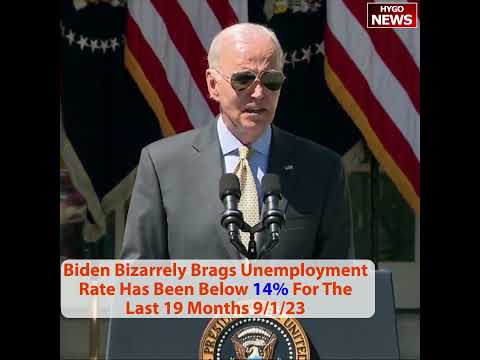
 Biden Bizarrely Brags Unemployment Rate Has Been Below 14% For The Last 19 Months
Biden Bizarrely Brags Unemployment Rate Has Been Below 14% for the Last 19 Months
On September 1, 2023, President Joe Biden delivered remarks on the August jobs report from the Rose Garden in what was his only public event of the day. In an attempt to promote his “Bidenomics” agenda, Biden declared that “the unemployment rate has been below 14% for the last 19 months, the longest stretch in over 50 years.” The statement was plainly a verbal error — Biden almost certainly meant to say “below 4%” — but the gaffe turned his intended boast into an unintentionally absurd claim, as bragging about unemployment being below 14% set an extraordinarily low bar for economic success.
The moment went viral as another example of Biden’s persistent verbal stumbles undermining his own messaging, particularly at a time when the administration was aggressively pushing the Bidenomics brand and the August jobs report it was responding to was itself raising concerns about the direction of the economy.
The Rose Garden Remarks
Biden’s brief appearance in the Rose Garden was intended to put a positive spin on the August 2023 jobs report. He paired the unemployment gaffe with another iteration of his Bidenomics pitch.
“Now unemployment and unemployment rate has been below 14% for the last 19 months, the longest stretch in over 50 years,” Biden said, apparently reading from prepared remarks or a teleprompter.
He continued with the Bidenomics talking point: “The Financial Times and the Wall Street Journal have heard me say it before, started calling my plan Bidenomics. It’s about investing in America and investing in Americans. It’s working.”
Biden clearly intended to say that unemployment had been below 4 percent for 19 consecutive months. This would have been an accurate statistic and a legitimate talking point for the administration. Instead, by saying “14 percent,” he created a statement that was technically true but absurdly meaningless. The U.S. unemployment rate had only briefly spiked above 14 percent during the worst of the COVID-19 pandemic shutdowns in April 2020, when it reached 14.7 percent. Bragging that unemployment had stayed below pandemic shutdown levels for 19 months was, unintentionally, the lowest possible bar for economic achievement.
The August Jobs Report Reality
The jobs report Biden was responding to actually contained mixed-to-negative signals about the economy, making his upbeat framing even more disconnected from the data.
The Bureau of Labor Statistics reported that the unemployment rate rose to 3.8 percent in August 2023, up from 3.5 percent in July. While 3.8 percent was still historically low, the direction was concerning, moving upward rather than continuing to decline. Nonfarm payrolls increased by 187,000 in August, a number that was below expectations and represented a slowdown from earlier months.
More critically, the report continued a pattern that had become a hallmark of Biden-era economic data: the previous months’ job numbers were revised downward. The Biden administration’s initial jobs reports had been repeatedly and systematically revised lower in subsequent months, a pattern that meant the economic picture was consistently being presented as better than it actually was when the data was first released.
This pattern of downward revisions had been noted by economists and financial analysts across the political spectrum. Over the course of Biden’s presidency, the cumulative downward revisions to monthly payroll numbers reached into the hundreds of thousands, meaning the initial economic reports that shaped public perception and media headlines were consistently overstating job creation.
The Bidenomics Disconnect
Biden’s Rose Garden appearance was part of the broader Bidenomics messaging campaign the White House had launched in mid-2023. The strategy involved the president repeatedly claiming credit for economic metrics that were either misleading or that Americans’ own experiences contradicted.
The core problem with Bidenomics as a political brand was the disconnect between the statistics the administration cited and the economic reality facing ordinary Americans. While the White House pointed to low unemployment numbers and job creation figures, Americans were experiencing the cumulative impact of 16.9 percent inflation since Biden took office, record credit card debt, soaring housing costs, and eroded purchasing power.
The credit card debt milestone was particularly telling. In 2023, total U.S. credit card debt surpassed $1 trillion for the first time in history, according to the Federal Reserve Bank of New York. This was not a sign of consumer confidence; it was a sign that Americans were increasingly borrowing to cover basic expenses as their wages failed to keep pace with inflated prices for food, housing, energy, and other necessities.
Average credit card interest rates had also risen to their highest levels in decades, exceeding 20 percent, as the Federal Reserve’s aggressive rate hikes to combat inflation flowed through to consumer borrowing costs. The combination of rising debt balances and higher interest rates created a tightening financial vise for millions of American families.
The Verbal Gaffe Pattern
The “below 14%” slip was one of countless verbal errors that marked Biden’s public appearances and consistently undermined his messaging. The significance of these gaffes was not merely that they were embarrassing; they actively sabotaged the administration’s own communications strategy.
In this case, Biden was given a straightforward task: go to the Rose Garden, read prepared remarks about a jobs report, and promote Bidenomics. Even with prepared text and a teleprompter, he managed to turn a statistical boast into a punchline. The clip that circulated on social media was not about the substance of the jobs report or the merits of Bidenomics; it was about a president who could not accurately read or deliver a basic economic statistic.
This pattern was particularly damaging because the Biden administration’s economic strategy depended heavily on changing public perception through consistent messaging. If the president could not deliver the message accurately, the entire strategy was undermined before it could gain traction.
The gaffe also highlighted the question of how much Biden understood about the economic data he was presenting. Saying “14 percent” instead of “4 percent” was the kind of error that suggested he was reading words on a screen without fully processing their meaning. A president who was engaged with the substance of economic data would likely have caught such an error in real time, recognizing that 14 percent was a nonsensical figure to brag about.
Only Public Event of the Day
The fact that the Rose Garden remarks were Biden’s only public event for the entire day added another layer to the story. By September 2023, Biden’s light public schedule had become a subject of recurring commentary. The president frequently had days with no public events at all, or days with a single brief appearance.
Critics argued that the limited schedule was evidence that the president’s staff was deliberately minimizing his public exposure to reduce the number of gaffe opportunities. If the president could not get through a single brief Rose Garden appearance without a significant verbal error, it raised obvious questions about what a fuller schedule might produce.
The contrast with previous presidents, who typically maintained packed daily schedules with multiple public events, meetings, and media interactions, was stark and reinforced the perception that Biden’s team was managing around his limitations rather than addressing them.
Additional Context
Biden’s “below 14%” gaffe came during the peak of the Bidenomics messaging campaign, which was already struggling to gain traction with the public. Despite weeks of concentrated effort, including speeches, media appearances, and a dedicated website, polls consistently showed that Americans gave Biden poor marks on the economy and did not believe his policies were improving their financial situation.
The administration would quietly phase out the Bidenomics branding by late 2023, tacitly acknowledging that the campaign had failed. The combination of stubborn inflation, rising interest rates, record consumer debt, and a president who could not articulate his own economic talking points without errors had made Bidenomics more of a liability than an asset.
Key Takeaways
- Biden said the unemployment rate had been “below 14%” for 19 months when he clearly meant to say “below 4%,” turning an intended economic boast into an unintentionally absurd claim.
- The gaffe occurred during Rose Garden remarks on the August 2023 jobs report, which itself showed unemployment rising to 3.8% and continuing a pattern of downward revisions to prior months’ job numbers.
- U.S. credit card debt had surpassed $1 trillion for the first time in history at the time of Biden’s remarks, undermining the administration’s claims that Bidenomics was working for American families.
- The appearance was Biden’s only public event for the day, reflecting the limited schedule that critics attributed to staff efforts to minimize gaffe opportunities.
- The verbal error sabotaged the Bidenomics messaging the appearance was designed to promote, as the clip went viral for the gaffe rather than the intended economic talking points.