 HYGO News
 Biden Asked Congress for $25 Billion for World Bank While Americans Face Spiking Credit Card Debt
Biden Asked Congress for $25 Billion for World Bank While Americans Face Spiking Credit Card Debt
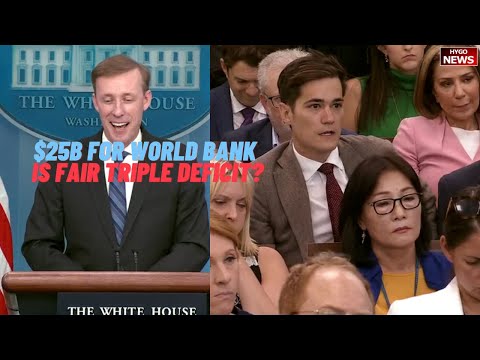
On September 5, 2023, National Security Advisor Jake Sullivan took the White House podium to brief reporters ahead of the G20 summit and faced pointed questions about President Biden’s request for $25 billion in World Bank financing at a time when Americans were struggling with high inflation, spiking credit card delinquencies, and mortgage rates that had risen to levels not seen in over two decades. Sullivan was also pressed on the Biden administration’s foreign policy record, particularly its claim that it had inherited a worse global situation than it actually had, and his attempt to blame the Trump administration for Iran’s nuclear progress produced one of the more notable exchanges of the briefing.
The $25 Billion World Bank Request
Sullivan’s briefing focused heavily on the Biden administration’s agenda heading into the G20 summit in New Delhi, India. He described the administration’s goal of “fundamentally reshaping and scaling up the multilateral development banks, especially the World Bank and the IMF.” As part of that effort, Sullivan announced: “Just last month, President Biden asked Congress for additional funds that would have the impact of increasing World Bank financing by more than $25 billion.”
The request came at a moment when American households were under significant financial stress. Inflation, while declining from its 2022 peak, remained well above the Federal Reserve’s 2 percent target. The Federal Reserve had raised interest rates aggressively over the previous year and a half, pushing mortgage rates above 7 percent for the first time since 2001. Credit card interest rates had climbed to record highs, and credit card debt had surpassed $1 trillion for the first time in American history during the second quarter of 2023.
Against this backdrop, Biden’s request to send $25 billion to the World Bank struck many observers as a misplaced priority. The money would not go directly to American consumers, businesses, or infrastructure. It would be channeled through an international institution to fund development projects in other countries.
”How Is That Fair to Citizens in Scranton?”
A reporter asked the question that many Americans were likely thinking: “Credit card delinquencies have spiked. Mortgage rates are through the roof. Inflation remains a problem… and the president wants to increase funding to foreign nations through the World Bank. How is that fair to citizens in, say, Scranton?”
The choice of Scranton was pointed. Scranton, Pennsylvania, was Biden’s birthplace and a city he frequently invoked as a symbol of working-class America. Biden had built much of his political identity around being “Scranton Joe,” the man who understood the struggles of ordinary Americans. The reporter was essentially asking how a president who claimed to represent working people could justify sending $25 billion overseas while those same working people were drowning in debt.
Sullivan’s response was to argue that the World Bank funding would “end up reducing the costs and burdens on working people in Minneapolis or Scranton.” The argument was that international development investment creates stability in global markets, which ultimately benefits American consumers through lower prices and more reliable supply chains.
The reasoning was technically defensible in academic economic terms, but it was a hard sell to a family in Scranton whose mortgage rate had doubled and whose credit card bills were climbing. The connection between World Bank financing in developing countries and relief for an American family’s monthly budget was, at best, indirect and long-term. The financial stress Americans were experiencing was immediate and concrete.
Gas Prices: Biden’s Undelivered Promise
Sullivan also addressed energy policy, claiming that the Biden administration stood for “a stable, effective supply of energy… so that we can, in fact, deliver relief to consumers at the pump.”
The claim was difficult to reconcile with the facts. When Biden took office on January 20, 2021, the national average price of gasoline was approximately $2.39 per gallon. By the time of Sullivan’s September 2023 briefing, gas prices had been consistently higher than that figure for Biden’s entire presidency. The price had spiked to over $5.00 per gallon nationally in June 2022 before declining somewhat, but it never returned to the level Biden inherited.
Biden had made gas prices a central issue, releasing oil from the Strategic Petroleum Reserve in an effort to bring prices down and repeatedly claiming credit when prices declined from their peaks. However, the baseline comparison was unfavorable: Americans were paying more for gas under Biden than they had been when he took office, and Sullivan’s claim of delivering “relief to consumers at the pump” rang hollow against that reality.
The administration’s energy policy was further complicated by its simultaneous pursuit of a green energy transition, which included policies designed to reduce fossil fuel production over time. Critics argued that Biden could not credibly claim to be focused on consumer relief at the pump while also pursuing policies that would constrain domestic oil and gas production.
Sullivan on Iran: “The Last Guy Let It Out of the Box”
When a reporter asked Sullivan to defend the Biden administration’s foreign policy record, noting that America’s relationships with Russia, China, North Korea, and Iran all appeared to be worse than before Biden took office, Sullivan offered a series of defenses that included a notable characterization of the Iran situation.
“With respect to Iran, I would just point out that, under the administration before the previous guy, Iran’s nuclear program was in a box,” Sullivan said. “The last guy let it out of the box. We are now trying to manage the results of that decision.”
The “administration before the previous guy” was the Obama-Biden administration, and “the last guy” was Trump. Sullivan was arguing that the Iran nuclear deal negotiated during the Obama administration had contained Iran’s nuclear ambitions, and that Trump’s decision to withdraw from the deal in 2018 had allowed Iran’s program to advance.
This characterization was a version of revisionist history that glossed over significant details. The Iran nuclear deal (JCPOA) was controversial from its inception, with critics arguing that it provided Iran with billions of dollars in sanctions relief and a clear pathway to nuclear weapons once the deal’s sunset provisions expired. The deal did not address Iran’s ballistic missile program, its support for terrorism, or its destabilizing activities in the Middle East.
Furthermore, by the time Sullivan was speaking in September 2023, the Biden administration had spent over two years attempting to negotiate a return to the Iran deal without success. Iran’s nuclear program had advanced significantly during that period, with Iran enriching uranium to 60 percent purity, well above what was needed for civilian purposes and close to weapons-grade levels.
Sullivan on China and North Korea
On China, Sullivan was notably circumspect: “I’m not sure I’d agree with your characterization of the previous administration. But I’m not interested in comparisons.” He then described the Biden approach as “competing intensively” while “managing that competition so that it doesn’t tip over into conflict.”
On North Korea, Sullivan blamed the Trump administration’s “summit-level diplomacy” for failing to end Pyongyang’s missile and nuclear programs, stating: “By the time we took office, North Korea’s missile and nuclear programs had accelerated dramatically.” He added that North Korea’s first intercontinental ballistic missile test “didn’t happen on Joe Biden’s watch; that happened before he came to office.”
This was technically true but misleading. North Korea did test its first ICBM in 2017, before Biden took office. However, North Korea conducted a record number of missile tests in 2022 under the Biden administration, including tests of new and more advanced ICBM systems. The suggestion that the North Korean missile threat was primarily a product of the Trump era required ignoring the significant acceleration of testing that occurred under Biden.
The Priorities Question
The September 5, 2023, briefing distilled a fundamental question about the Biden administration’s priorities. At a time when American families were struggling with inflation, record credit card debt, and unaffordable housing, the president was requesting $25 billion for international development financing.
Sullivan’s argument that international investment eventually benefits American workers was the kind of economic reasoning that made sense in a think tank white paper but was disconnected from the immediate reality of American households. The reporter’s Scranton question cut through the policy abstractions to the human level: how does sending money to the World Bank help the people Biden claims to champion?
The administration never provided a satisfying answer to that question because there was no immediate, tangible connection between World Bank financing and the financial relief that American families needed in the fall of 2023.
Key Takeaways
- National Security Advisor Jake Sullivan announced that Biden had asked Congress for funds to increase World Bank financing by more than $25 billion, ahead of the G20 summit in September 2023.
- A reporter challenged Sullivan on the fairness of sending money overseas when Americans faced spiking credit card delinquencies, record mortgage rates, and persistent inflation, specifically asking how it was fair to citizens in Biden’s hometown of Scranton.
- Sullivan claimed the administration stood for “relief to consumers at the pump,” but gas prices had been higher than the $2.39/gallon level Biden inherited for his entire presidency.
- Sullivan blamed the Trump administration for Iran’s nuclear progress, calling it “the last guy let it out of the box,” while the Biden administration had spent over two years failing to renegotiate the Iran deal.
- The briefing highlighted the tension between Biden’s working-class political identity and his administration’s prioritization of international development spending during a period of domestic financial stress.