 HYGO News
 Biden allows only 4 reporters from Approved List To Call On During Presser With Macron
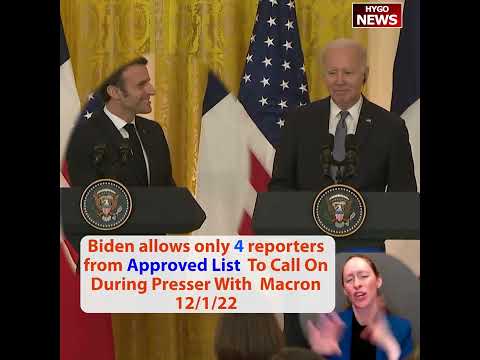
Biden Holds Joint Press Conference With Macron — Reveals “My List” of Pre-Approved Reporters: Only Four Questions Total for Both Leaders
On 12/1/2022, President Biden hosted French President Emmanuel Macron for a joint press conference at the White House — one of the most high-profile foreign policy events of Biden’s presidency. But the press conference format revealed once again that Biden’s press interactions operated on preapproved reporter lists and fixed question quotas. Biden announced: “All right, we’re going to — we’re each going to call on two people — the total of two people total for all the toll — and the first questioner is going to be from AFP.” Later, Biden referenced “my list here” when deciding which reporter to call on next, confirming that his selections were pre-scripted. For a bilateral state visit with a major European ally, the total press engagement was just four questions — two called on by each leader from preapproved lists.
”Two People Total for All the Toll”
Biden’s opening announcement was characteristically stumbling. “All right, we’re going to take — we’re each going to call on two people — the total of two people total for all the toll — and the first questioner is going to be from AFP,” Biden said.
The sentence was grammatically broken but the substance was clear: four questions total, two called by each leader. This was an extraordinarily limited press engagement for a joint press conference with a major world leader.
Historical context made the limitation stark. Previous presidents had held joint press conferences with foreign leaders that included many more questions. Obama, Bush, and Clinton had all conducted joint pressers where reporters had opportunities to ask multiple questions and follow up on previous answers. The Biden-Macron format — four questions total — was substantially more restricted than historical precedent for similar events.
The “two total for all the toll” formulation showed Biden struggling with the word “total.” He appeared to start saying “total for all” then catch himself and restart, producing the garbled “total of two people total for all the toll.” The verbal struggle was characteristic of Biden’s late-2022 speech patterns — near-misses on simple words.
The State Visit Context
Macron’s visit to Washington was the first official state visit of Biden’s presidency. State visits are among the most elaborate diplomatic ceremonies the U.S. government conducts. They involve elaborate protocol, bilateral meetings, official dinners, and substantial press coverage. The visit is meant to demonstrate the importance of the relationship with the visiting head of state.
Macron and Biden had disagreements to discuss. The recently passed Inflation Reduction Act included climate provisions that provided subsidies to American-made electric vehicles and clean energy products — provisions that French and European officials viewed as protectionist and harmful to European manufacturing. Macron had publicly expressed concerns about the IRA’s impact on European competitiveness.
A joint press conference was supposed to allow the leaders to address these substantive issues publicly — to explain their positions, respond to reporter questions, and clarify points of agreement and disagreement. Four questions total made this kind of substantive press engagement essentially impossible.
”Is This to Very Much Clarify All of This”
Biden’s next sentence dissolved into incoherence. “Miss — and is and others will enable is to very much clarify all of this without any difficulty. So I’m going home a confident but as well. Let’s see this to what remains to be done on the European side, which is a good thing? I’m confident. It’s my answer,” Biden said.
The passage was nearly impossible to parse. Biden appeared to be answering a question about EU-US relations, but the sentence structure collapsed into incomprehension. Phrases like “is and others will enable is to very much clarify” and “I’m going home a confident but as well” were not grammatical English sentences.
The garbled delivery during an international press conference was particularly damaging. Foreign leaders, journalists, and observers were watching Biden’s performance closely. A joint press conference with a major ally was supposed to demonstrate American leadership and clear communication. Biden’s verbal stumbles contradicted that image.
Macron, standing next to Biden, was watching his counterpart struggle with basic sentence construction during a formal diplomatic event. What Macron thought privately is unknown, but the image of a confused American president fumbling through responses during a state visit was politically damaging regardless of what Macron said publicly.
”My List Here”
Biden then revealed the preapproved reporter system. “Okay, who’s the next question — got my list here — my turn to call on someone — right, okay, how about NPR — Tamera Keith?” Biden said.
The phrase “got my list here” was a clear admission that Biden’s reporter selections were not spontaneous. He was working from a prepared list of reporters who had been preapproved to receive questions at the press conference. This was consistent with the pattern from previous Biden press events where he had worked from similar lists.
The specific reporter selection — “NPR — Tamera Keith” — was also revealing. NPR was an outlet that tended to ask substantive but generally non-confrontational questions. Tamera Keith was a veteran White House correspondent who was known for thoughtful questioning that rarely crossed into adversarial territory. Selecting her fit the pattern of Biden calling on reporters who were less likely to ask uncomfortable questions.
The transparency of the list was notable. By saying “got my list here” aloud, Biden inadvertently confirmed what reporters had long suspected — that his press conference reporter selections were predetermined rather than spontaneous. This undermined the administration’s occasional claims that Biden called on reporters based on who he saw in the room rather than based on preapproved selections.
The Political Implications
The preapproved list system had several political implications for the Biden presidency:
It reduced accountability. A president who takes questions only from preapproved reporters has less accountability than one who takes open questions. The president knows in advance who will be called on and can prepare specific responses to each reporter’s expected topics. This eliminates the element of surprise that makes press conferences function as accountability mechanisms.
It rewarded favorable coverage. If the White House chose which reporters to call on, those reporters had incentive to ask questions the White House would welcome. The quid pro quo wasn’t explicit — no reporter was told “ask softball questions or you won’t be called on” — but the structural incentive existed.
It limited substantive engagement. With only four questions at a major bilateral press conference, complex issues couldn’t be explored in depth. Follow-up questions were rarely allowed. Each reporter got one chance to ask, and then the press conference moved on. Nuanced issues like the IRA dispute with European allies couldn’t be adequately addressed.
It contrasted with democratic norms. Press freedom advocates argued that open press conferences were essential to democratic accountability. Reporters needed the ability to ask unexpected questions and pursue follow-ups to hold leaders accountable. The Biden format undermined this accountability function.
Key Takeaways
- Biden hosted French President Macron for a joint press conference at the White House — the first state visit of his presidency.
- The press format limited questions to four total — two called by each leader from preapproved lists.
- Biden explicitly referenced “got my list here” when selecting which reporter to call on, confirming the preapproved system.
- His responses during the press conference contained significant verbal stumbles, including the unparseable phrase “I’m going home a confident but as well.”
- The restrictive format fit a broader pattern of Biden’s press management that prioritized message control over accountability.
Transcript Highlights
The following is transcribed from the video audio (unverified — AI-generated from audio).
- All right, we’re going to — we’re each going to call on two people — the total of two people total for all the toll.
- The first questioner is going to be from AFP.
- And others will enable is to very much clarify all of this without any difficulty.
- So I’m going home a confident but as well.
- Okay, who’s the next question — got my list here — my turn to call on someone.
- Right, okay, how about NPR — Tamera Keith?
Full transcript: 107 words transcribed via Whisper AI.