 HYGO News
 Biden: After Elected VP (In 2008) He Awarded Uncle A Purple Heart. Uncle died 1999, father died 2002
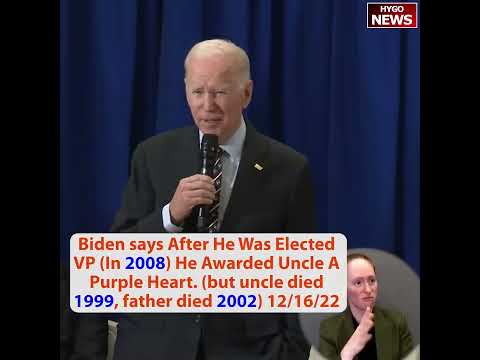
Biden Retells Uncle Frank Purple Heart Story — Timeline Issue: Uncle Died 1999, Father Died 2002, But Biden Became VP in 2009
In December 2022, President Biden retold a story about his Uncle Frank and a Purple Heart medal. “My dad, when I got elected Vice President, he said, Joey, Uncle Frank fought in the Battle of the Bulge. He was not feeling very well now… and he won the Purple Heart. And he never received it. He never got it. Do you think you could help and get it?” Biden recounted. “So he got in the Purple Heart. He had won it in the Battle of the Bulge. And I remember he came over to the house, and I came out, and he said, presented to him… I said, Uncle Frank, you won this… And he said, I don’t want the damn thing. I’m serious.” The story generated attention because of timeline problems: Biden’s Uncle Frank had died in 1999, Biden’s father had died in 2002, but Biden became Vice President in January 2009 — meaning the events Biden described couldn’t have happened as narrated.
The Story Biden Told
Biden’s narrative had specific temporal claims:
“When I got elected Vice President” — This would be November 2008 election or January 2009 inauguration.
“My dad said, Joey” — Joseph Biden Sr. was speaking to Biden at this time.
Uncle Frank request — About getting Purple Heart.
“Surprise him” — Father’s suggestion to give medal as surprise.
Ceremony at house — Biden presenting medal to Uncle Frank.
“I don’t want the damn thing” — Uncle Frank’s reaction.
For all these events to have happened, both Biden’s father and Uncle Frank would need to have been alive in 2008-2009 when Biden became Vice President. But neither was.
The Timeline Problem
The factual record contradicted Biden’s narrative:
Joseph Biden Sr. — Biden’s father died on September 2, 2002.
Frank Biden — Biden’s uncle died in 1999 or earlier (exact date disputed but clearly before 2002).
Biden elected Vice President — November 4, 2008.
Biden inaugurated — January 20, 2009.
These dates meant:
Uncle Frank had been dead for 9-10 years — When Biden became Vice President.
Biden’s father had been dead for 6-7 years — When Biden became Vice President.
Father couldn’t have told Biden — About the Uncle Frank request as Vice President.
Biden couldn’t have presented — A medal to Uncle Frank after becoming VP.
The story as Biden told it was chronologically impossible. If the events had happened, they would have been during Biden’s Senate career, not his Vice Presidential career.
Possible Explanations
Several possible explanations existed for the timeline problem:
Biden misremembered — Confused when events occurred.
Biden conflated stories — Mixing different family anecdotes.
Biden confused positions — Thinking VP when he meant Senator.
Biden embellished — Making Senator-era events seem more important.
Transcript errors — Possible but unlikely.
The most charitable interpretation was memory confusion. Biden was 80 years old. Family stories over decades could become confused about specifics. Which position he held when didn’t change the story’s emotional content, even if the timeline was wrong.
The Story’s Emotional Content
Despite timeline issues, the story had emotional content:
Family military service — Uncle Frank in Battle of the Bulge.
Delayed recognition — Purple Heart never received.
Family request — Father asking Biden to help.
Reunion ceremony — Biden presenting medal.
Uncle Frank’s response — Complex reaction about other soldiers.
These elements made for a powerful personal narrative. The emotional truth — Biden’s family, military service, eventual recognition — could be meaningful even if specific timing was wrong.
But for political audiences evaluating Biden’s current capacity, the timeline errors mattered. If Biden couldn’t correctly place major family events in time, it raised questions about broader memory and cognitive accuracy.
”Others Got Hurt” — The Incomplete Ending
Biden’s story ended incompletely in the transcript. “I said, Uncle Frank, you won this… And he said, I don’t want the damn thing. I’m serious. He said, I don’t want it. I said, what’s the matter, Uncle Frank? You earned it. He said, yeah, but the others,” Biden said.
The incomplete ending — “yeah, but the others” — suggested Uncle Frank was reluctant to accept the medal because of:
Fallen comrades — Who had died in the battle.
Other soldiers — Who deserved recognition.
Survivor’s guilt — About accepting honor while others didn’t.
Collective service — Emphasizing team over individual.
This would have been the meaningful conclusion of the story — Uncle Frank’s humility and connection to fellow soldiers. But Biden either didn’t complete the story or the clip cut off before the conclusion.
The Pattern of Verbal Issues
This story fit a broader pattern of Biden verbal issues in late 2022:
Timeline confusions — Getting historical dates wrong.
Family member conflations — Mixing up relatives or details.
Repetitive stories — Telling same tales multiple times.
Unfinished narratives — Starting stories without completing them.
Wrong positions referenced — Vice President vs. Senator, etc.
Each individual instance could be explained. But the cumulative pattern was concerning for observers watching for age-related cognitive changes.
The Battle of the Bulge Reference
The Battle of the Bulge reference gave context. The Battle of the Bulge was:
December 1944-January 1945 — World War II.
Largest battle on Western Front — For U.S. forces.
Severe casualties — Both sides suffered heavily.
Purple Heart eligibility — Many soldiers qualified.
Generational significance — Greatest Generation service.
Frank Biden’s service in this battle would have been genuine family history. If he had been wounded and was eligible for a Purple Heart, receiving it decades later would have been appropriate. The core of the story — a WWII veteran finally receiving recognition — was plausible even if Biden’s telling had timeline issues.
The Political Risk
Biden’s storytelling with factual errors had political implications:
Media coverage — Could focus on errors rather than content.
Fact-checking — Would highlight timeline issues.
Opposition exploitation — For age and capacity concerns.
Supporter defense — Difficult when facts were clearly wrong.
Cumulative impact — As errors accumulated over time.
Each telling of such stories with factual issues added to the political record. By late 2022, enough such instances had occurred that patterns were emerging. Republican researchers were cataloging Biden’s verbal issues for eventual 2024 use.
The Biden Family Narrative Style
Biden’s storytelling often had this structure:
Personal family member — As protagonist.
Emotional situation — That engaged audience.
Biden involvement — Showing his role.
Folksy dialogue — Direct quotes attributed to family.
Moral lesson — Usually about values.
This style was part of Biden’s political identity. Throughout his long career, Biden had been known for personal storytelling that connected him to ordinary Americans through family narratives. The style was effective when executed well.
But the style depended on factual accuracy for credibility. Stories that couldn’t be factually verified — because timelines were wrong or details were confused — lost their effectiveness. Audiences that detected errors would question even accurate personal narratives.
The Uncle Frank Historical Reality
Frank Biden — Joseph Biden Sr.’s brother — had actually served in World War II. Historical records show:
Military service — In World War II era.
Family documentation — Of his service.
Death date — 1999, per records.
Funeral attended by Biden — As family member.
So the underlying fact of Uncle Frank’s military service was accurate. Biden was drawing from real family history. The problem was the specific timeline Biden attributed to his role in the story.
If Biden had said “when I was a senator” instead of “when I got elected Vice President,” the story could have been plausible. Biden had been a senator from 1973 to 2009, overlapping with Uncle Frank’s lifetime. During that long Senate career, helping a family member receive delayed military recognition would have been feasible.
The Vice President vs. Senator Confusion
The specific error — saying Vice President when events happened during Senate career — was a specific kind of memory confusion. Different positions Biden held at different times could be confused:
Senator 1973-2009 — Long period with various events.
Vice President 2009-2017 — Different role.
President 2021-present — Current role.
Various committee chairs — Other positions.
Biden’s decades of public service created opportunity for confusing which role he held when. If events from his Senate career got moved forward to Vice Presidential or Presidential eras, the specific details would be wrong.
This kind of confusion was characteristic of age-related memory changes. The underlying events were remembered, but their timing got shifted forward toward more recent times. Medical observers of aging memory often documented similar patterns.
The Media Response
Media response to Biden’s Uncle Frank story was mixed:
Conservative media — Highlighted timeline errors.
Liberal media — Often overlooked details.
Mainstream media — Gave limited coverage.
Social media — Spread clips and fact-checks.
Political commentary — Used in broader age narratives.
The polarized response was typical of Biden verbal issues. Different audiences saw different things. Conservative audiences saw evidence of decline. Liberal audiences saw minor misstatements overblown by critics. Each interpretation reinforced existing views rather than producing shared understanding.
The 2024 Implications
By late 2022, such stories were accumulating political weight. Each:
Added to the record — For future campaigns.
Generated clips — For potential advertisements.
Reinforced narratives — About Biden’s age.
Provided evidence — For various arguments.
Required administration management — Of messaging.
The cumulative weight of Biden verbal issues would affect 2024 decisions. Whether Biden would run, whether Democrats would challenge him, whether voters would support him — all depended partly on how these accumulating issues were evaluated.
Key Takeaways
- In December 2022, Biden retold a story about Uncle Frank and a Purple Heart medal during World War II service.
- Biden said his father asked him to help get Uncle Frank the medal “when I got elected Vice President” (2008).
- The timeline had factual problems: Uncle Frank had died in 1999, Biden’s father in 2002 — both before Biden became Vice President in 2009.
- The underlying story — Uncle Frank’s WWII service and belated medal — had real family basis, but Biden’s placement of events in time was inaccurate.
- Uncle Frank’s reaction (“I don’t want the damn thing… yeah, but the others”) referenced his reluctance to accept honor when other soldiers had died.
- The timeline issue fit a broader pattern of Biden verbal issues that complicated administration messaging in the lead-up to the 2024 campaign cycle.
Transcript Highlights
The following is transcribed from the video audio (unverified — AI-generated from audio).
- You know, my dad, when I got elected Vice President, he said, Joey, Uncle Frank fought in the Battle of the Bulge.
- He won the Purple Heart. And he never received it. He never got it. Do you think you could help and get it?
- So he got in the Purple Heart. He had won it in the Battle of the Bulge.
- I said, Uncle Frank, you won this, and I went to peace.
- And he said, I don’t want the damn thing. I’m serious. He said, I don’t want it.
- I said, what’s the matter, Uncle Frank? You earned it. He said, yeah, but the others.
Full transcript: 153 words transcribed via Whisper AI.