 HYGO News
 Biden Advisor Keisha Bottoms GRILLED & Can't Explain Why Biden Refuses To Visit Southern Border
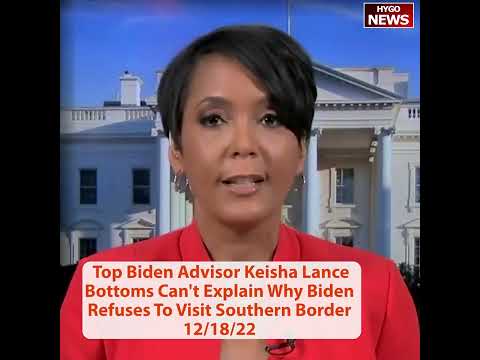
Biden Advisor Keisha Lance Bottoms on Face the Nation: “Presidential Travel Comes to a Halt” — Can’t Explain Border Avoidance
In mid-December 2022, former Atlanta mayor and current Biden advisor Keisha Lance Bottoms appeared on Face the Nation where host Margaret Brennan pressed her directly on President Biden’s refusal to visit the southern border. “Simply because people don’t see the president at the border, doesn’t mean that he’s not working,” Bottoms said. “But why doesn’t he go to the border? He was just in Arizona. Why wasn’t it worth his time?” Brennan asked. Bottoms pivoted to presidential travel logistics: “When the president travels, it’s not like you are eye-jumping on an airplane and getting off and going to our destination. Everything comes to a halt.” When Brennan asked “Is that why he didn’t go?” Bottoms admitted: “Well, I can’t speak to why he has or has not gone.” The exchange became a notable moment showing the administration’s difficulty explaining Biden’s consistent border avoidance even when it was politically convenient.
The Keisha Lance Bottoms Context
Keisha Lance Bottoms had joined the Biden administration as a senior advisor earlier in 2022. Her role:
Senior Advisor — In the White House.
Former Atlanta Mayor — Significant political experience.
Biden ally — Since 2020 campaign.
Public engagement — Including media appearances.
Broad portfolio — Various initiatives.
Bottoms had been Mayor of Atlanta from 2018 to 2022 before joining the White House. She had been an early Biden supporter during the 2020 Democratic primary, endorsing him in 2019 before it was popular.
Her appearance on Face the Nation was part of her public engagement role. She was there to advocate for administration positions on various topics, including immigration.
Margaret Brennan’s Challenge
Face the Nation’s Margaret Brennan was an experienced White House correspondent. Her questioning style:
Direct but professional — Pointed questions without being combative.
Prepared with facts — Specific details to press on.
Willingness to follow up — Not satisfied with initial deflections.
Mainstream credibility — Her Sunday show had wide viewership.
Her challenge to Bottoms about Biden’s border avoidance was in this vein. The question was factually grounded: Biden had visited Arizona but not the border. Why? This was a question reasonable observers would want answered.
”He’s Working”
Bottoms’s first response defended Biden’s engagement. “Simply because people don’t see the president at the border, doesn’t mean that he’s not working,” Bottoms said.
The framing claimed behind-the-scenes engagement:
“People don’t see the president” — Acknowledging visible absence.
“Doesn’t mean not working” — Claiming invisible effort.
Administration work continuing — Regardless of visibility.
Value of seeing vs. working — Implicitly deprioritizing presence.
This was a standard framing for questions about Biden’s limited personal engagement with issues. When Biden wasn’t visible on an issue, the defense was that he was working on it privately. This made presidential visibility optional rather than essential.
The TSMC Trip Context
Brennan pressed with specific context. “He was just in Arizona. Why wasn’t it worth his time?” Brennan asked.
The TSMC trip context made Bottoms’s defense particularly difficult. If Biden had been in Arizona for the chip factory visit, adding a border stop would have been:
Logistically feasible — Same state, same trip.
Politically meaningful — Showing border engagement.
Minimal incremental cost — Already in the state.
Clear signal — Of personal attention.
Operational benefit — Seeing conditions firsthand.
The specific question — why wasn’t the border visit “worth his time” during the Arizona trip — couldn’t be answered with “he’s too busy” or “logistics are difficult.” He had already accepted the logistics to visit TSMC.
”Everything Comes to a Halt”
Bottoms pivoted to logistics. “When the president travels, it’s not like you are eye-jumping on an airplane and getting off and going to our destination. Everything comes to a halt,” Bottoms said.
The “eye-jumping” wording was garbled — likely “I’m jumping” or “you’re jumping.” The substance was about presidential travel complexity.
The “everything comes to a halt” framing had some validity:
Presidential travel is complex — Security, logistics, staff all required.
Community disruption — Major events for visited areas.
Resource intensive — Every trip costs substantially.
Advance planning — Required for weeks.
Traffic and access — Affected significantly.
But the framing couldn’t answer Brennan’s specific question. The complexity existed equally for TSMC visits and border visits. Both would disrupt local areas. Both required security and logistics. The fact that complexity existed didn’t explain why one was worth the complexity and the other wasn’t.
”Is That Why He Didn’t Go?”
Brennan pinned Bottoms with a direct question. “Is that why he didn’t go?” Brennan asked.
The question was a test. If logistics was the reason Biden hadn’t visited the border, then Bottoms could confirm this. If not, Bottoms would have to offer a different explanation or admit she couldn’t explain.
Bottoms chose admission. “Well, I can’t speak to why he has or has not gone. I’m just speaking to the fact that it’s a bit more disruptive for the president of the United States to travel than you or I,” Bottoms said.
The Admission’s Significance
Bottoms’s admission was significant. “I can’t speak to why he has or has not gone” was an acknowledgment that:
She didn’t know — The actual reason.
Or couldn’t share — The actual reason.
Logistics wasn’t the real reason — Just deflection context.
Real reason was political — Probably.
She had no defense — For the specific choice.
As a senior administration advisor, Bottoms presumably had some understanding of presidential decision-making. Her inability to explain Biden’s border avoidance meant either:
Biden’s decision was personal — Not shared with advisors.
The reason was politically awkward — To share publicly.
No good reason existed — Just political calculation.
Coordination was poor — Between Biden and advisors.
Any of these interpretations was unflattering. The senior advisor couldn’t explain the president’s visible choice on a major political issue.
”Lean In on This Immigration Issue”
Bottoms pivoted back to generic engagement claims. “But what the president has done is continue to lean in on this immigration issue,” Bottoms said.
The “lean in” framing was vague but standard:
No specific actions — Described.
No concrete engagement — Specified.
Abstract commitment — Claimed.
Visibility irrelevant — Implied.
“Leaning in” was appropriate when you couldn’t describe specific actions. It claimed engagement without requiring evidence. This was the standard recourse when substantive defense wasn’t available.
The Biden Border Absence Pattern
Bottoms’s exchange on Face the Nation fit a broader pattern of administration difficulty defending Biden’s border absence:
KJP couldn’t explain it — In regular briefings.
Cabinet officials deflected — When asked.
Surrogates struggled — In media appearances.
Supporters made excuses — That didn’t quite fit.
This pattern was notable. On most issues, the administration could offer some defense, even weak one. On the specific question of Biden’s border avoidance, consistent difficulty emerged. Different officials struggled differently, but all struggled.
The pattern suggested that the administration had no good defense. Biden’s border avoidance was a political calculation — probably that border visits would produce worse imagery than continued absence — that couldn’t be defended publicly without admitting the calculation.
The Political Calculation
The likely political calculation behind Biden’s border avoidance:
Border conditions unfavorable — For positive imagery.
Protests or confrontations — Possible during visits.
Tying to specific scenes — That would be replayed.
Reducing flexibility — On policy positioning.
Implicit acknowledgment of crisis — By requiring visit.
The administration’s position was that the border was being handled effectively. Biden visiting might implicitly concede otherwise. The decision to not visit was likely a communications strategy to avoid generating imagery that would undermine administration messaging.
This calculation might be politically rational but couldn’t be admitted publicly. Admitting the calculation would mean acknowledging that political imagery concerns were overriding substantive engagement needs. This wouldn’t play well.
The January 2023 Visit
Biden eventually visited El Paso in January 2023 — about a month after this exchange. The visit was:
Carefully managed — Limited exposure to migrants or protests.
Brief — Just a few hours.
Official — Meetings with officials rather than community engagement.
Defensive — Responding to pressure rather than proactive.
Late — After nearly two years of avoidance.
The eventual visit confirmed that Biden had been avoidant rather than just busy. When pressure built sufficiently, a visit could happen. The specific trip showed that the earlier absence had been choice, not necessity.
The Surrogate Difficulty
Bottoms’s difficulty was representative of challenges facing Biden surrogates:
Defending specific Biden choices — That had no good defense.
Maintaining party discipline — On messaging.
Dealing with tough reporters — Like Margaret Brennan.
Preserving own credibility — While defending administration.
Balancing multiple audiences — Supporters, critics, media.
Appearing on mainstream programs like Face the Nation required surrogates to handle tough questions professionally. Bottoms’s admission — “I can’t speak to why” — was professionally honest but not effective advocacy. A more skilled surrogate might have deflected more effectively, but no defense could actually answer the specific question.
The Communication Strategy Limits
The exchange showed limits of administration communication strategy:
Vague framings — Didn’t satisfy specific questions.
Surrogate deployment — Couldn’t overcome underlying facts.
Media engagement — Produced difficult moments.
Political calculation — Had communication costs.
Visibility matters — Absence created its own narrative.
The administration’s approach to managing border messaging — vague engagement claims, blaming Republicans, referring to Congressional action — couldn’t substitute for presidential presence when presidential presence was expected. Communication strategies can manage perceptions up to a point, but at some point, the absence of action generates its own story.
The Approaching Title 42 Deadline
Brennan’s pressing was connected to the approaching Title 42 deadline. Border issues would become even more prominent in the coming weeks. Bottoms’s inability to defend Biden’s absence suggested the administration was poorly positioned for the coming challenges.
If Biden hadn’t been to the border before the anticipated surge, the pressure to visit would only grow. The administration’s defenders would face more difficult questions. Eventually something would have to give — either Biden would visit, or his absence would become politically untenable.
The January 2023 visit was effectively forced by these dynamics. The administration couldn’t sustain the absence through the Title 42 crisis period.
Key Takeaways
- Biden Senior Advisor Keisha Lance Bottoms appeared on Face the Nation where Margaret Brennan pressed her on Biden’s border avoidance.
- Bottoms initially defended: “Simply because people don’t see the president at the border, doesn’t mean that he’s not working.”
- Asked why Biden didn’t visit during his Arizona TSMC trip, Bottoms pivoted to presidential travel logistics.
- When pressed “Is that why he didn’t go?” Bottoms admitted: “I can’t speak to why he has or has not gone.”
- The admission was notable for its honesty — a senior advisor acknowledging she couldn’t explain the president’s visible choice on a major issue.
- Biden eventually visited El Paso in January 2023, about a month after this exchange, after sustained political pressure.
Transcript Highlights
The following is transcribed from the video audio (unverified — AI-generated from audio).
- Simply because people don’t see the president at the border, doesn’t mean that he’s not working.
- But why doesn’t he go to the border? He was just in Arizona. Why wasn’t it worth his time?
- When the president travels, it’s not like you are eye-jumping on an airplane and getting off and going to our destination. Everything comes to a halt.
- Is that why he didn’t go?
- Well, I can’t speak to why he has or has not gone.
- What the president has done is continue to lean in on this immigration issue.
Full transcript: 127 words transcribed via Whisper AI.