 HYGO News
 Biden: 9 million people signed on, could be 40 million which is 25% of voters will vote Dems
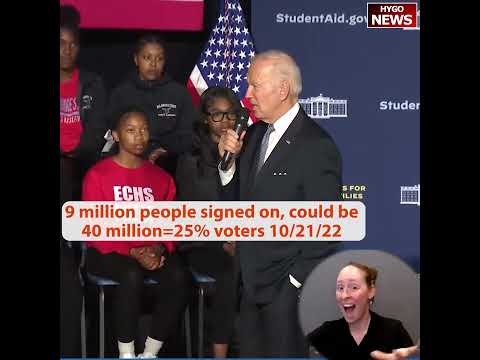
Biden Touts 9 Million Student Loan Sign-Ups, Says 40 Million Could Benefit — Supreme Court Would Strike Down the Program Months Later
On 10/21/2022, President Biden visited Delaware State University to promote his student loan forgiveness program, boasting that “almost 9 million people signed on” in the first weekend and that “more than 40 million Americans stand to benefit from this relief.” Biden compared the application launch to the disastrous Affordable Care Act rollout, saying “we made sure we tested it” this time. He delivered the remarks before heading to Rehoboth Beach for another weekend vacation — 18 days before the midterm elections. The 40 million potential beneficiaries represented roughly 25% of the 2020 electorate, making the program one of the largest pre-election giveaways in American political history. The Supreme Court would strike it down eight months later.
”We Tested It for a Weekend”
Biden referenced the ACA healthcare.gov launch disaster as context for why the student loan application process was handled carefully. “One of the things I wanted to make sure is we didn’t end up where we were in a position that Barack and I were in, in terms of the Affordable Care Act,” Biden said. “It was — made it a little bit more difficult, but we made sure we tested it. We tested it for a weekend to see how it worked, John. And guess what? It worked.”
The ACA comparison was revealing in ways Biden may not have intended. The healthcare.gov website crashed spectacularly on its October 2013 launch, becoming the signature embarrassment of the Obama administration’s domestic policy rollout. Biden was taking credit for learning from that failure — but the lesson he drew was about website functionality, not about the constitutional propriety of the underlying program.
The student loan forgiveness application “worked” in the sense that the website didn’t crash. But “working” as a website is different from “working” as constitutional policy. The application Biden was proudly touting was collecting information from millions of Americans for a program that multiple federal courts would soon halt and the Supreme Court would ultimately declare unconstitutional.
”Almost 9 Million People Signed On”
Biden celebrated the sign-up numbers as evidence of demand. “Almost 9 million people signed on,” Biden said to applause.
The rapid sign-up rate was unsurprising. The application offered up to $10,000 in free money ($20,000 for Pell Grant recipients) to anyone with federal student loans earning under $125,000 per year. The income threshold was generous enough to include the vast majority of borrowers. The only required action was filling out a brief online form. The real surprise would have been if millions of people declined free money.
The 9-million-in-a-weekend figure also reflected the pent-up demand Biden had strategically created. By announcing the forgiveness plan in August 2022 — prime midterm campaign season — but not opening applications until October, the administration generated weeks of anticipation and media coverage. The October launch timing ensured maximum public awareness coinciding with the peak of midterm election attention.
”22 Million” and “40 Million”
Biden escalated the numbers rapidly. “In less than a week, just close to 22 million people have already given us the information to consider this life-changing relief,” Biden said. “And in total, more than 40 million Americans stand to benefit from this relief.”
The 40-million figure was staggering in political context. Approximately 158 million Americans voted in the 2020 presidential election. If 40 million borrowers — and their families — stood to benefit from loan forgiveness, the program potentially touched roughly one-quarter of the entire electorate. The political arithmetic was impossible to miss: a program benefiting 25% of voters, launched and promoted during the final weeks of a midterm election cycle, with applications flooding in and forgiveness promised before the new year.
The administration maintained the program was not politically motivated. But the timing — announcement in August, application launch in October, forgiveness expected by year’s end — mapped perfectly onto the midterm election calendar.
The Legal Cloud
Even as Biden celebrated sign-up numbers, the program’s legal foundation was crumbling. Multiple lawsuits challenged Biden’s authority to unilaterally cancel student debt without congressional action. The administration relied on the HEROES Act of 2003, a post-9/11 law that allowed the Secretary of Education to “waive or modify” student loan provisions during national emergencies. The administration argued the COVID-19 pandemic constituted such an emergency.
Critics — including many legal scholars across the political spectrum — argued the HEROES Act was never intended to authorize the wholesale cancellation of hundreds of billions of dollars in debt for tens of millions of borrowers. The law was designed to help military service members and individuals directly affected by national emergencies, not to implement a broad economic redistribution program.
On November 14, 2022 — six days after the midterm election — a federal judge in Texas struck down the program. The Eighth Circuit Court of Appeals had already issued a stay blocking debt cancellation on October 21 — the same day Biden was delivering this speech. The Supreme Court would hear the case in February 2023 and rule 6-3 against the administration in Biden v. Nebraska on June 30, 2023, finding that the HEROES Act did not authorize the program.
The Cost Question
Biden described the forgiveness as “life-changing relief” without mentioning the cost to taxpayers. Independent estimates placed the program’s price tag between $400 billion and $1 trillion depending on assumptions about take-up rates and the interaction with income-driven repayment changes announced simultaneously.
The Penn Wharton Budget Model estimated approximately $519 billion over ten years. The Committee for a Responsible Federal Budget estimated the combined cost of forgiveness plus IDR changes at approximately $1 trillion. These figures exceeded the total spending in the Inflation Reduction Act that Biden touted as deficit-reducing.
The cost was borne by all taxpayers — including the two-thirds of American adults who did not have college degrees and received no benefit from the program. The transfer was regressive in important respects: college graduates earn more on average than non-graduates, meaning the program transferred wealth from lower-earning taxpayers without degrees to higher-earning taxpayers with degrees.
The Delaware State University Setting
Biden chose Delaware State University — a historically Black university in his home state — as the venue for his student loan remarks. The choice was strategic: Black borrowers carry disproportionately higher student debt burdens on average, and HBCUs are a cornerstone of Democratic electoral support.
The Pell Grant provision — $20,000 in forgiveness versus $10,000 for non-Pell recipients — was designed partly to address racial disparities in student debt. Black students are more likely to receive Pell Grants, making the doubled forgiveness amount a targeted benefit for communities of color.
The political message was clear: vote Democratic to protect this benefit. The implicit warning — that Republicans would take it away — became even more potent as legal challenges mounted and the possibility of the program being struck down became real.
Key Takeaways
- Biden boasted 9 million people signed up for student loan forgiveness in the first weekend, with 40 million potential beneficiaries — roughly 25% of the 2020 electorate.
- He compared the launch to the ACA healthcare.gov disaster, taking credit for a website that “worked” — while ignoring the program’s constitutional vulnerability.
- The 40-million-beneficiary program was launched in October, 18 days before midterms, with forgiveness promised before year’s end.
- The Eighth Circuit Court of Appeals issued a stay blocking the program on the same day Biden delivered this speech.
- The Supreme Court struck down the program 6-3 in June 2023, finding Biden lacked the authority for mass debt cancellation.
Transcript Highlights
The following is transcribed from the video audio (unverified — AI-generated from audio).
- One of the things I wanted to make sure is we didn’t end up where we were in terms of the Affordable Care Act.
- We tested it for a weekend to see how it worked. And guess what? It worked.
- Almost 9 million people signed on.
- Close to 22 million people have already given us information to consider this life-changing relief.
- More than 40 million Americans stand to benefit from this relief.
- We made sure we tested it. It was made a little bit more difficult, but it worked.
Full transcript: 106 words transcribed via Whisper AI.