 HYGO News
 KJP Says 'Bi-Carmel' Three Times While Discussing the Respect for Marriage Act
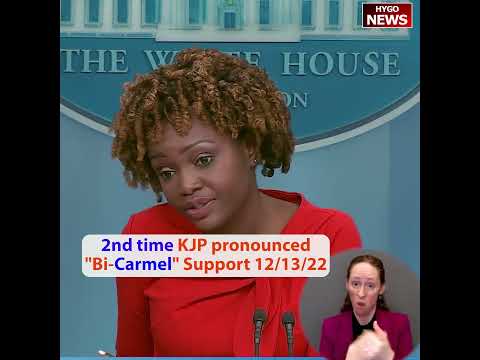
KJP Says “Bi-Carmel” Three Times While Discussing the Respect for Marriage Act
On December 13, 2022, White House Press Secretary Karine Jean-Pierre was fielding questions about President Biden’s signing of the Respect for Marriage Act when she repeatedly used the word “Bi-Carmel” instead of “bicameral.” She did not use the invented word once and move on. She used it three times during the same briefing, each time pairing it with “bipartisan” as though the two words naturally belonged together. The mispronunciation became another viral entry in Jean-Pierre’s growing catalog of verbal stumbles and raised further questions about how she was selected for a role that demands precise command of political vocabulary.
The Briefing Exchange
The briefing began with a reporter asking a substantive question about the significance of the Respect for Marriage Act: “Is there a sense today, with the President signing the Respect for Marriage Act, that that makes it settled in America? Or is there still some concern that, based on some of the comments from Justice Thomas or the potential for other litigation, that this could still be an issue that would be explored in the U.S.?”
Jean-Pierre’s response introduced the mispronunciation: “So I think — a couple of things there: Look, this is an important civil rights accomplishment that achieved — that was achieved in a Bi-Carmel and bipartisan way. And it got that support, right? And when the President signs it today, it will build on gener— it will build on generations of civil rights advocacy that — that brought us to this historic moment. So that’s important to note.”
A second reporter then raised a more pointed question about the bill’s religious liberty provisions: “Thanks, Karine. The President (inaudible) about to enact a landmark piece of civil rights legislation, but I was hoping you could speak to the concerns that some have expressed that what’s actually in the bill could be read as something that codifies discrimination. There’s a section here that speaks to the ability of nonprofit religious organizations, faith-based social agencies, educational institutions, employees of those organizations to deny services, accommodations, facilities, goods, advantages, privileges to gay couples. So how is that not codifying discrimination?”
Jean-Pierre deflected the substance of the question and repeated her mispronunciation: “I know there’s questions about religious liberty. And so we believe that — you know, we believe that the RFMA contains strong protections for houses of worship and religious nonprofits. And this question was well litigated throughout the legislative process where it passed with both chambers of bipartisan support. And I think that matters, right? Bi-Carmel, bipartisan support was had for this piece of legislation.”
A third reporter followed up: “Karine, thanks. Just to follow up on what Steve asked, we understand how the legislation was framed and will be signed by the President. Do you anticipate that this administration will go back or that the Democrats will go back and try to clean up the language in the legislation so it does not codify discrimination?”
Jean-Pierre used “Bi-Carmel” a third time: “Look, what we’re saying to you today is that this — this piece of legislation was done in a bipartisan, Bi-Carmel way, and it will make a difference for millions of Americans across the country.”
What “Bicameral” Means
“Bicameral” is a standard political term meaning “having two chambers.” In American politics, it refers specifically to the structure of Congress, which consists of the House of Representatives and the Senate. When a piece of legislation passes with “bicameral” support, it means both chambers have approved it. The word is derived from the Latin “bi” (two) and “camera” (chamber).
It is one of the most basic words in the political lexicon. Anyone who has taken a high school civics class or watched congressional proceedings would have encountered it. For a White House press secretary, it is a word that should be as familiar as “bipartisan” itself.
Jean-Pierre’s substitution of “Bi-Carmel” for “bicameral” suggested that she was unfamiliar with the correct pronunciation and had created her own approximation of the word. The fact that she used “Bi-Carmel” three times without correction indicated it was not a one-time slip but rather how she believed the word was pronounced. No one in the briefing room corrected her.
The Respect for Marriage Act Context
The legislation Jean-Pierre was discussing was itself significant. The Respect for Marriage Act codified federal recognition of same-sex and interracial marriages, providing a statutory backstop in case the Supreme Court’s 2015 Obergefell v. Hodges decision were ever overturned. The bill had been prompted by Justice Clarence Thomas’s concurring opinion in Dobbs v. Jackson Women’s Health Organization (2022), in which he suggested the Court should reconsider other precedents, including Obergefell.
The bill passed the Senate with bipartisan support, receiving votes from twelve Republican senators, and was signed by President Biden on December 13, 2022. It was a genuine legislative achievement that the White House had every reason to celebrate and communicate effectively.
Instead, the press coverage of Jean-Pierre’s briefing was diverted by her repeated mispronunciation and her inability to substantively address the religious liberty concerns that reporters were raising. The reporters’ questions about whether the bill’s exemptions for religious organizations effectively “codified discrimination” were substantive and deserved detailed responses. Jean-Pierre’s answers relied on repeating that the legislation had “Bi-Carmel, bipartisan” support without engaging with the specific provisions the reporters were asking about.
The Religious Liberty Question She Dodged
The reporters’ questions about the Respect for Marriage Act’s religious liberty provisions were not hostile or unfair. Section 6 of the Act explicitly stated that nonprofit religious organizations and their employees could not be compelled to provide services, accommodations, or goods for same-sex marriages if doing so conflicted with their religious beliefs.
For supporters of the Act, this provision was a necessary compromise that secured bipartisan support. For critics, it created a legal framework that allowed religiously affiliated organizations to deny services to same-sex couples. The question of whether this constituted “codifying discrimination” was a legitimate policy debate.
Jean-Pierre’s response to this question — pointing to the legislative process and bipartisan support rather than addressing the substance of the provision — was a standard deflection technique. But her inability to engage with the specifics, combined with her repeated mispronunciation of “bicameral,” created the impression of a spokesperson who did not fully understand the legislation she was promoting.
The “Beyond Capable” Contrast
This clip was part of a series that juxtaposed Jean-Pierre’s verbal struggles with her podcast interview in which she described herself as “beyond capable.” In that appearance with Stacy Brown, Jean-Pierre explained that the Bidens chose her because “they decided that they wanted Karine Jean-Pierre, with all of the things, all of the communities that I represent, clearly being a black person, right, being a black woman.”
The contrast between claiming to be “beyond capable” and being unable to correctly pronounce “bicameral” — a word that any press secretary should use routinely — underscored the gap between the White House’s messaging about Jean-Pierre’s qualifications and the evidence of her daily performance.
Jean-Pierre often lacked answers to straightforward questions, regularly referred reporters to other departments, and consistently blamed the Trump administration for ongoing issues. Her verbal struggles were not isolated to “Bi-Carmel”; they included “Noble Prize” for Nobel Prize (five times in one statement), “warload” for warlord, “hypo-theoreticals” for hypotheticals, and “armtice” for armistice.
The Pattern of Avoidance
Beyond the mispronunciation, the December 13 briefing illustrated Jean-Pierre’s broader tendency to treat her talking points as the answer to every question, regardless of what was actually being asked. Three different reporters approached the same topic from three different angles, each seeking specific information about the Respect for Marriage Act’s provisions. Jean-Pierre gave essentially the same answer each time: the legislation had bipartisan (“Bi-Carmel”) support, and that was what mattered.
This approach frustrated reporters who were trying to pin down the White House’s position on a genuine tension within the legislation. The religious liberty exemptions were a deliberate policy choice, and the White House’s failure to articulate a clear position on them left a void that critics of the bill were happy to fill.
Key Takeaways
- Karine Jean-Pierre said “Bi-Carmel” instead of “bicameral” three times during a December 13, 2022, briefing about the Respect for Marriage Act, never correcting herself.
- “Bicameral” is a basic political term meaning “having two chambers” and refers to the structure of Congress. It is standard vocabulary for any White House press secretary.
- Reporters asked substantive questions about whether the Act’s religious liberty provisions codified discrimination against same-sex couples, but Jean-Pierre repeatedly deflected by pointing to the bill’s bipartisan support.
- The clip was part of a series contrasting Jean-Pierre’s verbal struggles with her “beyond capable” self-description from a podcast interview.
- The repeated mispronunciation, combined with the inability to address policy specifics, reinforced the pattern of communication difficulties that defined Jean-Pierre’s tenure.