 HYGO News
 Bessent: Ukrainians 'Texting Everyone Begging to Come Back and Sign' After Being Asked to Leave the Building
Bessent: Ukrainians “Texting Everyone Begging to Come Back and Sign” After Being Asked to Leave the Building
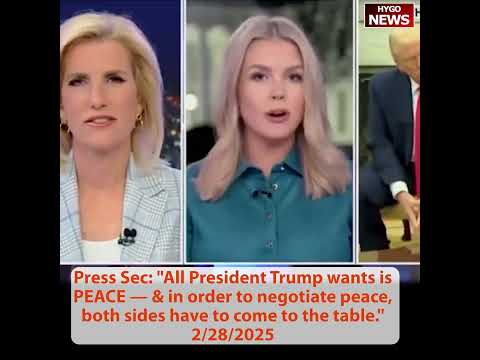
Treasury Secretary Scott Bessent revealed the aftermath of the Trump-Zelensky confrontation in vivid detail: the Ukrainian delegation had been “asked to leave the room, then they had to be asked to leave the building, and they were texting everyone begging to come back out and sign the Economic Partnership.” Bessent said “it’s impossible to have an economic partnership with someone who doesn’t want to be your partners in peace” and blamed Zelensky for antagonizing Vance and picking “a fight on worldwide television.” Press Secretary Leavitt said “all President Trump wants is peace.” And in a moment from the meeting itself, Trump dismissed a reporter’s hypothetical about Russia breaking a ceasefire with: “What if a bomb drops on your head right now?"
"Asked to Leave the Room, Then the Building”
Bessent provided the behind-the-scenes account of the expulsion that filled in details the public footage had not captured.
“We were having a press conference, we were going into lunch, and then we were going to sign the Economic Partnership Agreement,” Bessent said, describing what had been planned as a landmark day. “This was supposed to be a day where Ukraine and the U.S. intertwined our economic prospects.”
He described the escalation in stages. “Instead, President Zelensky, I think he’s probably used to dealing with American leadership that is weak,” Bessent said. “And he ran into President Trump, who didn’t back down, Vice President Vance, who didn’t back down.”
Then the specifics of the departure: “They were asked to leave the room, then they had to be asked to leave the building,” Bessent said. The two-step process — first the room, then the building — suggested that the Ukrainian delegation had initially resisted leaving or had lingered hoping the situation could be salvaged.
The most revealing detail: “And they were texting everyone begging to come back out and sign the Economic Partnership.”
The image of Zelensky’s team frantically texting American officials from outside the White House, trying to get back in to sign the minerals deal they had just sabotaged through their president’s confrontational behavior, captured the desperation of Ukraine’s diplomatic position. The deal they needed — the deal that would provide American investment, implicit security guarantees, and a framework for economic recovery — was slipping away because Zelensky had chosen to lecture the president who held all the leverage.
”Impossible to Have a Partnership Without Peace”
Bessent drew the connection between the economic agreement and the peace process that Zelensky had been resisting.
“And I tell you, it’s impossible to have an economic partnership with someone who doesn’t want to be your partners in peace,” Bessent said.
The statement reframed the minerals deal not as a standalone economic arrangement but as an integral part of the peace process. The United States was not willing to invest billions in Ukrainian mineral development while Ukraine’s leader refused to engage in peace negotiations. The economic partnership and the peace partnership were two sides of the same coin — you could not have one without the other.
Bessent, who had personally negotiated with the Ukrainians in Kyiv and had been described by Trump as having an “extended, heated negotiation” over the deal, spoke with the authority of someone who had experienced Zelensky’s negotiating style firsthand. His assessment that the Ukrainians had been “incredibly hard-headed” carried the weight of direct experience.
”He Picked a Fight”
Bessent challenged the media narrative that Trump and Vance had ambushed Zelensky.
“It was President Zelensky, if you roll the tape, who actually antagonized the Vice President in front of the cameras and picked a fight with him,” Bessent said.
He then endorsed Trump’s decision to let the cameras capture the confrontation. “As President Trump said, I think it was great that the cameras were rolling, because the American people and the entire world got to see what President Trump and his team have been dealing with behind closed doors in the negotiations with the Ukrainians,” Bessent said.
The revelation that the public confrontation reflected what had been happening privately was significant. It meant the Oval Office exchange was not an aberration but a compressed version of weeks of frustrating negotiations in which the Ukrainians had been, in Bessent’s words, “incredibly hard-headed” about engaging in the peace process.
”You Don’t Negotiate in Public”
Bessent then articulated the diplomatic protocol that Zelensky had violated.
“You don’t do a negotiation with the President of the United States in public like this,” Bessent said. “We were scheduled to have lunch afterwards, and perhaps he could have brought up some of the points.”
The distinction was crucial. Zelensky had grievances and disagreements — that was understood and expected. The proper venue for expressing them was the private lunch and working sessions that had been scheduled for after the press pool departed. Instead, Zelensky had chosen to challenge Trump and Vance while cameras were rolling, turning a diplomatic meeting into a public confrontation.
“Instead, he chose to let things go into a downward spiral on worldwide television,” Bessent said. “And again, I keep coming back to the disrespect of the American people.”
Leavitt: “All He Wants Is Peace”
Press Secretary Leavitt provided the administration’s framing in its simplest form.
“All President Trump wants is peace,” Leavitt said. “And in order to negotiate peace, both sides have to come to the table, both sides have to talk, and both sides, in a good deal, usually walk away a little unhappy.”
She added the contrast with Biden: “This is not the previous administration. Joe Biden is no longer in that Oval Office. We are no longer going to just write blank checks to a war very far away without real, lasting peace. And that’s what the President wants.”
The “blank checks” characterization of Biden’s approach — sending money without conditions, without accountability, and without a diplomatic endgame — captured the administration’s fundamental critique. Trump wanted conditions, accountability, and an endgame. Zelensky had resisted all three.
”What If a Bomb Drops on Your Head?”
The compilation also included a moment from the Oval Office meeting that showcased Trump’s characteristic response to hypothetical questions.
A reporter asked: “What if Russia breaks the ceasefire? What if Russia breaks peace talks? What if they do that?”
Trump’s response was instant: “What if anything? What if a bomb drops on your head right now? Okay? What if they break it?”
The dismissal was effective because it exposed the futility of hypothetical objections to the peace process. Any agreement carries risk. Any ceasefire could be broken. But the alternative — no agreement and no ceasefire — guaranteed continued killing. Trump was saying that the possibility of failure was not a reason to avoid trying.
The reporter’s question also reflected the narrative that critics had used to argue against engagement with Russia: that Putin could not be trusted to honor any agreement. Trump’s “what if a bomb drops on your head” retort reframed the question as absurd — you could hypothesize risks about anything, but at some point you had to act rather than asking “what if” forever.
Key Takeaways
- Treasury Secretary Bessent revealed that after being expelled, the Ukrainian delegation was “texting everyone begging to come back out and sign the Economic Partnership” — having been “asked to leave the room, then asked to leave the building.”
- Bessent said “it’s impossible to have an economic partnership with someone who doesn’t want to be your partners in peace” and blamed Zelensky for antagonizing Vance on camera.
- He said the public confrontation reflected what had been happening “behind closed doors” for weeks, with Ukrainians being “incredibly hard-headed.”
- Leavitt said “we are no longer going to just write blank checks to a war very far away without real, lasting peace.”
- Trump dismissed a reporter’s hypothetical about Russia breaking a ceasefire: “What if a bomb drops on your head right now?”