 HYGO News
 Bessent: Media Said Economy 'Great' Under Biden, Now It's a 'Problem' After 5 Weeks of Trump
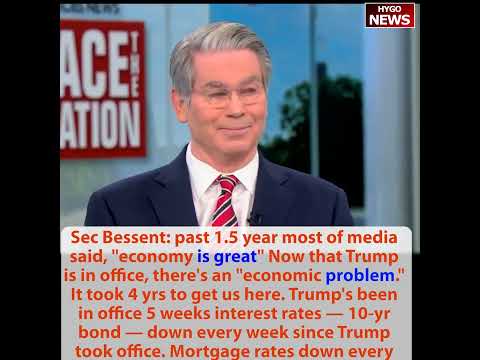
Bessent: Media Said Economy “Great” Under Biden, Now It’s a “Problem” After 5 Weeks of Trump
Treasury Secretary Scott Bessent called out the media’s double standard on economic coverage in March 2025, noting that “for the past year and a half, most of the media said ‘the economy is great, it’s just a vibes session.’ Now that President Trump’s in office, there’s an ‘economic problem.’” Bessent pointed out that the 10-year bond rate and mortgage rates had “been down every week since President Trump took office” and diagnosed the inherited crisis as “a demand shock from government spending met by supply constraints from over-regulation.” British Ambassador Lord Peter Mandelson called for Zelensky to give “unequivocal backing” to Trump’s peace initiative. Commerce Secretary Lutnick said Zelensky “was not there to make peace” and that his demands were “ridiculous.”
The Media’s Economic Double Standard
Bessent opened with the observation that had frustrated the administration and its supporters since inauguration.
“What I find interesting is, for the past year and a half and during the campaign, most of the media said ‘the economy is great, it’s just a vibes session,’” Bessent said. “Now that President Trump’s in office, there’s an ‘economic problem.’”
The “vibes session” reference was to the media framing that had been used throughout 2024 to dismiss voter concerns about the economy. When polls showed Americans felt the economy was bad despite positive GDP numbers, the media argued that consumers were wrong about their own financial situation — that it was a problem of perception (“vibes”) rather than reality.
Bessent rejected that framing. “This idea that working-class Americans didn’t know what they were talking about — they didn’t know their lived experience, they didn’t know what their pocketbooks were feeling,” he said. “President Trump was elected. One of the reasons was the affordability crisis, and we are setting about fixing that.”
The Treasury Secretary then provided the economic diagnosis. “After four years of disastrous policies, we’re running these gigantic deficits that led to the affordability problem, massive government regulations,” Bessent said. “What we had was a demand shock from the government spending that was met by supply constraints with over-regulation.”
The formulation was precise: Biden had simultaneously flooded the economy with government money (demand shock) while making it harder for businesses to produce goods and services (supply constraints). The result was inflation — too much money chasing too few goods — exactly what economists like Furman and Summers had warned about.
“So we are in the process of deregulating, which will free the supply side, and we are cutting back the government spending,” Bessent said.
Interest Rates: “Down Every Week”
Bessent then cited the market data that supported the administration’s economic strategy.
“It took four years to get us here. President Trump’s been in office five weeks, and I can tell you we’re working every day,” Bessent said. “But I will point out: interest rates — the 10-year bond, which I am focused on — have been down every week since President Trump was president. Mortgage rates have been down every week.”
The 10-year Treasury rate was the benchmark that influenced mortgage rates, corporate borrowing costs, and consumer lending rates across the economy. Its steady decline since inauguration suggested that financial markets believed the Trump administration’s combination of spending cuts and deregulation would reduce inflation and improve the fiscal outlook.
For ordinary Americans, the mortgage rate decline was the most tangible benefit. Each week of declining rates meant that new homebuyers faced lower monthly payments and that existing homeowners could refinance at better terms. Bessent’s emphasis on tracking this metric “every week” demonstrated the administration’s focus on translating macroeconomic policy into consumer-level improvements.
The “five weeks” framing was also strategic. By emphasizing how recently Trump had taken office, Bessent was making the case that any economic problems were Biden’s legacy while any improvements — like declining interest rates — were attributable to the new administration’s policies and the confidence they inspired.
British Ambassador: “Unequivocal Backing”
British Ambassador to the United States Lord Peter Mandelson weighed in on the Zelensky crisis with a call for a diplomatic reset.
“We need a very radical reset,” Mandelson said. “The reset has to consist of the United States and Ukraine getting back on the same page, and President Zelensky giving his unequivocal backing to the initiative that President Trump is taking to end the war and to bring a just and lasting peace to Ukraine.”
Mandelson then outlined specific steps that went beyond rhetoric. “The Europeans need to back the calls for a ceasefire,” he said. “And by the way, I think that Ukraine should be the first to commit to a ceasefire and defy the Russians to follow.”
The proposal that Ukraine should declare a ceasefire first — rather than waiting for mutual agreement — was a bold diplomatic suggestion. It would put moral pressure on Russia to reciprocate while demonstrating Ukraine’s commitment to peace.
Mandelson also addressed the security guarantee question that had been central to Zelensky’s demands. “The Europeans and perhaps some other countries too have got to consider how they are going to put forces on the ground to play their part in providing enduring security and deterrence for Ukraine,” he said.
The call for European ground forces as peacekeepers represented the UK’s contribution to the post-war security architecture. Rather than asking the United States to provide security guarantees — which Trump had refused — European nations would deploy their own forces to monitor and enforce a peace agreement.
Mandelson noted that British PM Starmer was actively working on these arrangements: “That’s what the British Prime Minister is working for in his meeting in London today.”
Lutnick: “His Requests Were Ridiculous”
Commerce Secretary Howard Lutnick provided the most detailed account of what had happened in the 40 minutes before the cameras captured the confrontation.
“We were 40 minutes before the cameras came in and 45 minutes before the meltdown,” Lutnick revealed. “And the fact was, Zelensky never stopped asking for — ‘I will give no concessions. They’ve got to leave my land. I want reparations of $300 billion. And I want the United States to give me security guarantees while they’re at war with Russia.’”
Lutnick identified the specific demand that Trump had called “gambling with World War III.” “We’re not going to give you security guarantees while you’re at war with Russia,” Lutnick said. “It’s just ridiculous. His requests were ridiculous. They were not reasonable.”
He described Trump’s patience running out. “The president let it go for a while — he was there to make peace. Our president is there to make peace,” Lutnick said. “And Zelensky was not there to make peace. He was there to strike some sort of make-believe bargain that he had in his mind.”
Lutnick concluded: “Eventually that just ran its course. And Donald Trump said, ‘I can’t take this nonsense anymore’ and made it crystal clear — he’s the peacemaker, and if Zelensky’s not interested in peace, then he should go home and think about it.”
The revelation that Zelensky had spent 40 minutes of private discussion making maximalist demands — no territorial concessions, $300 billion in reparations, and American security guarantees during an active war — explained why Trump’s patience evaporated when the cameras arrived and Zelensky continued the same approach publicly. The private demands had been unreasonable; the public repetition of them was unacceptable.
The Economic-Diplomatic Connection
The compilation’s pairing of Bessent’s economic commentary with the Zelensky aftermath was not accidental. Both segments addressed the same theme: accountability. The media was being held accountable for its double standard on economic coverage. Zelensky was being held accountable for his ingratitude and obstructionism. In both cases, the Trump administration was insisting that reality — not narratives, not PR, not diplomatic courtesy — would govern the relationship.
Bessent’s point about interest rates declining “every week” demonstrated that markets rewarded the administration’s fiscal discipline. The Zelensky confrontation demonstrated that allies who resisted the administration’s peace agenda faced consequences. Together, the segments projected an administration that was producing results domestically while demanding accountability internationally.
Key Takeaways
- Treasury Secretary Bessent exposed the media double standard: economy was “great” under Biden but became a “problem” after five weeks of Trump, despite the 10-year bond and mortgage rates declining “every week.”
- He diagnosed the inherited crisis as “a demand shock from government spending met by supply constraints from over-regulation” and said the administration was fixing both simultaneously.
- British Ambassador Mandelson called for Zelensky to give “unequivocal backing” to Trump’s peace initiative and proposed Ukraine declare a ceasefire first to pressure Russia.
- Commerce Secretary Lutnick revealed Zelensky had spent 40 private minutes demanding no concessions, $300B in reparations, and U.S. security guarantees during an active war — requests Lutnick called “ridiculous.”
- Lutnick said Trump “made it crystal clear — he’s the peacemaker, and if Zelensky’s not interested in peace, he should go home and think about it.”