 HYGO News
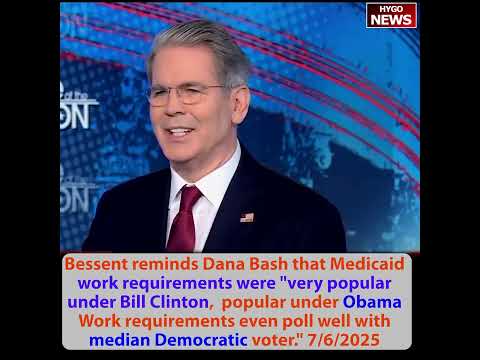
 Bessent: Only DC 20% hike=cut Medicaid funding up 20%; work requirements popular under Clinton/Obama
Bessent: Only DC 20% hike=cut Medicaid funding up 20%; work requirements popular under Clinton/Obama
Treasury Secretary Scott Bessent delivered one of the cleanest demolitions of the Democratic “Medicaid cuts” messaging on a CNN Sunday morning interview. Bessent pointed out the basic mathematical fact that Medicaid funding actually increases by 20% over the next 10 years under the One Big Beautiful Bill — which means the Democrats’ characterization of “cuts” requires redefining what the word “cut” means. He noted that Medicaid work requirements were popular under Bill Clinton, popular under Barack Obama, and still poll well with median Democratic voters. He dismissed the Yale Budget Lab’s analysis as coming from “ex-Biden officials” whose institutional composition should disqualify their conclusions. And he delivered what may be the week’s most politically important framing: “For 20 years, the big lie was that this kind of mass, unfettered immigration didn’t hurt working people’s wages."
"Only In D.C. Is A 20% Hike A Cut”
Bessent opened with the mathematical framing. “Well, first of all, that affordability and saving Medicaid, let’s separate those. Only in D.C. is a 20% hike over 10 years a cut. So Medicaid funding will go up 20% over the next 10 years.”
The framing is devastating. The bill’s Medicaid provisions, taken as a whole, actually increase funding by 20% over 10 years. Democrats characterize that increase as “the largest Medicaid cut in history.” Only in Washington, where budget baselines assume specific future trajectories, can an actual spending increase be characterized as a cut.
The phenomenon reflects Washington’s peculiar budget accounting. Current law projects Medicaid spending to grow at specific rates based on demographic and utilization projections. If the bill’s provisions produce spending growth slower than the projection, the bill is characterized as “cutting” Medicaid relative to the projection — even though actual spending increases.
Why The Mathematical Framing Matters
Bessent’s framing matters because it contradicts the Democratic rhetoric at the level of basic fact. Democrats have characterized the bill as “the largest Medicaid cut in history.” If Medicaid funding actually goes up by 20% over 10 years, that characterization is mathematically wrong. The funding is increasing, not decreasing.
Voters processing the competing claims can evaluate them against the mathematical reality. Democrats saying “Medicaid is being cut” are saying something that is technically false if actual spending is going up. Bessent’s framing forces voters to engage with that mathematical reality rather than with the rhetorical characterization.
Refocusing On Core Beneficiaries
Bessent then described the reform’s mechanism. “The people who Medicaid were designed for, pregnant women, the disabled, families with children under 14, will be refocused.”
The “refocusing” captures what the reform actually does. Medicaid’s traditional beneficiary categories — pregnant women, the disabled, families with young children, seniors — continue to receive full program benefits. The reforms target the expansion population — able-bodied adults without dependents who had been added to Medicaid through the Affordable Care Act’s expansion.
”Able-Bodied Americans Are Not Vulnerable Americans”
Bessent’s framing of the distinction. “The able-bodied Americans are not vulnerable Americans.”
The distinction is important for the philosophical framework. Medicaid was designed to serve vulnerable populations — those who could not provide for themselves because of specific categorical limitations. Pregnancy, disability, childhood, and old age are the traditional markers of vulnerability that justified public healthcare support.
Able-bodied working-age adults without children do not fit the traditional vulnerability category. They can, in principle, provide for themselves through work. Public support for them has always been more controversial than support for traditional vulnerable groups.
”Work Requirement Or Community Service”
Bessent described the specific policy mechanism. “So a work requirement or a community service requirement, that’s very popular with the public and many state programs have that now.”
The reform is flexible. Beneficiaries who work qualify. Beneficiaries who perform community service qualify. Beneficiaries who are disabled qualify through the disability exemption. Beneficiaries who are caring for children qualify through the caregiver exemption. Beneficiaries who are enrolled in workforce training qualify through that pathway.
The specific flexibility matters because it addresses Democratic concerns about individuals who cannot meet specific work requirements. Virtually anyone who has any kind of productive engagement with the community — work, service, training, caregiving — qualifies.
”Many State Programs Have That Now”
The observation captures that work requirements are not new or experimental. Various states have implemented Medicaid work requirements over the past decade. Arkansas, Wisconsin, Michigan, and others have had state-level programs at various points. The federal reform expands what has been working at the state level.
The “Cumbersome” Critique
The reporter pushed back on the administration’s framing. “Those work requirements are going to be very cumbersome to actually prove, and it will inevitably force the people who need that Medicaid coverage off the rolls.”
The critique is that paperwork requirements will eliminate genuinely eligible beneficiaries. People who should qualify will fail to document their compliance and will lose coverage as a result. The net effect, in this critique, is coverage loss for vulnerable individuals rather than just removal of the able-bodied non-working.
”Democrats Think Poor People Are Stupid”
Bessent’s pointed counter. “Well, first of all, the Republicans are not the most vocal on this. It is a group of Democrats who unfortunately seem to think that poor people are stupid. I don’t think poor people are stupid. I think they have agency. I think to have them registered twice a year for these benefits, that is not a burden.”
The framing is sharp. Democrats, in Bessent’s characterization, are claiming that low-income Americans cannot handle simple paperwork requirements. That claim is, in Bessent’s view, condescending. Poor Americans have agency. They can manage their own affairs. Registering twice a year for benefits is not beyond their capability.
“These people who want to infantilize the poor” is Bessent’s characterization of the Democratic framing. The word “infantilize” is specifically accusatory — Democrats are treating poor Americans as though they are children incapable of adult responsibility.
”Popular Under Bill Clinton, Popular Under Obama”
Bessent then deployed the historical precedent. “My impression of the Republican Party is that historically wanted to cut through the red tape and not create more red tape. But I do want to move on because of- Well, no, no, no, but we’ve also wanted to put in work requirements, which somehow was very popular under Bill Clinton, was popular under President Obama.”
The historical framing is important. Welfare reform with work requirements was a signature accomplishment of the Clinton administration (the 1996 welfare reform). Obama continued to support the basic framework. Both Democratic presidents endorsed the principle that public assistance programs should include work-oriented components.
The current Democratic opposition to work requirements represents a shift from the Clinton-Obama Democratic consensus. Something has changed in the Democratic Party between the Clinton-Obama era and the current moment that has moved the party away from its earlier support for work requirements.
”Democratic Party Blew Out The Deficit In 2020”
Bessent added the fiscal framing. “And this Democratic Party blew out the deficit in 2020. They never want to bring it back.”
The 2020 reference is to the pandemic response. The federal government authorized substantial deficit spending to address the COVID-19 emergency. Some of that spending was genuinely necessary for pandemic response. Some, in Bessent’s view, represented Democratic spending priorities that would not have been enacted in normal conditions.
“They never want to bring it back” captures the ratchet effect. Spending that gets added during emergencies often becomes permanent even when the emergency ends. Democrats, in Bessent’s framing, have been reluctant to address the permanent spending increases that began during the pandemic.
”Median Democratic Voter”
Bessent offered the polling observation. “But work requirements even pull well with the median Democratic voter, maybe not the fringe.”
The observation matters because it distinguishes Democratic politicians from Democratic voters. Democratic politicians — members of Congress, state-level officeholders, campaign strategists — may oppose work requirements. Democratic voters, particularly the median voter rather than the activist fringe, actually support them.
That disconnect between politicians and voters creates political vulnerability for Democrats. When Democratic politicians oppose a policy that Democratic voters actually support, they are failing to represent their own constituents on that specific issue.
The Yale Budget Lab Critique
The reporter cited the Yale Budget Lab’s analysis. “The Yale Budget Lab says the richest Americans will see their income rise by nearly 2%. The lowest earning Americans will see their income drop by 3% when factoring in cuts to Medicaid and food stamps. You argue that the benefits will really be aimed at the middle class. How does that square?”
The Yale Budget Lab’s characterization aligns with the Democratic messaging on the bill. Richest Americans benefit. Lowest-earning Americans lose. The bill is therefore distributionally unfair.
”They’re All Ex-Biden Officials”
Bessent’s institutional challenge. “This week, I actually went on their website. They’re all ex-Biden officials, so I think we can discount everything they say. I’d encourage all your viewers to look at the composition of both the board and the staff. It’s just not right.”
The challenge is ad hominem but operationally significant. If the Yale Budget Lab’s board and staff are composed primarily of former Biden administration officials, the Lab’s analyses are not independent assessments. They are the political positions of a specific administration translated into the form of academic analysis.
Whether Bessent’s characterization holds up to scrutiny depends on the actual composition of the Lab. If the characterization is accurate — if the Lab’s board and staff are predominantly former Biden officials — then the Lab’s credibility as an independent analytical voice is compromised.
”Middle Class And Working Class Bill”
Bessent’s counter-framing. “What we have here is a middle class and working class bill. We are going to see wages accelerate.”
The framing is the opposite of the Yale Budget Lab characterization. Middle class and working class Americans are the primary beneficiaries. Wages will accelerate as the bill’s provisions take effect.
The specific mechanisms supporting this framing include:
- 15% tax cut for $30K-$80K earners
- No tax on tips for service workers
- No tax on overtime for first responders and many working-class categories
- Expanded child tax credit for families
- Social Security tax elimination for seniors
- American manufacturing preference that supports domestic employment
- Work requirements that push able-bodied adults into employment
- Immigration enforcement that reduces downward wage pressure from undocumented labor
Each mechanism, if it produces the expected effects, benefits working-class and middle-class Americans.
”The Highest Wage Earners” Under 2017 Cuts
Bessent deployed the 2017 historical data. “Just as we saw with President Trump’s first tax bill, we are making permanent these tax cuts. And what happened in 2017, 2018 was the highest wage earners went from paying 37% of all taxes to 45%.”
The claim is specific and testable. Under the 2017 tax cuts, the share of federal taxes paid by high-income earners increased from 37% to 45%. The tax cuts, despite critical framing that characterized them as benefiting the wealthy, actually produced a more progressive distribution of federal tax burden.
The mechanism was that the tax cuts for middle-class and working-class Americans reduced their federal tax payments. The richest Americans’ tax payments declined less as a share of their income than those of middle-class Americans. The result was that the high-income share of federal taxes went up, not down.
”Permanently, The Highest 10% Will Pay A Higher Percent”
Bessent’s summary. “So that’s going to be permanent now. So permanently, the highest 10% will pay a higher percent of the taxes.”
The permanence is the key. The 2017 cuts were scheduled to expire. Making them permanent locks in the distributional effect — permanently, the highest 10% of earners pay a higher share of federal taxes than they did before the 2017 cuts.
That distributional effect contradicts the Democratic framing that the bill benefits billionaires at the expense of ordinary Americans. If the highest 10% pays a larger share of federal taxes than before, the bill is not benefiting them at the distributional level.
Why The Distributional Math Matters
The distributional math is politically central. Democrats characterize the bill as benefiting the wealthy. The administration characterizes it as benefiting working Americans. Voters want to know which characterization is accurate.
Bessent’s mathematical framing — with specific numbers supporting his claim — provides ammunition for the administration’s position. Voters who encounter Bessent’s claim can ask why the Democratic framing differs from the specific distributional data.
If the 2017 cuts actually made the tax system more progressive (as measured by share of taxes paid by high earners), and the 2025 bill makes those cuts permanent, then the current bill’s distributional effect is also more progressive than the pre-2017 system. The Democratic framing that the bill favors the wealthy requires rejecting that distributional data.
”The Big Lie”
Bessent’s most politically consequential framing came on immigration and wages. “For 20 years, the big lie was that this kind of mass, unfettered immigration didn’t hurt working people’s wages.”
“The big lie” is strong language. Bessent is characterizing the mainstream economic consensus of the past 20 years — that mass immigration does not meaningfully affect American wages — as a lie. Not a mistake. Not a methodological error. A lie.
The academic consensus on the wage effects of immigration has been contested. Some economists (David Card and others) argued immigration had limited wage effects. Other economists (George Borjas and others) argued immigration did produce substantial downward wage pressure on specific labor market segments.
The political framing that immigration did not affect wages served specific interests. Business interests that benefited from cheaper labor. Political interests that supported immigration policy that concentrated benefits on specific constituencies. Intellectual interests that found the Card framework more congenial than the Borjas framework.
Bessent is arguing that the entire framework was knowingly wrong — a lie, not an error. That framing is politically aggressive. It accuses specific economists, politicians, and commentators of having deceived the public for 20 years.
”Wall Street Has Done Well”
Bessent continued. “Wall Street has done well. Now, it’s time for Main Street to do well… and that’s the One Big Beautiful Bill.”
The dichotomy captures the administration’s political framing. Wall Street — the financial sector, corporate profits, asset holders — has experienced substantial gains over the past decades. Main Street — the working-class and middle-class Americans whose wages and financial security are the foundation of the real economy — has experienced less benefit.
The bill, in Bessent’s framing, addresses that asymmetry. Main Street benefits flow through the tax provisions, the wage protection of immigration enforcement, the manufacturing preference, and the various other mechanisms the bill contains.
Why The Main Street Framing Matters
The Main Street framing matters politically because it captures a specific voter sentiment. Many Americans feel that the economic gains of recent decades have not flowed to them personally. Wall Street executives have become wealthier. Asset holders have seen their portfolios appreciate. But many working Americans feel they have been left behind.
If the bill actually delivers Main Street benefits — if wages accelerate, if American manufacturing expands, if working-class Americans see measurable improvement in their financial situations — the political benefit to the administration would be enormous. Those voters would feel that their concerns had finally been addressed.
The administration’s bet is that delivery will match rhetoric. Main Street improvements that Americans experience in their own lives will produce political support that survives critical framing. Voters will trust their own experience more than they will trust political messaging that contradicts it.
Key Takeaways
- Bessent on Medicaid “cuts”: “Only in D.C. is a 20% hike over 10 years a cut. So Medicaid funding will go up 20% over the next 10 years.”
- On work requirements history: “Work requirements, which somehow was very popular under Bill Clinton, was popular under President Obama…work requirements even poll well with the median Democratic voter.”
- On the Democratic framing of poor Americans: “A group of Democrats who unfortunately seem to think that poor people are stupid. I don’t think poor people are stupid. I think they have agency.”
- The Yale Budget Lab dismissal: “They’re all ex-Biden officials, so I think we can discount everything they say.”
- The “big lie” on immigration: “For 20 years, the big lie was that this kind of mass, unfettered immigration didn’t hurt working people’s wages…Wall Street has done well. Now, it’s time for Main Street to do well.”