 HYGO News
 Bessent on why BBB not up deficit: deficit to GDP will change, peace deals, tax deals, trade deals
Bessent on why BBB not up deficit: deficit to GDP will change, peace deals, tax deals, trade deals
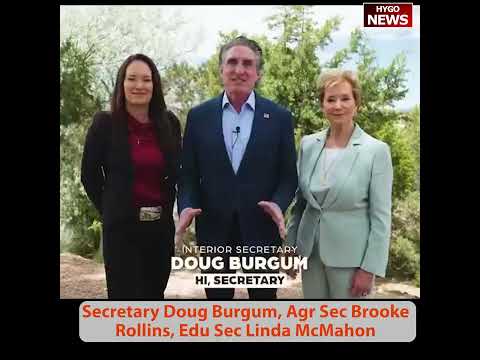
Treasury Secretary Scott Bessent spent the day on Capitol Hill selling the One Big Beautiful Bill to skeptical conservative senators and then laying out the administration’s July 4 target for passage. In a series of coordinated appearances with cabinet colleagues, the administration made the full case for the bill — Energy Secretary Chris Wright on ending what he called the “green delusion,” Interior Secretary Doug Burgum on permitting reform and national parks, Agriculture Secretary Brooke Rollins on family farm tax provisions, and Education Secretary Linda McMahon on returning education authority to states. The day captured the administration’s working rhythm in a single frame: cabinet officers working together to sell a signature bill while the president runs the multiple foreign policy tracks that Bessent characterized as “peace deals, tax deals, trade deals."
"Through Growth”
The reporter opened with the conservative-caucus concern. “How are you convincing Conservative members that this is not going to have a negative impact on the deficit?”
Bessent’s answer was direct. “It’s through growth. We are constraining spending, bringing that down, so the trajectory of the deficit to GDP will change.”
The “through growth” argument is the supply-side claim at the heart of the administration’s fiscal framework. Tax cuts, in this telling, do not reduce revenue on a static basis because the growth effects they produce expand the tax base. When the tax base grows faster than rates are cut, total revenue rises. When combined with spending restraint, the deficit-to-GDP ratio improves.
The “constraining spending” half of the equation is the complementary argument. The bill does not just cut taxes. It cuts specific categories of federal spending — Medicaid for noncitizens, certain Green New Deal subsidies, specific program waste. The combined effect, in Bessent’s framing, produces improving deficit metrics over time.
”Trajectory Of The Deficit To GDP Will Change”
The metric Bessent cites — deficit to GDP — is the meaningful one. Raw deficit dollars are less economically meaningful than the deficit as a share of the economy. A $2 trillion deficit in a $30 trillion economy is a different fiscal situation than a $2 trillion deficit in a $20 trillion economy.
Bessent’s claim is that the trajectory improves. The current trajectory, absent policy change, would produce rising deficit-to-GDP. The administration’s policy framework, he is arguing, reverses that trajectory. Whether the reversal materializes depends on whether the growth assumptions the administration uses turn out to be accurate.
”Vote This Friday For July 4th”
Bessent laid out the legislative timeline. “We had a very successful lunch meeting with the Senators. I think that we are on track for a, hopefully for a vote this Friday for July 4th for the tax bill.”
The July 4 target is the administration’s political framing of the bill as an Independence Day deliverable. Passing a major tax bill on or near July 4 creates the rhetorical connection between national independence and economic freedom. Whether the Senate meets the target depends on procedural choices by Senate leadership and on whether the caucus disagreements Bessent was addressing can be resolved in the next several days.
”Peace Deals, Tax Deals, Trade Deals”
Bessent’s framing of the broader Trump agenda was compressed into three categories. “The President is doing peace deals, tax deals, trade deals, so he’s done a peace deal. I think we’d have the tax deal done by July 4th, and then we can finish with the trade deals.”
Each category references specific work streams. Peace deals include the Iran-Israel ceasefire, the Rwanda-Congo settlement, the Serbia-Kosovo work, and continuing efforts on Russia-Ukraine. Tax deals are the One Big Beautiful Bill and related legislation. Trade deals are the UK agreement, the pending Canada deal, the Indian and Pakistani negotiations, and the broader tariff framework.
Sequencing the three — one done, one on the target July 4 track, one to follow — captures the administration’s working rhythm.
Wright On Permitting
Energy Secretary Chris Wright then took over the briefing to make the case for the bill’s permitting provisions. “So the bill just goes back to sort of common sense on permitting of this. Of course we’re going to do environmental reviews and safety reviews. It’s just going back to the original intention of permitting, very critical for the bill.”
The “original intention of permitting” framing is the administration’s argument that environmental review processes have drifted from their original purpose. The National Environmental Policy Act, passed in 1970, was designed to ensure that federal agencies considered environmental impacts before taking major actions. Over decades, the process has become, in the administration’s telling, a tool for procedural delay rather than substantive environmental protection.
The bill’s permitting reforms aim to restore what Wright calls the “original intention” — environmental review as a genuine but time-bounded part of federal decision-making, not as an indefinite veto on action.
”Get Rid Of These Subsidies And Distortions”
Wright continued. “Get rid of these subsidies and distortions that have hurt not just our electricity market, but our broader energy markets. One of the greatest upsides for the United States is to bring industry back to our country.”
The subsidies Wright is referencing are the Inflation Reduction Act’s clean energy provisions — tax credits for solar, wind, electric vehicles, battery manufacturing, and related categories. The administration’s position is that these subsidies distort energy markets by favoring specific technologies over competing alternatives, and that the distortions harm both the electricity sector and the broader economy.
Removing the subsidies, in Wright’s framing, produces a more level playing field where the most economically efficient energy sources win on their merits.
The “Green Delusion”
Wright’s most memorable passage was the “green delusion” observation. “In a green delusion, we decided to make it so hard to build things in the United States that instead what happens, we still consume those same products. Just now they’re built in Asia with a coal powered electricity instead of natural gas in the United States. And then they’re Asian workers and then we load them on diesel powered ships and ship it across the ocean and bring it back to the United States and call that green or a climate policy. There’s just so much nonsense.”
The observation is substantively important. Much of the American “green” regulatory framework has, in practice, moved production overseas rather than reducing global emissions. A widget made with coal-powered electricity in China, shipped on a diesel-powered vessel across the Pacific, and sold in an American store has a larger carbon footprint than the same widget made with natural gas in Texas and sold locally. But the American carbon accounting counts only the emissions that occur within American borders, so the China-made widget looks like an American emissions reduction.
Wright’s argument is that the carbon accounting is the wrong frame. Global emissions are the meaningful metric. American regulations that export production without reducing consumption increase, rather than reduce, global emissions. The “green delusion” is to treat such exports as environmental achievements.
”Cleaning Out Underbrush And Nonsense”
Wright offered his summary characterization of the bill. “The one big beautiful bill, actually it is big. There are a lot of things in it, but a lot of them are just cleaning out underbrush and nonsense. So it’s easier to build things in our country again, remove the distortions from the energy markets, unleash American businesses to build energy production of all different kinds, but kinds that work without subsidies.”
“Cleaning out underbrush” is the metaphor. Forest management requires periodic clearing of accumulated dead material. Regulatory frameworks similarly accumulate provisions that, while individually well-intentioned, collectively impede function. The bill, in Wright’s telling, clears that accumulated regulatory underbrush.
Secretary Burgum’s Pitch
Interior Secretary Doug Burgum joined the briefing. “Hi, Secretary Doug Burgum and I’m here with Secretary Rollins and Secretary McMahon. We’re here today to talk to you about the big beautiful bill. It’s big and it’s beautiful and it’s got something for everybody.”
The multi-cabinet-officer briefing is the signal that the bill’s scope crosses multiple agencies. Interior, Agriculture, and Education — three separate cabinet departments — each have specific provisions in the legislation. The coordinated briefing demonstrates to senators and to the public that the bill’s benefits are broad, not narrow.
Rollins On Family Farms
Agriculture Secretary Brooke Rollins delivered her segment. “I just came from a lettuce farm, a small family farm run by two brothers. The amazing accomplishments in the big beautiful bill for our farmers and our ranchers, preserving 2 million of our farmers and ranchers from having to be subject to the inheritance tax, which is devastating for those who are very land heavy and couldn’t keep their land under the current regime.”
The 2 million figure — the number of American family farms that Rollins says will be preserved from inheritance tax burdens — is substantial. American agriculture depends heavily on family operations. When those operations face estate tax liabilities at the death of senior family members, they often must be sold to satisfy the tax. The bill’s provisions, in Rollins’s framing, prevent that forced sale for 2 million farms.
”$10 Billion Tax Cut Just For Our Farmers And Ranchers”
Rollins continued with the specific numbers. “Number two, a 10 billion dollar tax cut just for our farmers and our ranchers. Number three, through reference prices, an additional 3.8 billion in income to arming and ranching industry has been living on the margins, especially after the last Biden administration.”
$10 billion in tax cuts plus $3.8 billion in income support is substantial direct benefit flowing to an industry that has been under pressure. American agriculture has faced commodity price volatility, trade disruption, and rising input costs. The administration’s framing is that the bill responds to those pressures with specific fiscal support.
McMahon On Tribal Schools
Education Secretary Linda McMahon addressed her sector. “And I just came from the Santa Fe Indian School, which we can see there the progress that has been made when you get bureaucracy out of education and the big beautiful bill is going to continue to do more, not only for our tribal schools, but for education across the country as we return education to the state and I put myself out of a job.”
“I put myself out of a job” is the McMahon framing that has circulated repeatedly since her confirmation. Her stated objective is to reduce the Department of Education’s scope sufficiently that the department itself can be substantially scaled back or, in the limit, eliminated. Returning education authority to the states is the mechanism.
The Santa Fe Indian School visit is the anecdotal anchor. McMahon is visiting schools to make the case that local control produces better outcomes than federal direction.
Burgum On National Parks And Red Tape
Burgum closed out the briefing. “And this bill cuts all kinds of Biden red tape. It lowers the cost of doing business, our country across every business, but especially in energy. And it protects our national parks. It protects our most beautiful places. What President Trump campaigned on promises made promises kept.”
“Cuts all kinds of Biden red tape” is the cross-cutting characterization. The bill’s regulatory reforms affect energy, agriculture, manufacturing, and other sectors. Each reform reduces specific procedural costs imposed by the regulatory state on private economic activity.
“Protects our national parks” is the Interior-specific provision. The Interior Department manages the National Park Service and adjacent public lands. The bill’s provisions fund national park operations, address deferred maintenance, and preserve the specific areas that are most valued by American visitors.
”Promises Made, Promises Kept”
Burgum’s closing — “promises made, promises kept” — is the administration’s political framing. Trump campaigned on specific commitments. The bill, in this telling, delivers on those commitments. Voters who supported Trump’s agenda in 2024 can point to the bill as evidence that their support is producing the outcomes they voted for.
The framing matters politically because it addresses the single most common voter complaint about all elected officials — that campaign promises do not translate into delivered policy. The administration is committing to the framing that this administration is different. Delivery is happening.
Key Takeaways
- Bessent on the deficit: “It’s through growth, and we are constraining spending and bringing that down. So, the trajectory of the deficit to GDP will change.”
- The July 4 target: “I think that we are on track for a…vote this Friday for July 4th for the tax bill.”
- The three-track framing: “The President is doing peace deals, tax deals, trade deals.”
- Wright’s “green delusion”: “They’re built in Asia with a coal powered electricity instead of natural gas in the United States…We load them on diesel powered ships and ship it across the ocean…and call that green or a climate policy. There’s just so much nonsense.”
- Rollins on agriculture: “Preserving 2 million of our farmers and ranchers from having to be subject to the inheritance tax…a 10 billion dollar tax cut just for our farmers and our ranchers.”