 HYGO News
 Bessent Owns Tapper on Qatar Jet: 'French Gave Us Statue of Liberty, British the Resolute Desk -- Not Sure They Asked for Anything'; Bongino on FBI: 'They're Weak, No Guts, Courage, Character'
Bessent Owns Tapper on Qatar Jet: “French Gave Us Statue of Liberty, British the Resolute Desk — Not Sure They Asked for Anything”; Bongino on FBI: “They’re Weak, No Guts, Courage, Character”
Treasury Secretary Scott Bessent delivered a clinic in cable news combat on CNN’s Jake Tapper show in May 2025. On the Qatar jet gift: “The French gave us the Statue of Liberty. The British gave us the Resolute Desk. I’m not sure they asked for anything in advance. The more important airplane deal was the $100 billion of orders from Qatari Airlines to Boeing — the biggest order in the company’s history.” On tariffs-as-tax: “If taxes are inflationary, let’s cut taxes. Bring down taxes — which according to this line of thinking, should be disinflationary.” On debt: “We’ll grow GDP faster than the debt grows, which stabilizes debt-to-GDP — even Yellen and I agree that’s the most important number.” In a separate interview, FBI Deputy Director Dan Bongino characterized the Trump investigations: “They’re weak. They didn’t have the guts, the courage, or the character to do the right thing. They did the easy thing. Donald Trump became a convenient political football.” FBI Director Kash Patel added: “We don’t prejudge any case. If you broke the law, we are going to find out and investigate you.”
The Statue of Liberty Analogy
The key Bessent-Tapper exchange set up the Qatar jet controversy.
“You’re a hard-nosed businessman,” Tapper said to Bessent. “Even if Qatar isn’t asking for anything in return now for the jet, I mean, that’s a bill that could come too. Nobody in the Middle East gives things just to… or anywhere in the world just gives a $400 million jet just to be nice.”
Bessent delivered his prepared response: “I don’t know, Jake. The French gave us the Statue of Liberty. The British gave us the Resolute Desk. I’m not sure they asked for anything in advance.”
The historical precedents were well-chosen. The Statue of Liberty had been a gift from France in 1886, presented with no explicit conditions or quid pro quo — a symbol of Franco-American friendship and shared commitment to liberty. The Resolute Desk had been crafted from timbers of HMS Resolute and gifted to President Rutherford B. Hayes in 1880, and had been used by most presidents since. Both gifts had been accepted gracefully without triggering ethical controversies.
Bessent redirected to substance: “The more important airplane deal was there’s a hundred billion of orders from Qatari Airlines to Boeing. Kelly Ortberg, the CEO of Boeing, was with us in the Middle East. This is the biggest order in the company’s history. You know, I think that that plane deal is much more important than this other one.”
The $100 billion Boeing order was indeed the larger story. Boeing had struggled for years — between the 737 MAX crisis, quality control failures, and management turnover, the company had lost market position to Airbus. A $100 billion order from Qatar Airways, the largest in Boeing’s history, represented a major commercial victory that would support American aerospace manufacturing jobs for years.
Tapper tried to push back: “Well, I will just say about the Statue of Liberty. I mean, that was authorized by Congress and it belongs to the American people. It doesn’t belong to whoever was president at the time.”
Bessent’s response was measured: “Well, I think that this plane would be a gift to the American government.”
The distinction Tapper attempted — that the Statue of Liberty went to “the American people” rather than a specific president — did not actually help his argument. Bessent was explicitly positioning the Qatar jet the same way: a gift to the American government (specifically, the Defense Department) that would serve presidential transportation purposes and eventually be decommissioned, possibly to a presidential library.
Debt-to-GDP: “The Most Important Number”
Bessent pivoted to fiscal policy.
“There is the growth, the potential growth of the debt,” Bessent said. “But what’s more important is that we grow the economy faster.”
He described the inherited situation: “So what we’ve seen under the past four years, I inherited 6.7% deficit to GDP, which was the highest deficit when we were not at war, not in a recession.”
He stated the strategy: “So we’ve been trying to bring down the spending and we are going to grow the revenue side. So we are going to grow the GDP faster than the debt grows, and that will stabilize the debt to GDP, which even Secretary Yellen and I agree is the most important number.”
The “inherited 6.7% deficit to GDP” framing was factually accurate and politically potent. The 6.7% figure referred to the fiscal 2024 deficit — roughly $1.8 trillion against approximately $27 trillion in GDP. This was indeed unusually high for a peacetime, non-recession period. Historical comparisons: WWII deficits had exceeded 25% of GDP, 2008 recession deficits had reached 10%, Obama-era deficits had averaged around 4-6%. A 6.7% deficit in normal conditions indicated structural fiscal imbalance.
The “grow GDP faster than debt grows” formulation was mathematically sound. If debt grew 3% annually while GDP grew 4% annually, the debt-to-GDP ratio would decline over time even without absolute debt reduction. This was the growth-based approach to fiscal sustainability, as opposed to austerity-based approaches that would require absolute spending cuts or tax increases.
The Yellen reference was carefully chosen. By citing agreement with the prior Treasury Secretary (a Democrat serving under Biden), Bessent was framing debt-to-GDP as a bipartisan fiscal metric rather than a partisan talking point. Both Yellen and Bessent had invoked debt-to-GDP as the key measure, even if they disagreed on how to stabilize it.
”If Taxes Are Inflationary, Let’s Cut Taxes”
On tariffs, Bessent turned the inflation argument on itself.
NBC had asked about Mike Pence’s critique: “How far is the administration willing to go to prevent CEOs from increasing prices?”
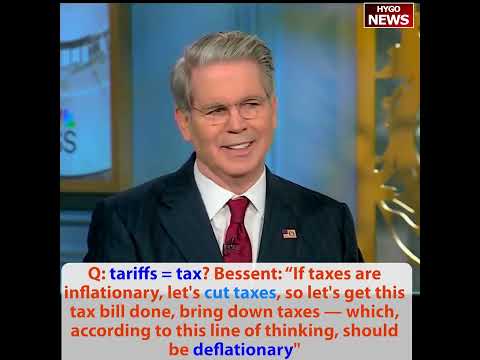
Bessent’s response was devastating in its simplicity: “People are saying tax increases are inflationary. When I was testifying before Congress last week, one of the congressmen said that. And I said, well, Congressman, if taxes are inflationary, let’s cut taxes. So let’s get this tax bill done, bring down taxes, which according to this line of thinking, should be disinflationary.”
The logical trap Bessent set was elegant. Democratic critics were simultaneously arguing:
- Trump’s tariffs (which the administration framed as taxes on imports) were inflationary because taxes raise prices
- Trump’s tax cut proposals would be inflationary because deficit spending raises prices
Bessent’s response exposed the contradiction. If the first argument was true — that taxes (tariffs) were inflationary — then the logical implication was that tax cuts would be deflationary. But critics did not accept this implication. They wanted both to argue that tariffs raised prices and that tax cuts also raised prices, which could not be simultaneously true under consistent economic reasoning.
The underlying economic reality was more nuanced. Tariffs did generate some price increases on tariffed imports, but also generated revenue that reduced the deficit pressure. Tax cuts could stimulate supply expansion, potentially reducing prices over time. The simple “all taxes are inflationary” framing was not actually coherent economics.
Bongino: “Because They’re Weak”
In a separate interview with Maria Bartiromo, FBI Deputy Director Dan Bongino discussed the political investigations of Trump.
“Why did they do that?” Bartiromo asked. “I mean, why put the FBI and its reputation at risk? Well, it was just to win an election? Why?”
Bongino’s response was raw: “Because they’re weak.”
Bartiromo repeated: “Because they’re weak.”
Bongino continued: “I hate weak people. I can’t stand it.”
He described the rationale: “They didn’t have, we’re on TV, so I already said BS once. But they didn’t have the guts, the courage, or the character to do the right thing. They did the easy thing.”
He framed the Trump role: “Donald Trump became a convenient political football they used. They thought they could leverage. They thought with the media on their side that they’d get away with it.”
The “weakness” framing was characteristic Bongino — direct, emotional, unapologetic. Rather than using institutional language like “misaligned priorities” or “inappropriate politicization,” Bongino described the FBI officials who had pursued Trump investigations as morally weak people who lacked the courage to follow proper procedures.
The “convenient political football” characterization was politically charged but defensible. The FBI’s investigations of Trump — from Crossfire Hurricane through the Mar-a-Lago raid — had shown patterns of aggressive treatment that differed from how similar potential violations by other political figures had been handled. Whether this represented “politicization” or legitimate law enforcement was itself contested, but the pattern of differential treatment was well-documented.
Patel: “We Don’t Prejudge Any Case”
FBI Director Kash Patel complemented Bongino’s critique with his prescription.
“Unlike other leaders who previously sat in these seats, we don’t prejudge any case,” Patel said. “We don’t care what party elected you to what. It doesn’t matter to us. It’s irrelevant.”
He stated the standard: “If you broke the law, we are going to find out and we are going to investigate you. And then we are going to discuss that matter with the Department of Justice.”
He made the crucial procedural point: “And this is one of the things that, if your viewers take away nothing else from this interview, the FBI does not make prosecutorial decisions.”
He named the alleged abuse: “You asked in the beginning how the FBI was weaponized. Well, the FBI hijacked the constitutional responsibility of the Department of Justice and the Attorney General, and James Comey and others specifically decided what cases to prosecute and not prosecute.”
He cited the evidence: “Don’t believe me? Go to the videotape in the Hillary Clinton investigation.”
He stated the new separation: “We don’t decide prosecutions and neither does any agent or intel analyst. We have great partners in our Attorney General Bondi. We’ve worked with them and discussed the matter with them, but the prosecutor decision is with them.”
The Comey reference was to the July 2016 press conference where then-FBI Director James Comey had announced that Hillary Clinton would not be charged for her handling of classified information, despite describing her conduct as “extremely careless.” That press conference had itself been controversial — departing from standard FBI practice of not commenting on closed investigations — and had been criticized by both sides of the political spectrum as inappropriate FBI interference in what should have been a DOJ decision.
Patel’s commitment to restoring the traditional separation — FBI investigates, DOJ prosecutes — was substantive reform. Under traditional practice, FBI agents had no role in prosecutorial decisions; they gathered evidence and referred cases to prosecutors. Under Comey and his successor Christopher Wray, the FBI had arguably overstepped this boundary, using its investigative authority to influence prosecutorial outcomes.
”Go to the Videotape”
Patel’s “go to the videotape” reference was particularly sharp. Video evidence of Comey’s 2016 press conference was publicly available and showed him performing exactly what Patel was describing: making a prosecutorial decision (recommending no charges) that was constitutionally the Attorney General’s responsibility. That videotape was not ambiguous — Comey had laid out the case for charges, described Clinton’s conduct as “extremely careless,” and then personally decided that no charges should be brought.
The broader reform implied by Patel’s statement was restoration of institutional norms. If every Attorney General knew that FBI agents would investigate without regard to political affiliation, and if every FBI agent knew that prosecutorial decisions were exclusively DOJ authority, then the political bias that had corrupted federal law enforcement could be structurally addressed.
Key Takeaways
- Bessent destroys Tapper on Qatar jet: “French gave us Statue of Liberty, British gave us Resolute Desk. Not sure they asked for anything in advance.”
- “More important plane deal: $100B Qatari Airlines orders to Boeing — biggest order in company’s history.”
- Bessent on debt: “Grow GDP faster than debt. Stabilize debt-to-GDP. Even Yellen agrees that’s the most important number.”
- Bessent’s tax trap: “If taxes are inflationary, let’s cut taxes. Tax bill should be disinflationary by same logic.”
- Bongino on FBI: “They’re weak. No guts, courage, or character. Trump became a convenient political football.” Patel: “We don’t prejudge any case.”