 HYGO News
 Bessent Crushes Brennan: 'In March You Said Big Inflation -- Actually, Inflation Numbers Are Best in Four Years. Stop Saying This COULD Happen, Wait and See What DOES Happen'; 'First Drop in Inflation in 4 Years'; Noem on Harvard's China Ties 'Deeply Alarming'; Jeffries: 'People Will Literally Die' -- Vought: OBBB 'Lowers Debt $1.4T'
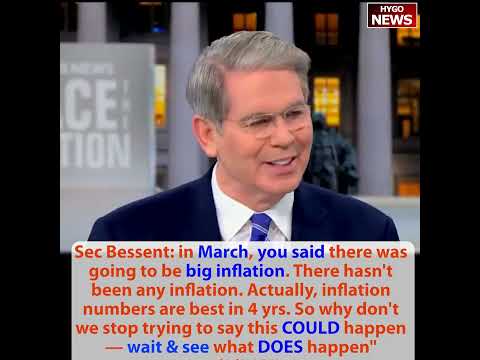
Bessent Crushes Brennan: “In March You Said Big Inflation — Actually, Inflation Numbers Are Best in Four Years. Stop Saying This COULD Happen, Wait and See What DOES Happen”; “First Drop in Inflation in 4 Years”; Noem on Harvard’s China Ties “Deeply Alarming”; Jeffries: “People Will Literally Die” — Vought: OBBB “Lowers Debt $1.4T”
Treasury Secretary Scott Bessent delivered a masterful rebuttal to CBS’s Margaret Brennan in early June 2025. Brennan had predicted inflation surge from Trump tariffs. Bessent: “When we were here in March, you said there was going to be big inflation. There hasn’t been any inflation. Actually, the inflation numbers are the best in four years. So why don’t we just stop trying to say this could happen and wait and see what does happen?” He continued: “We wanted to make sure that there aren’t price increases, Margaret — and thus far, there have been no price increases. Everything has been alarmist, that the inflation numbers are actually dropping. We saw the first drop of inflation in four years.” On Chinese producers absorbing tariffs: “65% of the tariffs will likely be eaten by the Chinese producers.” DHS Secretary Kristi Noem on Harvard’s China ties: “Hundreds and hundreds of millions of dollars… These ties to China are deeply alarming — and they’re not just Harvard, there’s other universities.” Minority Leader Hakeem Jeffries claimed OBBB would make “people literally die.” OMB Director Russ Vought rebutted: “This bill doesn’t increase the deficit or hurt the debt. In fact, it lowers it by $1.4 trillion… biggest mandatory savings package that we have seen since the 1970s.”
The Brennan-Bessent Exchange
CBS’s Margaret Brennan had been predicting inflation catastrophe.
Brennan had set up: “The reality is there will either be less inventory or things at higher prices or both.”
Bessent’s response was direct: “When we were here in March, you said there was gonna be big inflation.”
He delivered the facts: “There hasn’t been any inflation. Actually, the inflation numbers are the best in four years.”
He delivered the methodological critique: “So why don’t we just stop trying to say this could happen and wait and see what does happen?”
The Pattern of Failed Predictions
Brennan’s March prediction had been consistent with broader media framing:
Predictions of economic catastrophe:
- Trump tariffs would cause massive inflation
- Supply shortages would affect American consumers
- Economic growth would stall
- Markets would crash
- Unemployment would spike
What actually happened:
- Inflation reached 4-year lows
- Supply chains adjusted without massive disruption
- Economic growth remained strong
- Markets reached new highs
- Unemployment at historic lows
The pattern had been consistent throughout 2025:
- Media pundits predicted tariff disaster
- Bessent and other officials said wait and see
- Data showed actual performance better than predictions
- Media moved to next alarming prediction
- Pattern repeated
Bessent’s “wait and see what does happen” framing was the proper epistemic approach. Rather than fight policy on predictions that might be wrong, wait for actual data. The administration’s willingness to be judged by results rather than predictions had consistently paid off because the results had consistently been better than critics predicted.
”No Price Increases”
Bessent addressed the core consumer concern.
“We wanted to make sure that there aren’t price increases, Margaret. And thus far, there have been no price increases,” Bessent said.
He made the broader point: “Everything has been alarmist, that the inflation numbers are actually dropping. We saw the first drop of inflation in four years.”
He cited the specific data: “The inflation numbers last week were very, the pro-consumer.”
The “First Drop in 4 Years”
The “first drop of inflation in four years” claim referenced specific data.
CPI Data trajectory:
- 2021: Inflation began rising
- 2022: CPI peaked at 9.1% year-over-year
- 2023-2024: Gradual decline but persistent elevated levels
- Early 2025: Continued moderation
- May 2025: First monthly drop in inflation since 2020/2021
The “first drop in four years” framing captured that:
- American consumers had not seen sustained deflation in years
- Prices had been continuously rising (even if rate decelerating)
- The recent data showed actual price declines in specific categories
- The deflationary shift was historically significant
- Administration policies were getting credit
”65% Eaten by Chinese Producers”
Bessent cited the tariff absorption data.
Brennan had cited corporate concerns: “But you listen to earnings calls just like we do. You know what Walmart’s saying, what Best Buy’s saying and what Target are saying.”
Bessent’s rebuttal was specific: “But Margaret, I also know what Home Depot and Amazon are saying.”
He made the international citation: “I know what the South China Morning Post wrote within the past 24 hours, that 65%, 65% of the tariffs will likely be eaten by the Chinese producers.”
The Tariff Economics
The “65% eaten by Chinese producers” finding was critical to the entire tariff debate.
Basic economic question: Who pays tariffs? Option A: American consumers through higher prices. Option B: Foreign producers through reduced profits. Option C: Some combination.
Traditional assumption: American consumers pay most of tariff costs through higher prices. This had been the conventional view for decades.
Actual 2025 data: Chinese producers were absorbing 65% of tariff costs. This meant:
- Chinese companies reduced prices to remain competitive
- Chinese margins declined rather than prices rising
- American consumers paid only 35% of tariff cost
- Substantial revenue flowed to U.S. Treasury
- China bore most of the economic pain
Why the difference:
- American market size gave buyer power
- Chinese manufacturers depended on American sales
- Chinese had limited alternative markets
- Currency effects supported absorption
- Profit margins had cushion to reduce
The political implications:
- Tariffs were effectively a wealth transfer from China to America
- American consumers saw minimal price impact
- American workers saw benefit from protection
- Trade deficit improvement confirmed policy success
- The conventional wisdom about tariff pass-through was wrong
The South China Morning Post’s reporting was particularly significant. A Hong Kong-based publication traditionally seen as sympathetic to Chinese interests was acknowledging that Chinese producers, not American consumers, bore most tariff costs. This was independent confirmation that contradicted American media’s alarmist framing.
Noem on Harvard’s China Ties
DHS Secretary Kristi Noem addressed Harvard’s Chinese connections.
Asked about Harvard’s money from China: “Oh my goodness. I don’t know specifically hundreds and hundreds of millions of dollars because these foreign students for years have paid full tuition.”
She described the additional funding: “Plus, they’ve also gotten grants, special participation in programs that China has financed and brought forward.”
She made the broader point: “So these ties to China are deeply alarming and they’re not just Harvard, there’s other universities.”
She described the administration approach: “We’re going through every single one of them.”
The Foreign Student Spy Concern
Noem articulated the core security concern.
“If you come to this country to learn your foreign student and you recognize the opportunity, that’s fantastic. But don’t come here and spy on us and take that information back home to an enemy that is working to destroy us every day,” Noem said.
She made the institutional observation: “And China has infiltrated this country. It’s my job to protect the homeland and I’ve been given that direction by President Trump.”
She stated the policy: “They will not participate in this foreign student program until they clean up their ways.”
The Harvard-China Pattern
Harvard’s China entanglements had multiple dimensions:
Direct financial relationships:
- Chinese government and quasi-governmental organizations had provided substantial funding to Harvard over decades
- Harvard Business School had extensive China programs
- Research partnerships with Chinese institutions
- Joint academic programs
- Faculty exchanges
Chinese student population:
- Thousands of Chinese students at Harvard
- Many paying full international tuition
- Significant revenue contribution
- Various scholarship and grant arrangements
- Some with Chinese government funding
Research vulnerabilities:
- Chinese students involved in sensitive research
- Research results shared through various channels
- Some research had direct military applications
- Chinese government recruitment of researchers
- Intellectual property flow to China
Documented espionage cases:
- Charles Lieber (former Harvard chemistry chair) convicted of hiding Chinese funding
- Various other Harvard faculty found with undisclosed Chinese ties
- Thousand Talents Program participants at Harvard
- Ongoing federal investigations
The Trump administration’s approach was to require:
- Transparency about foreign funding
- Disclosure of research connections
- Restrictions on foreign student access to sensitive research
- Accountability for past failures
- Compliance with federal requirements
The “Other Universities” Point
Noem’s “they’re not just Harvard, there’s other universities” was important.
Many elite American universities had similar patterns:
- Yale, Princeton, Stanford, MIT, Caltech
- State universities with research programs
- University of California system
- Various medical schools
- Private research institutions
Harvard was getting specific attention because:
- Highest profile institution
- Most direct confrontation with administration
- Largest foreign student percentage
- Public controversy about compliance
- Clear refusal to cooperate with federal requirements
But the pattern extended across American higher education. The Harvard battle was the first major fight in what would likely be extended reform of American university-China relationships.
Jeffries’s “People Will Literally Die”
Minority Leader Hakeem Jeffries deployed apocalyptic rhetoric.
“This bill actually hurts everyday Americans in order to reward billionaires,” Jeffries said.
He made the specific claim: “It would strip away health care from approximately 14 million Americans, premiums, copays and deductibles for tens of millions more will go up.”
He delivered the dramatic finale: “Actually, if it ever were to be implemented into law, hospitals will close, nursing homes will shut down and people will literally die.”
The “People Will Die” Framing
Democratic rhetoric had frequently claimed Republican policies would cause deaths:
- Obamacare repeal efforts: “People will die”
- Medicaid reforms: “People will die”
- Various healthcare policy debates: “People will die”
- Tax reform bills: “People will die”
- Immigration enforcement: “People will die”
The pattern had become so consistent that it had lost effectiveness. Voters had:
- Heard the same predictions for years
- Seen that Republican policies had not caused mass deaths
- Become skeptical of apocalyptic claims
- Recognized political manipulation
- Increasingly ignored such framing
For Jeffries to continue using this framing suggested:
- Limited alternative rhetorical options
- Political desperation
- Base mobilization rather than persuasion
- Repetition of failed message
- Inability to adapt to policy realities
The “14 Million” Claim
Jeffries’s specific “14 million Americans” number came from CBO analysis but was:
- Based on static scoring assumptions
- Assumed CBO baseline projections
- Counted able-bodied non-workers as “losing coverage”
- Included people who would voluntarily leave if required to work
- Missed the distinction between mandatory benefit and choice
The reality was:
- OBBB did not “strip” coverage from people who qualified
- Medicaid work requirements allowed able-bodied adults to comply
- Those who chose not to work could retain coverage
- The “14 million” included voluntary non-participants
- Actual loss of necessary care was far smaller
Vought’s Rebuttal
OMB Director Russ Vought provided the administration’s fiscal case.
“This bill doesn’t increase the deficit or hurt the debt. In fact, it lowers it by $1.4 trillion,” Vought said.
He addressed the scoring methodology: “What some of the watchdogs have done is they have used CBO’s artificial baseline, which doesn’t allow and assume that current tax law will be extended because of sunsets that are in the law.”
He explained the problem: “They don’t do that with suspending.”
He made the common sense argument: “It is totally something that would be foreign to any common sense person who comes and looks at how we budget in this country.”
The Scoring Methodology Issue
The CBO scoring controversy was substantively important.
The CBO baseline: CBO’s default methodology assumed current law without modification. This meant:
- TCJA provisions expiring in 2025 would expire
- Continued baseline tax collections after expiration
- OBBB extending these provisions counted as “new spending”
- Despite being continuation of current policy
The alternative approach (Vought’s preferred): Assume that TCJA extensions would occur regardless because Congress wouldn’t allow massive automatic tax increases. This meant:
- OBBB extending TCJA was current policy continuation
- Not new spending relative to realistic alternative
- Different scoring under this methodology
- Deficit reduction when new provisions (work requirements) added
The “common sense” argument: Any reasonable observer would expect that TCJA wouldn’t be allowed to expire automatically. The CBO baseline assumed scenarios that wouldn’t actually occur. More realistic baselines showed OBBB as deficit reducing.
”$1.4 Trillion Over 10 Years Deficit Reduction”
Vought articulated the specific numbers.
“When you assume the extension of President’s tax relief from 2017, this budget or this bill, and it’s really a reconciliation bill, it’s not really a budget bill. It is using a budget process. This is a $1.4 trillion over 10 years deficit reduction,” Vought said.
He provided the components: “It’s $1.6 trillion in mandatory savings.”
He acknowledged spending: “Obviously, we have a little bit of spending in there as well for border and defense.”
He delivered the historical superlative: “But that is the biggest mandatory savings package that we have seen since the 1970s. It’s very historic.”
The “Biggest Since 1970s”
The “biggest mandatory savings package since the 1970s” framing was historically significant.
The 1970s context:
- Social Security reforms
- Medicare initial structures
- Various welfare reform efforts
- Budget framework changes
- Major fiscal adjustments
Between the 1970s and now:
- Most mandatory spending had grown steadily
- Few serious reduction efforts succeeded
- Reagan-era reforms were largely defense-focused
- Clinton-era welfare reform was modest relative to OBBB
- Obama/Biden eras expanded mandatory spending
OBBB’s significance:
- $1.6 trillion in mandatory program savings
- Work requirements reforms
- Eligibility verification changes
- Various specific program reforms
- Cumulative impact across many programs
Political significance: A generational reform effort. The last comparable mandatory savings package had been over 50 years earlier. This was historic rather than incremental change.
Key Takeaways
- Bessent destroys Brennan: “In March you predicted big inflation. Actually, inflation numbers are best in four years. Wait and see what DOES happen.”
- On tariff absorption: “65% of the tariffs will likely be eaten by the Chinese producers.” (South China Morning Post)
- Noem on Harvard China ties: “Hundreds of millions of dollars. Deeply alarming. Not just Harvard — going through every single one of them.”
- Jeffries on OBBB: “Hospitals will close, nursing homes will shut down, people will literally die” — apocalyptic rhetoric with declining effectiveness.
- Vought on OBBB: “Lowers deficit by $1.4 trillion. $1.6T mandatory savings. Biggest since 1970s.”